Ultrahigh strength, modulus, and conductivity of graphitic fibers by macromolecular coalescence
- PMID: 35452295
- PMCID: PMC9032978
- DOI: 10.1126/sciadv.abn0939
Ultrahigh strength, modulus, and conductivity of graphitic fibers by macromolecular coalescence
Abstract
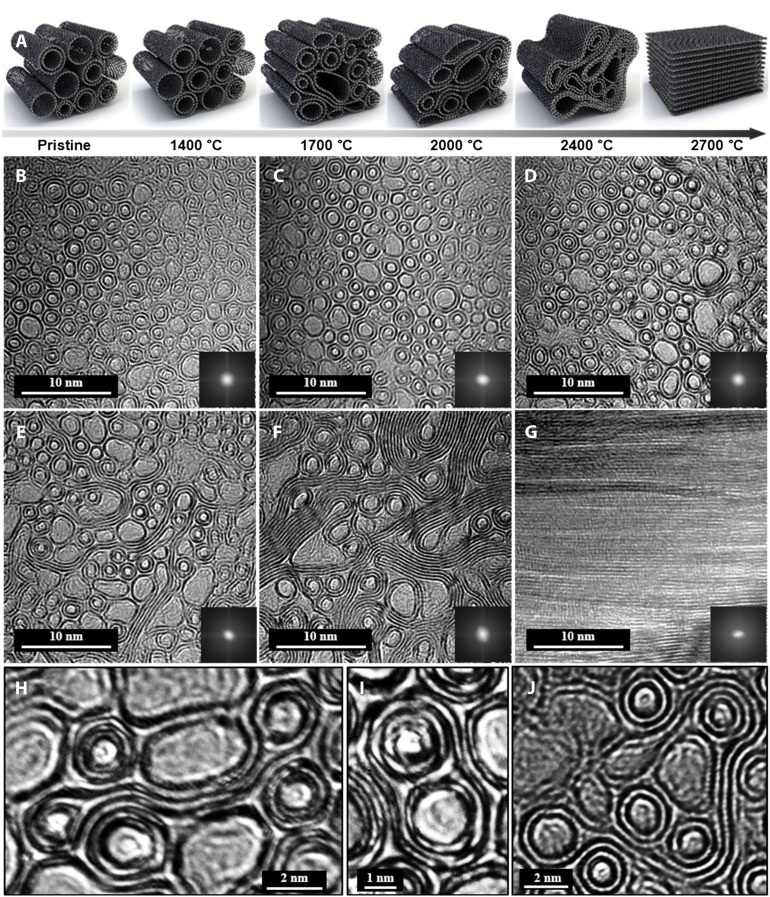
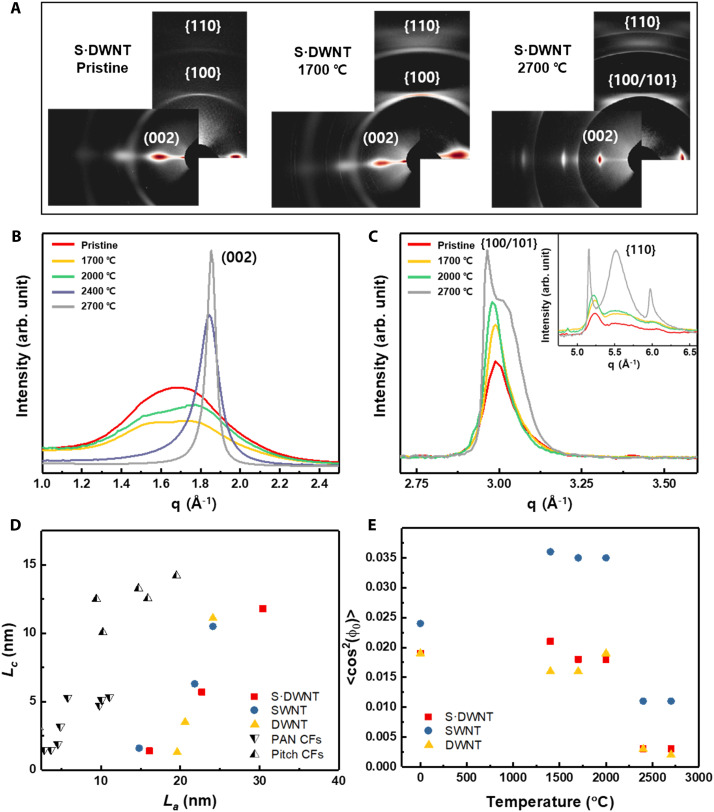
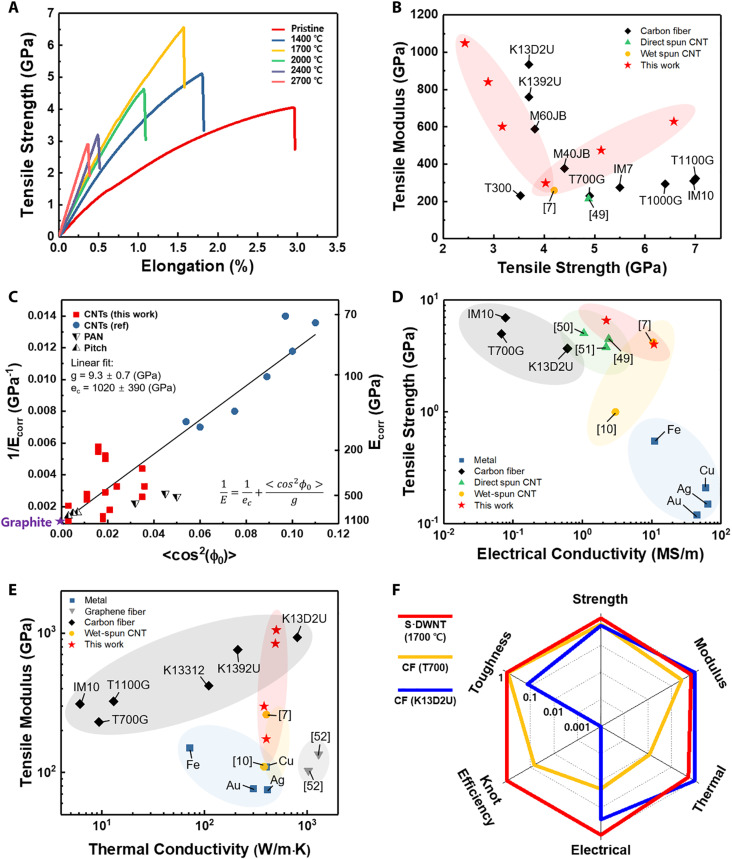
Theoretical considerations suggest that the strength of carbon nanotube (CNT) fibers be exceptional; however, their mechanical performance values are much lower than the theoretical values. To achieve macroscopic fibers with ultrahigh performance, we developed a method to form multidimensional nanostructures by coalescence of individual nanotubes. The highly aligned wet-spun fibers of single- or double-walled nanotube bundles were graphitized to induce nanotube collapse and multi-inner walled structures. These advanced nanostructures formed a network of interconnected, close-packed graphitic domains. Their near-perfect alignment and high longitudinal crystallinity that increased the shear strength between CNTs while retaining notable flexibility. The resulting fibers have an exceptional combination of high tensile strength (6.57 GPa), modulus (629 GPa), thermal conductivity (482 W/m·K), and electrical conductivity (2.2 MS/m), thereby overcoming the limits associated with conventional synthetic fibers.
Figures
References
-
- Chae H. G., Kumar S., Making strong fibers. Science 319, 908–909 (2008). - PubMed
-
- Lee C., Wei X., Kysar J. W., Hone J., Measurement of the elastic properties and intrinsic strength of monolayer graphene. Science 321, 385–388 (2008). - PubMed
-
- Javey A., Guo J., Wang Q., Lundstrom M., Dai H., Ballistic carbon nanotube field-effect transistors. Nature 424, 654–657 (2003). - PubMed
-
- Yu C., Shi L., Yao Z., Li D., Majumdar A., Thermal conductance and thermopower of an individual single-wall carbon nanotube. Nano Lett. 5, 1842–1846 (2005). - PubMed
-
- Adnan M., Pinnick R. A., Tang Z., Taylor L. W., Pamulapati S. S., Carfagni G. R., Pasquali M., Bending behavior of CNT fibers and their scaling laws. Soft Matter 14, 8284–8292 (2018). - PubMed
LinkOut - more resources
Full Text Sources