


Antimicrobial Susceptibility Testing: A Comprehensive Review of Currently Used Methods
- PMID: 35453179
- PMCID: PMC9024665
- DOI: 10.3390/antibiotics11040427
Antimicrobial Susceptibility Testing: A Comprehensive Review of Currently Used Methods
Abstract
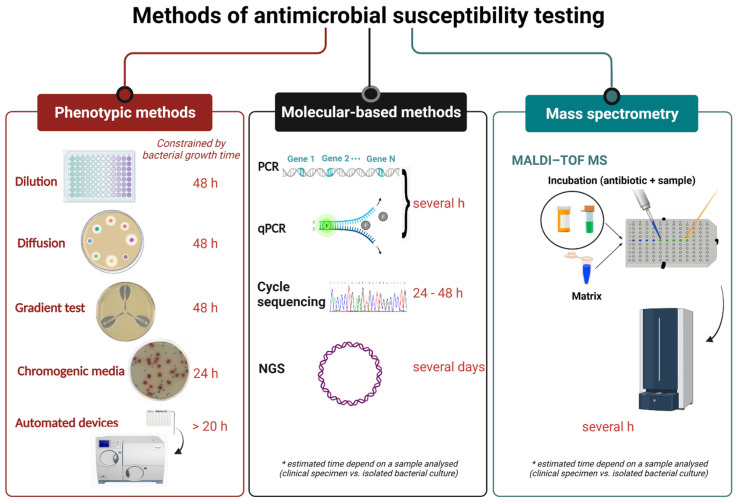
Antimicrobial resistance (AMR) has emerged as a major threat to public health globally. Accurate and rapid detection of resistance to antimicrobial drugs, and subsequent appropriate antimicrobial treatment, combined with antimicrobial stewardship, are essential for controlling the emergence and spread of AMR. This article reviews common antimicrobial susceptibility testing (AST) methods and relevant issues concerning the advantages and disadvantages of each method. Although accurate, classic technologies used in clinical microbiology to profile antimicrobial susceptibility are time-consuming and relatively expensive. As a result, physicians often prescribe empirical antimicrobial therapies and broad-spectrum antibiotics. Although recently developed AST systems have shown advantages over traditional methods in terms of testing speed and the potential for providing a deeper insight into resistance mechanisms, extensive validation is required to translate these methodologies to clinical practice. With a continuous increase in antimicrobial resistance, additional efforts are needed to develop innovative, rapid, accurate, and portable diagnostic tools for AST. The wide implementation of novel devices would enable the identification of the optimal treatment approaches and the surveillance of antibiotic resistance in health, agriculture, and the environment, allowing monitoring and better tackling the emergence of AMR.
Keywords: antimicrobial resistance; antimicrobial susceptibility testing; methods.
Conflict of interest statement
The authors declare no conflict of interest.
Figures
References
-
- WHO Antibiotic Resistance. [(accessed on 23 February 2022)]. Available online: https://www.who.int/news-room/fact-sheets/detail/antibiotic-resistance.
-
- WHO New Report Calls for Urgent Action to Avert Antimicrobial Resistance Crisis. [(accessed on 23 February 2022)]. Available online: https://www.who.int/news/item/29-04-2019-new-report-calls-for-urgent-act....
Publication types
LinkOut - more resources
Full Text Sources
Other Literature Sources
Research Materials
