


Kinetics of Biomarkers of Oxidative Stress in Septic Shock: A Pilot Study
- PMID: 35453325
- PMCID: PMC9031382
- DOI: 10.3390/antiox11040640
Kinetics of Biomarkers of Oxidative Stress in Septic Shock: A Pilot Study
Abstract
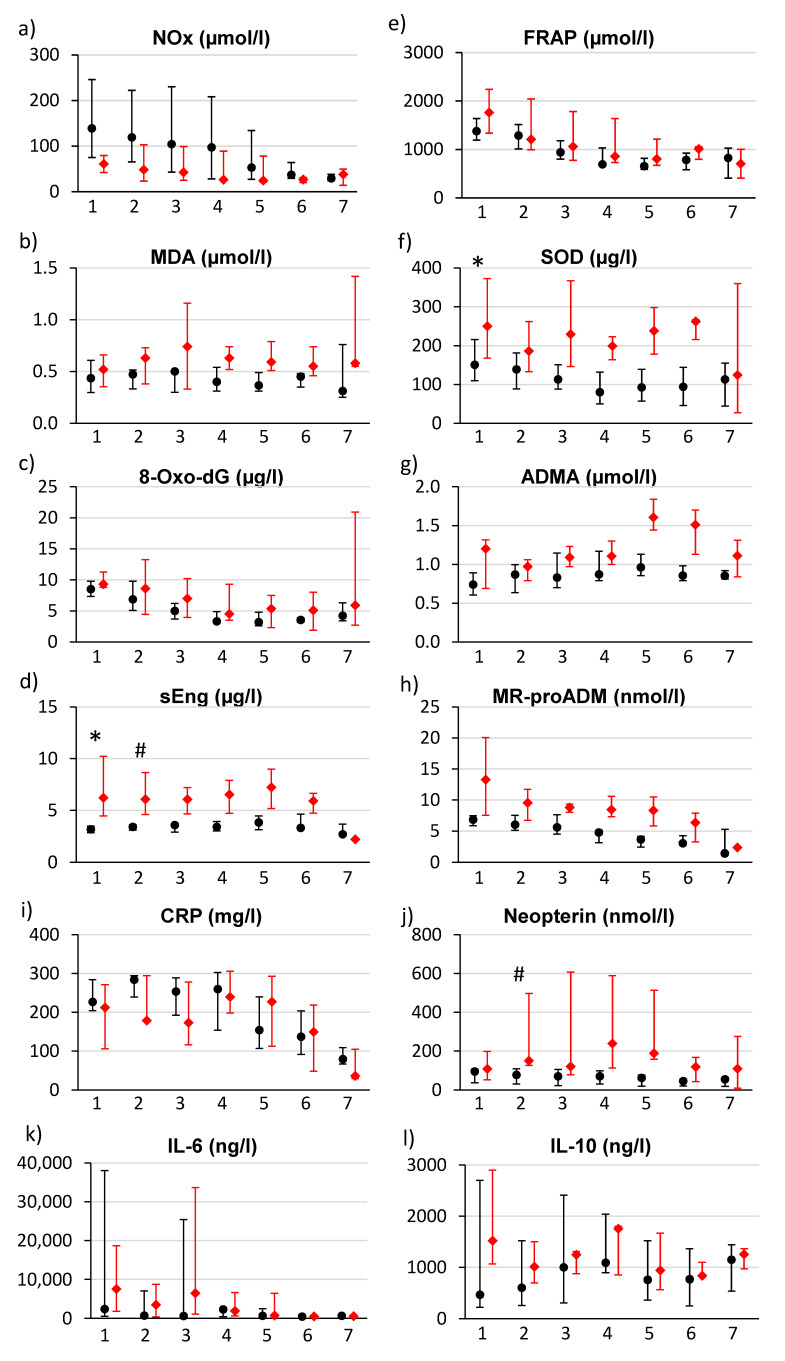
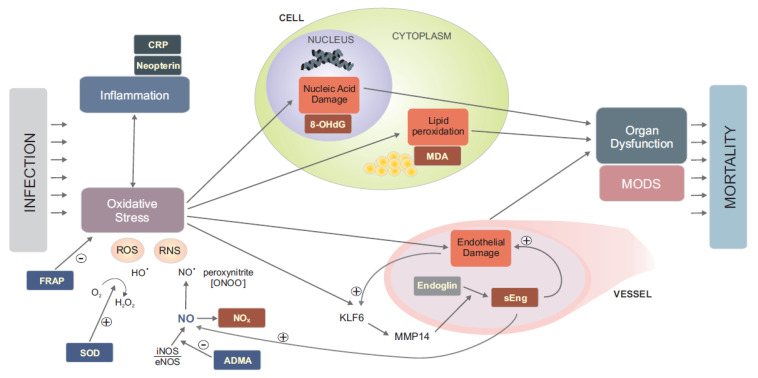
Septic shock is a major cause of mortality in ICU patients, its pathophysiology is complex and not properly understood. Oxidative stress seems to be one of the most important mechanisms of shock progression to multiple organ failure. In the present pilot study, we have analysed eight oxidative-stress-related biomarkers in seven consecutive time points (i.e., the first seven days) in 21 septic shock patients admitted to the ICU. Our objective was to describe the kinetics of four biomarkers related to pro-oxidative processes (nitrite/nitrate, malondialdehyde, 8-oxo-2'-deoxyguanosine, soluble endoglin) compared to four biomarkers of antioxidant processes (the ferric reducing ability of plasma, superoxide dismutase, asymmetric dimethylarginine, mid-regional pro-adrenomedullin) and four inflammatory biomarkers (CRP, IL-6, IL-10 and neopterin). Furthermore, we analysed each biomarker's ability to predict mortality at the time of admission and 12 h after admission. Although a small number of study subjects were recruited, we have identified four promising molecules for further investigation: soluble endoglin, superoxide dismutase, asymmetric dimethylarginine and neopterin.
Keywords: antioxidant; asymmetric dimethylarginine; biomarker; neopterin; oxidative stress; sepsis; septic shock; soluble endoglin; superoxide dismutase.
Conflict of interest statement
The authors declare no conflict of interest.
Figures
References
-
- Singer M., Deutschman C.S., Seymour C.W., Shankar-Hari M., Annane D., Bauer M., Bellomo R., Bernard G.R., Chiche J.-D., Coopersmith C.M., et al. The Third International Consensus Definitions for Sepsis and Septic Shock (Sepsis-3) JAMA. 2016;315:801–810. doi: 10.1001/jama.2016.0287. - DOI - PMC - PubMed
-
- Parenica J., Kala P., Mebazaa A., Littnerova S., Benesova K., Tomandl J., Goldbergová Pavkova M., Jarkovský J., Spinar J., Tomandlova M., et al. Activation of the Nitric Oxide Pathway and Acute Myocardial Infarction Complicated by Acute Kidney Injury. Cardiorenal Med. 2020;10:85–96. doi: 10.1159/000503718. - DOI - PubMed
-
- Tomandlova M., Parenica J., Lokaj P., Ondrus T., Kala P., Miklikova M., Helanova K., Helan M., Malaska J., Benesova K., et al. Prognostic Value of Oxidative Stress in Patients with Acute Myocardial Infarction Complicated by Cardiogenic Shock: A Prospective Cohort Study. Free Radic. Biol. Med. 2021;174:66–72. doi: 10.1016/j.freeradbiomed.2021.07.040. - DOI - PubMed
LinkOut - more resources
Full Text Sources
Research Materials
Miscellaneous
