. 2022 Apr 2;11(4):703.
doi: 10.3390/antiox11040703.

Respiratory Burst Oxidase Homolog D as a Modulating Component of Oxidative Response under Ammonium Toxicity

Affiliations

Respiratory Burst Oxidase Homolog D as a Modulating Component of Oxidative Response under Ammonium Toxicity

Maria Burian et al. Antioxidants (Basel). .

Abstract

Delayed growth, a visible phenotypic component of the so-called ammonium syndrome, occurs when ammonium is the sole inorganic nitrogen source. Previously, we have shown that modification of apoplastic reactive oxygen species (apROS) metabolism is a key factor contributing to plant growth retardation under ammonium nutrition. Here, we further analyzed the changes in apROS metabolism in transgenic plants with disruption of the D isoform of the respiratory burst oxidase homolog (RBOH) that is responsible for apROS production. Ammonium-grown Arabidopsisrbohd plants are characterized by up to 50% lower contents of apoplastic superoxide and hydrogen peroxide. apROS sensing markers such as OZF1 and AIR12 were downregulated, and the ROS-responsive signaling pathway, including MPK3, was also downregulated in rbohd plants cultivated using ammonium as the sole nitrogen source. Additionally, the expression of the cell-wall-integrity marker FER and peroxidases 33 and 34 was decreased. These modifications may contribute to phenomenon wherein ammonium inhibited the growth of transgenic plants to a greater extent than that of wild-type plants. Overall, this study indicated that due to disruption of apROS metabolism, rbohd plants cannot adjust to ammonium toxicity and are more sensitive to these conditions.

Keywords: ammonium syndrome; apoplastic antioxidants; apoplastic reactive oxygen species metabolism; growth retardation; respiratory burst oxidase homolog.


Conflict of interest statement

The authors declare no conflict of interest.

Figures
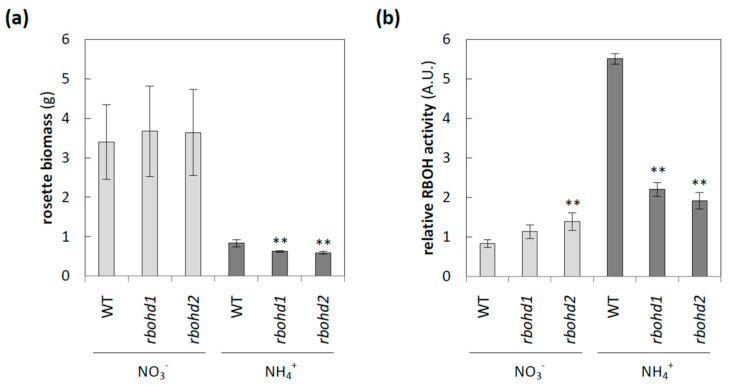
Figure 1
Figure 1
Phenotypic characterization of rbohd plants. (a) Rosette biomass of 8-week-old WT and rbohd plants grown in nitrate or ammonium as the sole nitrogen source. (b) Relative activity of RBOH measured as DPI-sensitive superoxide production. Comparison tests between rbohd and WT plants were performed on the mean of experimental conditions for the nitrate (light grey) or ammonium (dark grey) growth regime separately. Statistical differences calculated using one-way analysis of variance (ANOVA) with Tukey’s post hoc test are indicated at p-value ≤ 0.01 **.
Figure 2
Figure 2
ROS level and biomolecule injuries in leaf tissue of WT and rbohd plants grown in nitrate or ammonium as a nitrogen source. (a) Leaf hydrogen peroxide concentration. (b) Membrane injury is measured as malondialdehyde content. (c) The profile of protein carbonylation in leaf tissues. Comparison tests between rbohd and WT plants were performed on the mean experimental conditions for the nitrate (light grey) or ammonium (dark grey) growth regime separately. Statistical differences calculated using one-way analysis of variance (ANOVA) with Tukey’s post hoc test are indicated at p-value ≤ 0.01 ** and p-value ≤ 0.05 *.
Figure 3
Figure 3
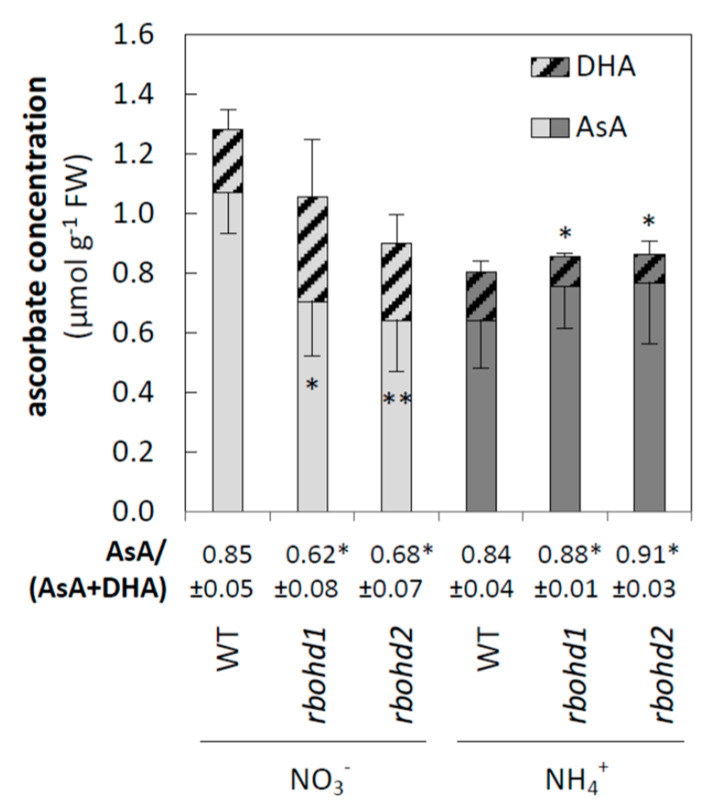
Ascorbate and dehydroascorbate concentration in leaves of WT and rbohd plants grown in medium containing nitrogen in the form of nitrate or ammonium ions. Comparison tests between rbohd and WT plants were performed on the mean experimental conditions for the nitrate (light grey) or ammonium (dark grey) growth regime separately. Statistical differences calculated using one-way analysis of variance (ANOVA) with Tukey’s post hoc test are indicated at p-value ≤ 0.01 ** and p-value ≤ 0.05 *.
Figure 4
Figure 4
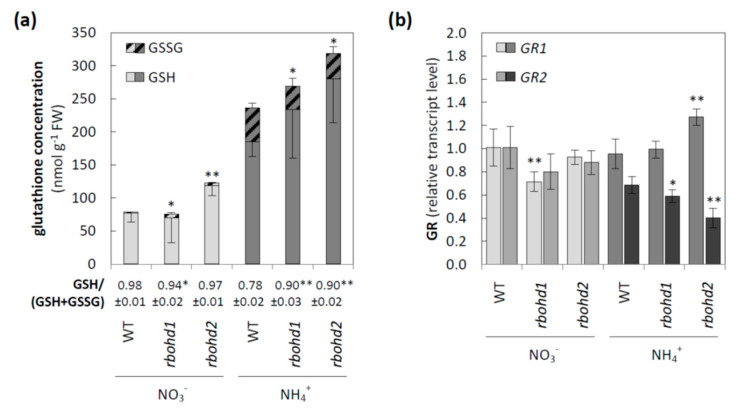
Glutathione-related leaf antioxidant system in WT and rbohd plants cultivated in the presence of nitrate or ammonium as a sole nitrogen source. (a) Reduced glutathione and glutathione disulfide concentration. (b) The transcript level of glutathione reductase 1 and glutathione reductase 2. Comparison tests between rbohd and WT plants were performed on the mean of experimental conditions for the nitrate (light grey) or ammonium (dark grey) growth regime separately. Statistical differences calculated using one-way analysis of variance (ANOVA) with Tukey’s post hoc test are indicated at p-value ≤ 0.01 ** and p-value ≤ 0.05 *.
Figure 5
Figure 5
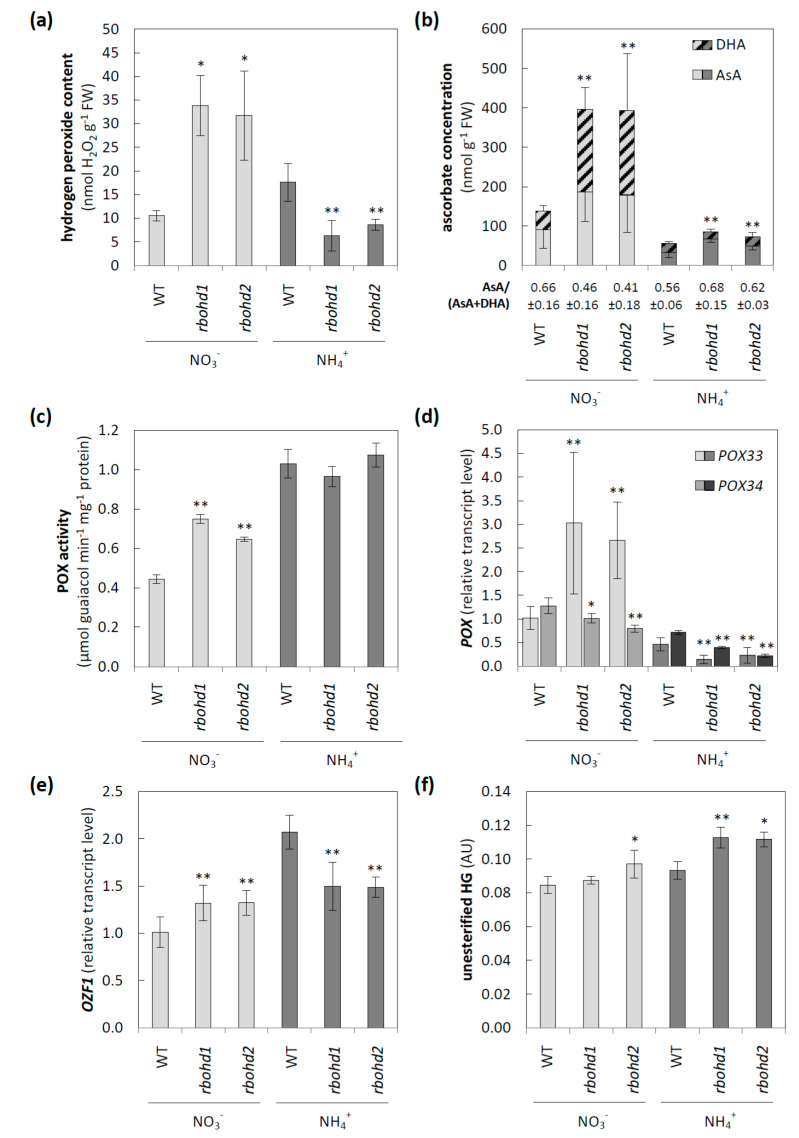
Changes in apoplastic metabolism of reactive oxygen species and the level of esterification of pectin resulting from RBOHD dysfunction in Arabidopsis grown in nitrate or ammonium as a sole nitrogen source. (a) The level of hydrogen peroxide in extracellular space. (b) The concentration of ascorbate and dehydroascorbate in leaf extracellular washing fluid. (c) Peroxidase activity in cell-wall-associated proteins. The transcript levels of (d) peroxidase 33 and peroxidase 34 and (e) oxidation-related zinc finger 1. (f) The level of unesterified pectin isolated from alcohol insoluble residue. Comparison tests between rbohd and WT plants were performed on the mean experimental conditions for the nitrate (light grey) or ammonium (dark grey) growth regime separately. Statistical differences calculated using one-way analysis of variance (ANOVA) with Tukey’s post hoc test are indicated at p-value ≤ 0.01 ** and p-value ≤ 0.05 *.
Figure 6
Figure 6
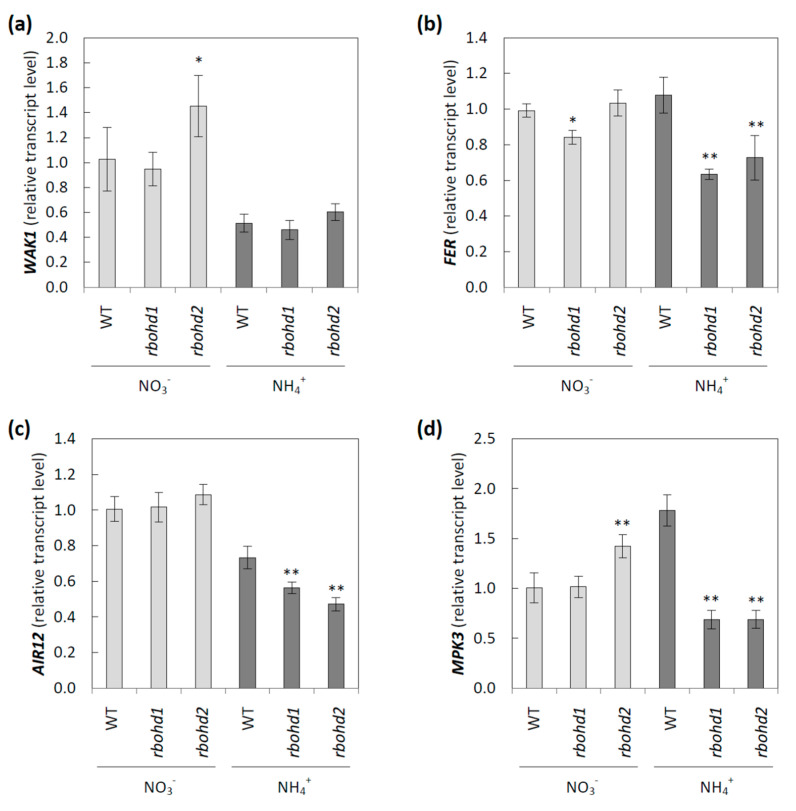
Signaling pathways related to cell-wall changes or to apoplastic reactive oxygen species metabolism in WT and rbohd plants grown in nitrate or ammonium as a sole nitrogen source. The transcript level of cell wall-associated kinase 1 (a), feronia (b), auxin-induced in root cultures 12 (c), and mitogen-activated protein kinase 3 (d). Comparison tests between rbohd and WT plants were performed on the mean experimental conditions for the nitrate (light grey) or ammonium (dark grey) growth regime separately. Statistical differences calculated using one-way analysis of variance (ANOVA) with Tukey’s post hoc test are indicated at p-value ≤ 0.01 ** and p-value ≤ 0.05 *.
Figure 7
Figure 7
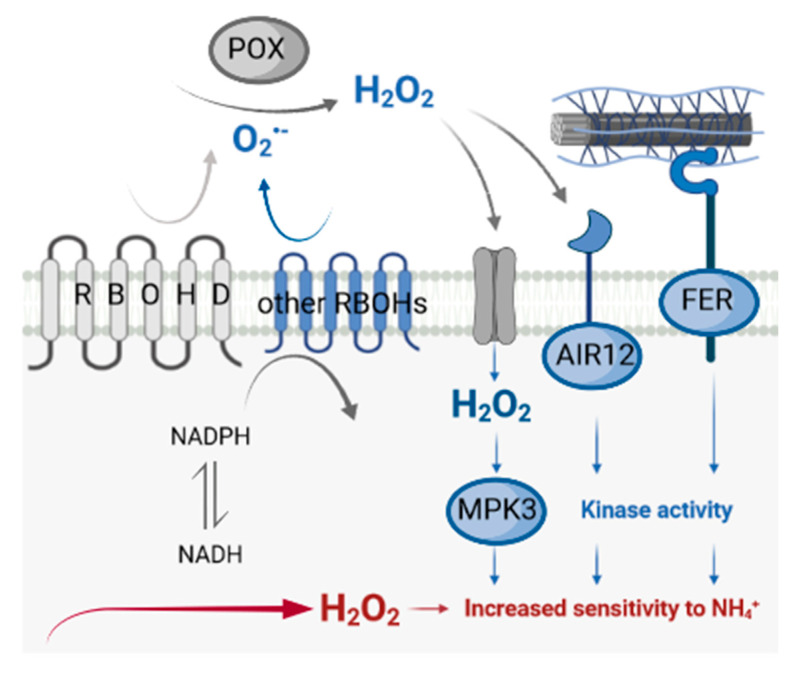
Metabolic effects of RBOHD disfunction for plants nourished with ammonium. When the major RBOHD is not active, other RBOHD isoforms cannot compensate for its activity, and O2 production is diminished. Lower O2 availability or POX activity can lead to decreased H2O2 contents as their product. As a consequence, H2O2-responsive receptors such as AIR12 are downregulated. Another cell-wall receptor is FER, and decreased pectin methyl-esterification leads to lower expression. Further signaling pathways from these receptors are not activated in cells, such as in the MAPK cascade. Since the H2O2 level is low in the apoplast, it would also pass to a minor extent into the cytosol; hence, direct activation of intracellular signaling kinases such as MPK3 is limited. Impaired apoplast/cytosol signaling does not induce defense/antioxidant systems, and therefore oxidative stress develops in cells. Due to these disturbances, rbohd showed high sensitivity to ammonium fertilization. Reduced responses are highlighted in blue, and red shows induced reactions. The scheme was created with BioRender.com.

References

    1. Shapiguzov A., Vainonen J.P., Wrzaczek M., Kangasjärvi J. ROS-talk—How the apoplast, the chloroplast, and the nucleus get the message through. Front. Plant Sci. 2012;3:292. doi: 10.3389/fpls.2012.00292. - DOI - PMC - PubMed
    1. Kangasjärvi S., Kangasjärvi J. Towards Understanding Extracellular ROS Sensory and Signaling Systems in Plants. Adv. Bot. 2014;2014:538946. doi: 10.1155/2014/538946. - DOI
    1. Sewelam N., Kazan K., Schenk P.M. Global Plant Stress Signaling: Reactive Oxygen Species at the Cross-Road. Front. Plant Sci. 2016;7:187. doi: 10.3389/fpls.2016.00187. - DOI - PMC - PubMed
    1. Mittler R. ROS Are Good. Trends Plant Sci. 2017;22:11–19. doi: 10.1016/j.tplants.2016.08.002. - DOI - PubMed
    1. Waszczak C., Carmody M., Kangasjärvi J. Reactive Oxygen Species in Plant Signaling. Annu. Rev. Plant Biol. 2018;69:209–236. doi: 10.1146/annurev-arplant-042817-040322. - DOI - PubMed

LinkOut - more resources