. 2022 Apr 1;11(4):551.
doi: 10.3390/biology11040551.

Clostridium perfringens Associated with Foodborne Infections of Animal Origins: Insights into Prevalence, Antimicrobial Resistance, Toxin Genes Profiles, and Toxinotypes

Affiliations

Clostridium perfringens Associated with Foodborne Infections of Animal Origins: Insights into Prevalence, Antimicrobial Resistance, Toxin Genes Profiles, and Toxinotypes

Mahmoud M Bendary et al. Biology (Basel). .

Abstract

Several food-poisoning outbreaks have been attributed to Clostridium perfringens (C. perfringens) worldwide. Despite that, this crisis was discussed in a few studies, and additional studies are urgently needed in this field. Therefore, we sought to highlight the prevalence, antimicrobial resistance, toxin profiles, and toxinotypes of C. perfringens isolates. In this study, 50 C. perfringens isolates obtained from 450 different animal origin samples (beef, chicken meat, and raw milk) were identified by phenotypic and genotypic methods. The antimicrobial susceptibility results were surprising, as most of the isolates (74%) showed multidrug-resistant (MDR) patterns. The phenotypic resistance to tetracycline, lincomycin, enrofloxacin, cefoxitin/ampicillin, and erythromycin was confirmed by the PCR detections of tet, lnu, qnr, bla, and erm(B) genes, respectively. In contrast to the toxinotypes C and E, toxinotype A prevailed (54%) among our isolates. Additionally, we found that the genes for C. perfringens enterotoxin (cpe) and C. perfringens beta2 toxin (cpb2) were distributed among the tested isolates with high prevalence rates (70 and 64%, respectively). Our findings confirmed that the C. perfringens foodborne crisis has been worsened by the evolution of MDR strains, which became the prominent phenotypes. Furthermore, we were not able to obtain a fixed association between the toxinotypes and antimicrobial resistance patterns.

Keywords: C. perfringens; MDR; antimicrobial resistance genes; toxin gene profiles; toxinotypes.


Conflict of interest statement

The authors declare no conflict of interest.

Figures
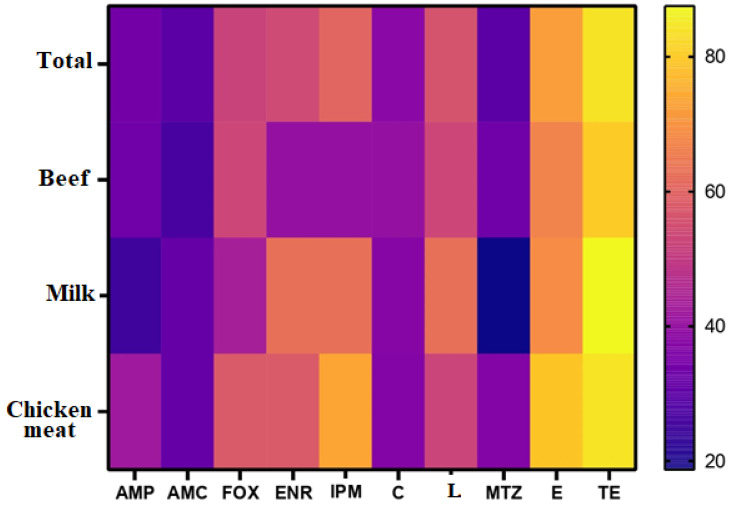
Figure 1
Figure 1
Frequency of resistance of C. perfringens isolates from beef, milk, and chicken meat samples to antimicrobials. AMP, ampicillin; AMC, amoxicillin/clavulanic acid; FOX, cefoxitin; ENR, enrofloxacin; IPM, imipenem; C, chloramphenicol; L, lincomycin; MTZ, metronidazole; E, erythromycin; TE, tetracycline. The percentages of resistance to antimicrobials are color-coded on the right of the figure.
Figure 2
Figure 2
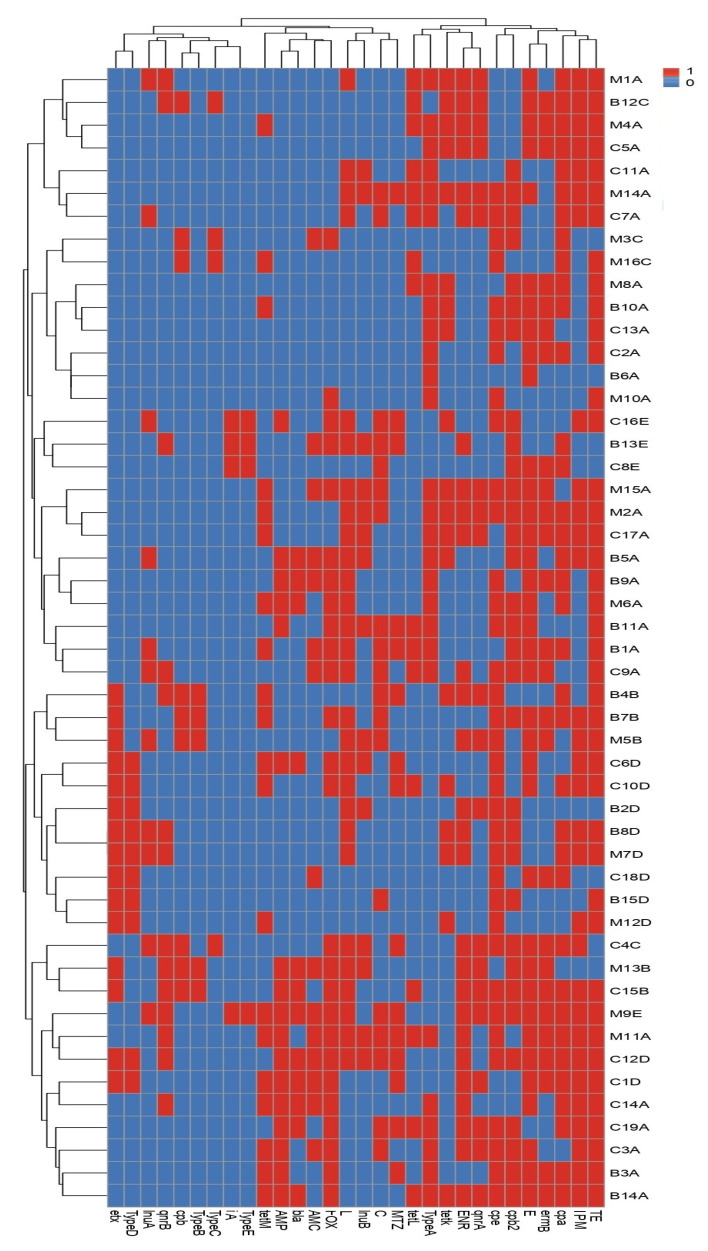
Heat map and hierarchical clustering of the examined C. perfringens isolates based on the occurrence of antimicrobial resistance, antibiotic resistance, and toxin genes and toxinotypes. In the heat map, red and blue colors refer to the resistance/sensitivity to an antimicrobial agent and to the presence/absence of an antibiotic resistance, the toxin gene and toxinotype, respectively. The code numbers on the right of the heat map refer to the isolate numbers for beef (B), chicken meat (C), and milk (M) samples. AMP, ampicillin; AMC, amoxicillin/clavulanic acid; FOX, cefoxitin; ENR, enrofloxacin; IPM, imipenem; C, chloramphenicol; L, lincomycin; MTZ, metronidazole; E, erythromycin; TE, tetracycline. The tet(K), tet(L), and tet(M); lnu(A) and lnu(B); erm(B); bla; and qnrA and qnrB are genes associated with tetracycline, lincomycin, erythromycin, β-lactams, and enrofloxacin resistances, respectively. The cpa, cpb, etx, ia, and cpe are C. perfringens alpha, beta, epsilon, iota, and enterotoxin genes, respectively, and cpb2 is the C. perfringens beta2 toxin gene.
Figure 3
Figure 3
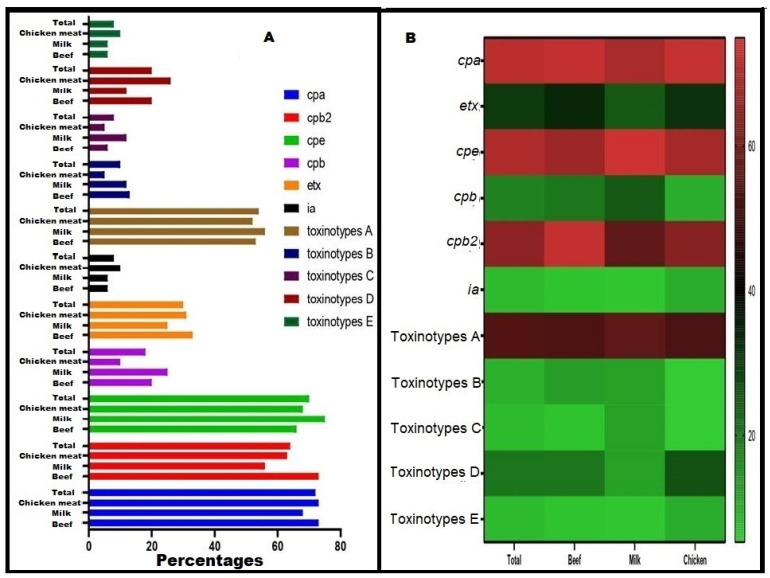
Distribution of toxinotypes and toxin genes among C. perfringens from chicken meat, milk, and beef samples. (A) Columns style using Graphpad prism, which showes the percentages of C. perfringens toxins and toxinotypes from each sample type. (B) Heat map style, in which the percentages of toxinotypes and toxin genes are color-coded on the right of the figure. The cpa, cpb, etx, ia, and cpe are C. perfringens alpha, beta, epsilon, iota, and enterotoxin genes, respectively; cpb2 is the C. perfringens beta2 toxin gene.
Figure 4
Figure 4
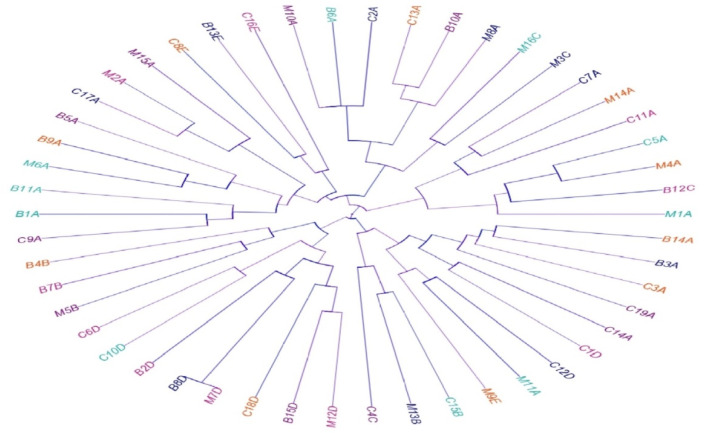
Dendrogram showing the relatedness of C. perfringens isolated from beef (B), chicken meat (C), and milk (M) samples as determined by the antimicrobial resistance and toxin gene profiles. The C. perfringens toxinotypes are indicated with different colors in the dendrogram to denote the specificity of various toxinotypes.
Figure 5
Figure 5
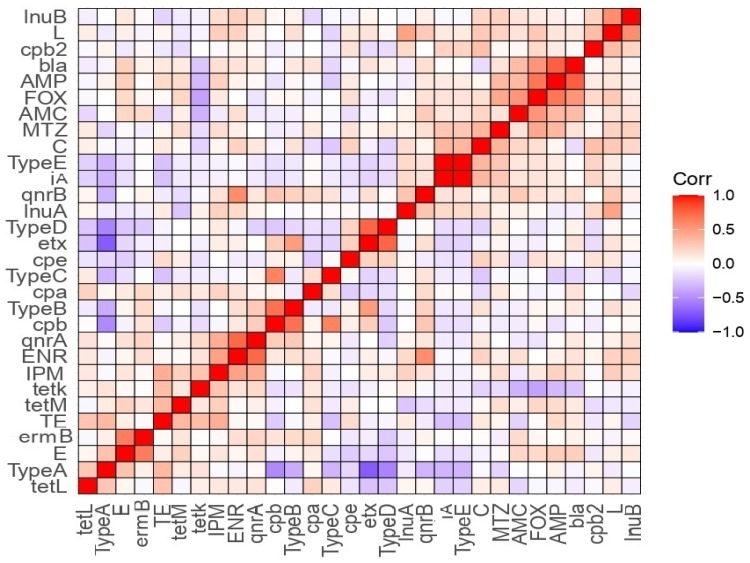
Correlation (r) between antimicrobial resistance, antibiotic resistance, and toxin genes and toxinotypes of C. perfringens isolates from different sample types. Red and blue colors indicate positive and negative correlations, respectively. The color key refers to correlation coefficient (r). The darker red and blue colors imply stronger positive (R = 0.5:1) and negative (R = −0.5:−1) correlations, respectively. AMP, ampicillin; AMC, amoxicillin/clavulanic acid; FOX, cefoxitin; ENR, enrofloxacin; IPM, imipenem; C, chloramphenicol; L, lincomycin; MTZ, metronidazole; E, erythromycin; TE, tetracycline. The tet(K), tet(L), and tet(M); lnu(A) and lnu(B); erm(B); bla; and qnrA and qnrB are genes associated with tetracycline, lincomycin, erythromycin, β-lactams, and enrofloxacin resistances, respectively. The cpa, cpb, etx, ia, and cpe are C. perfringens alpha, beta, epsilon, iota, and enterotoxin genes, respectively, and cpb2 is the C. perfringens beta2 toxin gene.

References

    1. Ghaly M., Shaheen A., Bouhy A., Bendary M. Alternative therapy to manage otitis media caused by multidrug-resistant fungi. Arch. Microbiol. 2020;1:1231–1240. doi: 10.1007/s00203-020-01832-z. - DOI - PubMed
    1. Okeke I.N., Laxminarayan R., Bhutta Z.A., Duse A.G., Jenkins P., O’Brien T.F., Pablos-Mendez A., Klugman K.P. Antimicrobial resistance in developing countries. Part I: Recent trends and current status. Lancet Infect. Dis. 2005;5:481–493. doi: 10.1016/S1473-3099(05)70189-4. - DOI - PubMed
    1. Abd El-Aziz N.K., Abd El-Hamid M.I., Bendary M.M., El-Azazy A.A., Ammar A.M. Existence of vancomycin resistance among methicillin resistant S. aureues recovered from animal and human sources in Egypt. Slov. Vet. Res. 2018;55:221–230.
    1. Abd El-Hamid M.I., Abd El-Aziz N.K., Samir M., El-Naenaeey E.Y., Abo Remela E.M., Mosbah R.A., Bendary M.M. Genetic Diversity of Campylobacter jejuni iolated from avian and human sources in Egypt. Front. Microbiol. 2019;10:2353. doi: 10.3389/fmicb.2019.02353. - DOI - PMC - PubMed
    1. Ghaly M.F., Nasr Z.M., Abousaty A.I., Seadawy H.G., Shaheen M.A.A., Albogami S., Al-Sanea M.M., Bendary M.M. Alternative and complementary therapies against foodborne Salmonella infections. Antibiotics. 2021;10:1453. doi: 10.3390/antibiotics10121453. - DOI - PMC - PubMed

LinkOut - more resources