


Self or Non-Self? It Is also a Matter of RNA Recognition and Editing by ADAR1
- PMID: 35453767
- PMCID: PMC9024829
- DOI: 10.3390/biology11040568
Self or Non-Self? It Is also a Matter of RNA Recognition and Editing by ADAR1
Abstract
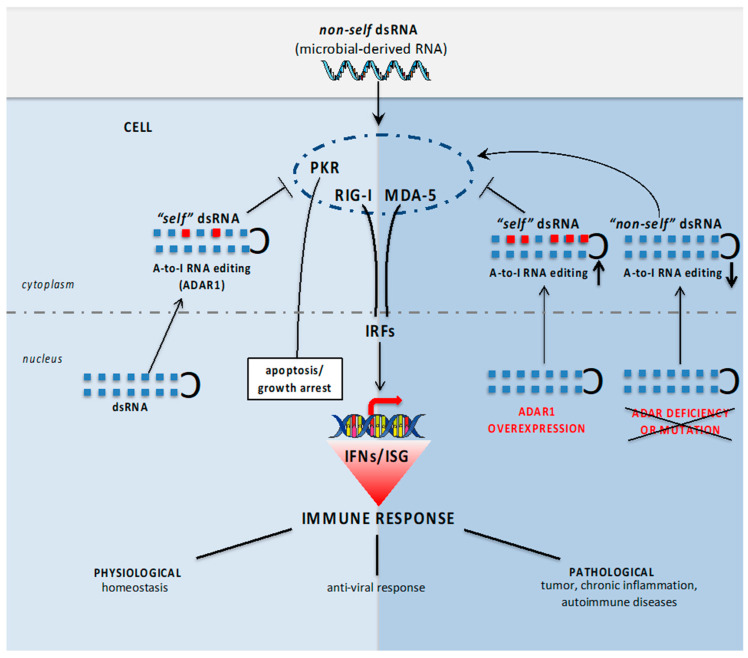
A-to-I editing is a post-transcriptional mechanism affecting coding and non-coding dsRNAs, catalyzed by the adenosine deaminases acting on the RNA (ADAR) family of enzymes. A-to-I modifications of endogenous dsRNA (mainly derived from Alu repetitive elements) prevent their recognition by cellular dsRNA sensors, thus avoiding the induction of antiviral signaling and uncontrolled IFN-I production. This process, mediated by ADAR1 activity, ensures the activation of an innate immune response against foreign (non-self) but not self nucleic acids. As a consequence, ADAR1 mutations or its de-regulated activity promote the development of autoimmune diseases and strongly impact cell growth, also leading to cancer. Moreover, the excessive inflammation promoted by Adar1 ablation also impacts T and B cell maturation, as well as the development of dendritic cell subsets, revealing a new role of ADAR1 in the homeostasis of the immune system.
Keywords: ADAR1; IFN; RNA editing; immune system.
Conflict of interest statement
The authors declare no conflict of interest.
Figures
References
-
- Crow Y.J., Chase D.S., Lowenstein Schmidt J., Szynkiewicz M., Forte G.M., Gornall H.L., Oojageer A., Anderson B., Pizzino A., Helman G., et al. Characterization of human disease phenotypes associated with mutations in TREX1, RNASEH2A, RNASEH2B, RNASEH2C, SAMHD1, ADAR, and IFIH1. Am. J. Med. Genet. A. 2015;167:296–312. doi: 10.1002/ajmg.a.36887. - DOI - PMC - PubMed
Publication types
Grants and funding
LinkOut - more resources
Full Text Sources
Research Materials
