


P-Wave Beat-to-Beat Analysis to Predict Atrial Fibrillation Recurrence after Catheter Ablation
- PMID: 35453877
- PMCID: PMC9028701
- DOI: 10.3390/diagnostics12040830
P-Wave Beat-to-Beat Analysis to Predict Atrial Fibrillation Recurrence after Catheter Ablation
Abstract
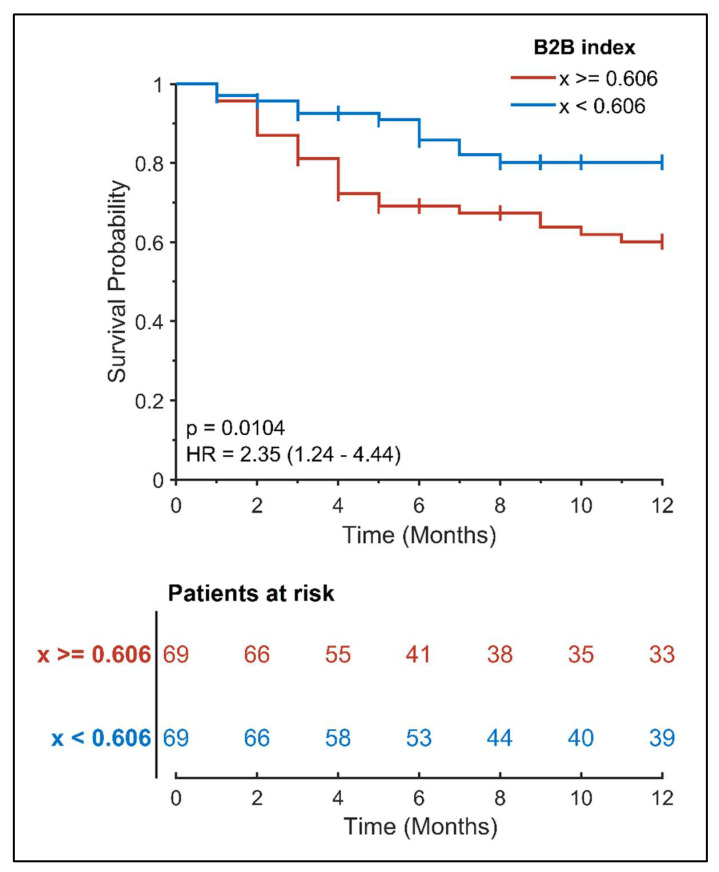
The identification of patients prone to atrial fibrillation (AF) relapse after catheter ablation is essential for better patient selection and risk stratification. The current prospective cohort study aims to validate a novel P-wave index based on beat-to-beat (B2B) P-wave morphological and wavelet analysis designed to detect patients with low burden AF as a predictor of AF recurrence within a year after successful catheter ablation. From a total of 138 consecutive patients scheduled for AF ablation, 12-lead ECG and 10 min vectorcardiogram (VCG) recordings were obtained. Univariate analysis revealed that patients with higher B2B P-wave index had a two-fold risk for AF recurrence (HR: 2.35, 95% CI: 1.24-4.44, p: 0.010), along with prolonged P-wave, interatrial block, early AF recurrence, female gender, heart failure history, previous stroke, and CHA2DS2-VASc score. Multivariate analysis of assessable predictors before ablation revealed that B2B P-wave index, along with heart failure history and a history of previous stroke or transient ischemic attack, are independent predicting factors of atrial fibrillation recurrence. Further studies are needed to assess the predictive value of the B2B index with greater accuracy and evaluate a possible relationship with atrial substrate analysis.
Keywords: P-wave analysis; P-wave indices; atrial fibrillation; atrial fibrillation ablation; atrial fibrillation score; recurrence prediction; signal processing.
Conflict of interest statement
The authors declare no conflict of interest. The funders had no role in the design of the study; in the collection, analyses, or interpretation of data; in the writing of the manuscript; or in the decision to publish the results.
Figures
References
-
- Virani S.S., Alonso A., Aparicio H.J., Benjamin E.J., Bittencourt M.S., Callaway C.W., Carson A.P., Chamberlain A.M., Cheng S., Delling F.N., et al. Heart Disease and Stroke Statistics-2021 Update A Report from the American Heart Association. Circulation. 2021;143:E254–E743. doi: 10.1161/CIR.0000000000000950. - DOI - PubMed
-
- Hindricks G., Potpara T., Dagres N., Bax J.J., Boriani G., Dan G.A., Fauchier L., Kalman J.M., Lane D.A., Lettino M., et al. 2020 ESC Guidelines for the Diagnosis and Management of Atrial Fibrillation Developed in Collaboration with the European Association for Cardio-Thoracic Surgery (EACTS): The Task Force for the Diagnosis and Management of Atrial Fibrillation of the European Society of Cardiology (ESC) Developed with the Special Contribution of the European Heart Rhythm Association (EHRA) of the ESC. Eur. Heart J. 2021;42:373–498. doi: 10.1093/EURHEARTJ/EHAA612. - DOI - PubMed
-
- Nielsen J.C., Johannessen A., Raatikainen P., Hindricks G., Walfridsson H., Pehrson S.M., Englund A., Hartikainen J., Mortensen L.S., Hansen P.S. Long-Term Efficacy of Catheter Ablation as First-Line Therapy for Paroxysmal Atrial Fibrillation: 5-Year Outcome in a Randomised Clinical Trial. Heart. 2017;103:368–376. doi: 10.1136/heartjnl-2016-309781. - DOI - PubMed
-
- Blomström-Lundqvist C., Gizurarson S., Schwieler J., Jensen S.M., Bergfeldt L., Kennebäck G., Rubulis A., Malmborg H., Raatikainen P., Lönnerholm S., et al. Effect of Catheter Ablation vs Antiarrhythmic Medication on Quality of Life in Patients with Atrial Fibrillation: The CAPTAF Randomized Clinical Trial. JAMA-J. Am. Med. Assoc. 2019;321:1059–1068. doi: 10.1001/jama.2019.0335. - DOI - PMC - PubMed
-
- Ganesan A.N., Shipp N.J., Brooks A.G., Kuklik P., Lau D.H., Lim H.S., Sullivan T., Roberts-Thomson K.C., Sanders P. Long-Term Outcomes of Catheter Ablation of Atrial Fibrillation: A Systematic Review and Meta-Analysis. J. Am. Heart Assoc. 2013;2:e004549. doi: 10.1161/JAHA.112.004549. - DOI - PMC - PubMed
Grants and funding
LinkOut - more resources
Full Text Sources
