Review
. 2022 Mar 29;12(4):837.
doi: 10.3390/diagnostics12040837.

Deep Learning on Histopathological Images for Colorectal Cancer Diagnosis: A Systematic Review

Affiliations
Review

Deep Learning on Histopathological Images for Colorectal Cancer Diagnosis: A Systematic Review

Athena Davri et al. Diagnostics (Basel). .

Abstract

Colorectal cancer (CRC) is the second most common cancer in women and the third most common in men, with an increasing incidence. Pathology diagnosis complemented with prognostic and predictive biomarker information is the first step for personalized treatment. The increased diagnostic load in the pathology laboratory, combined with the reported intra- and inter-variability in the assessment of biomarkers, has prompted the quest for reliable machine-based methods to be incorporated into the routine practice. Recently, Artificial Intelligence (AI) has made significant progress in the medical field, showing potential for clinical applications. Herein, we aim to systematically review the current research on AI in CRC image analysis. In histopathology, algorithms based on Deep Learning (DL) have the potential to assist in diagnosis, predict clinically relevant molecular phenotypes and microsatellite instability, identify histological features related to prognosis and correlated to metastasis, and assess the specific components of the tumor microenvironment.

Keywords: CNN; CRC; DL; colorectal cancer; convolutional neural networks; deep learning; histopathology; microscopy images.


Conflict of interest statement

The authors declare no conflict of interest.

Figures
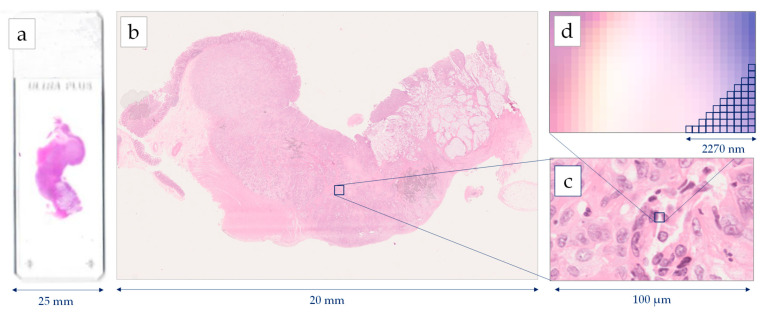
Figure 1
Figure 1
Image generation using a Hamamatsu NanoZoomer whole slide scanner: (a) histological slide 75 mm × 25 mm, (b) Whole Slide Image (WSI), (c) cell level in 40× magnification, (d) pixel level in 40× magnification digitizing images 227 nm per pixel.
Figure 2
Figure 2
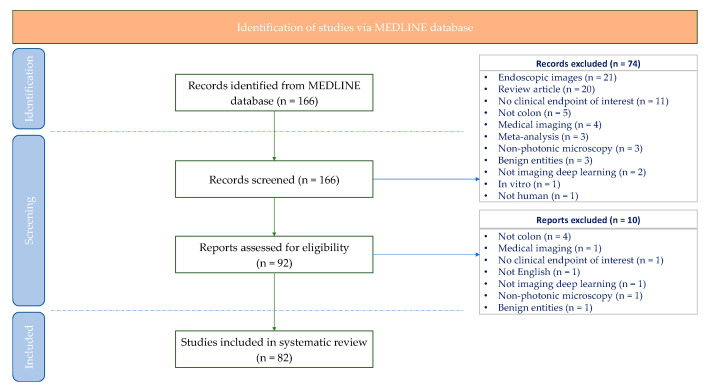
Systematic review flow-chart illustrating systematic search and screening strategy, including number of studies meeting eligibility criteria and number of excluded studies. Last search carried out on 14 January 2022.
Figure 3
Figure 3
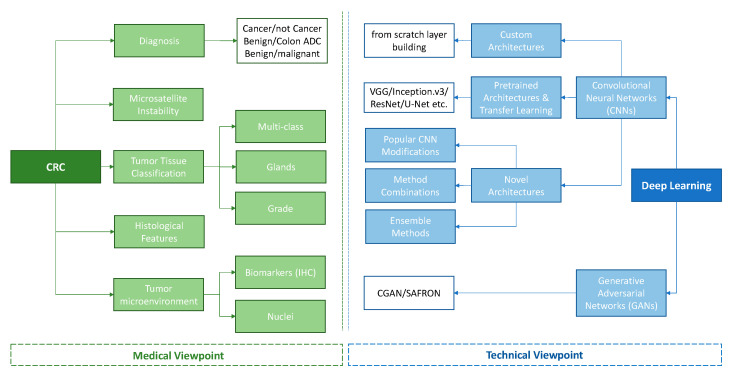
Tree diagram for the categorization of the studies.

References

    1. Sung H., Ferlay J., Siegel R.L., Laversanne M., Soerjomataram I., Jemal A., Bray F. Global Cancer Statistics 2020: GLOBOCAN Estimates of Incidence and Mortality Worldwide for 36 Cancers in 185 Countries. CA Cancer J. Clin. 2021;71:209–249. doi: 10.3322/caac.21660. - DOI - PubMed
    1. Douaiher J., Ravipati A., Grams B., Chowdhury S., Alatise O., Are C. Colorectal Cancer-Global Burden, Trends, and Geographical Variations. J. Surg. Oncol. 2017;115:619–630. doi: 10.1002/jso.24578. - DOI - PubMed
    1. Sawicki T., Ruszkowska M., Danielewicz A., Niedźwiedzka E., Arłukowicz T., Przybyłowicz K.E. A Review of Colorectal Cancer in Terms of Epidemiology, Risk Factors, Development, Symptoms and Diagnosis. Cancers. 2021;13:2025. doi: 10.3390/cancers13092025. - DOI - PMC - PubMed
    1. Müller M.F., Ibrahim A.E.K., Arends M.J. Molecular Pathological Classification of Colorectal Cancer. Virchows Arch. 2016;469:125–134. doi: 10.1007/s00428-016-1956-3. - DOI - PMC - PubMed
    1. Marzouk O., Schofield J. Review of Histopathological and Molecular Prognostic Features in Colorectal Cancer. Cancers. 2011;3:2767–2810. doi: 10.3390/cancers3022767. - DOI - PMC - PubMed

LinkOut - more resources