


Prenatal Diagnosis and Outcome of Umbilical-Portal-Systemic Venous Shunts: Experience of a Tertiary Center and Proposal for a New Complex Type
- PMID: 35453921
- PMCID: PMC9027129
- DOI: 10.3390/diagnostics12040873
Prenatal Diagnosis and Outcome of Umbilical-Portal-Systemic Venous Shunts: Experience of a Tertiary Center and Proposal for a New Complex Type
Abstract
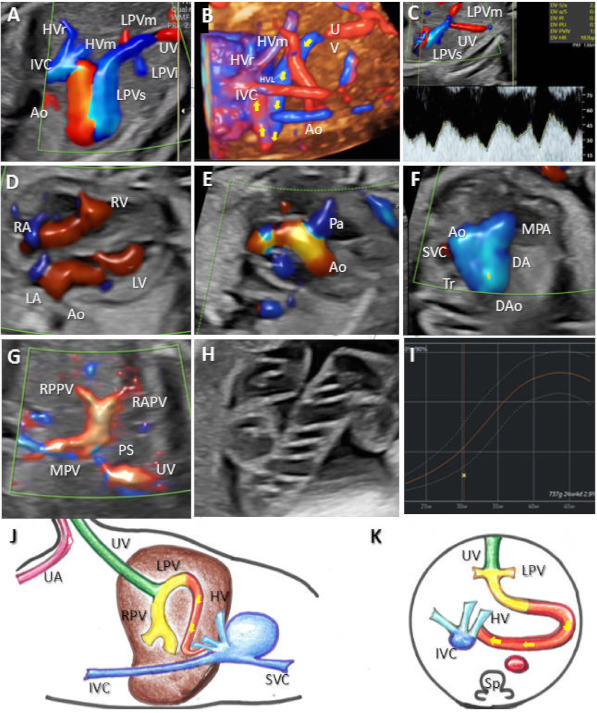
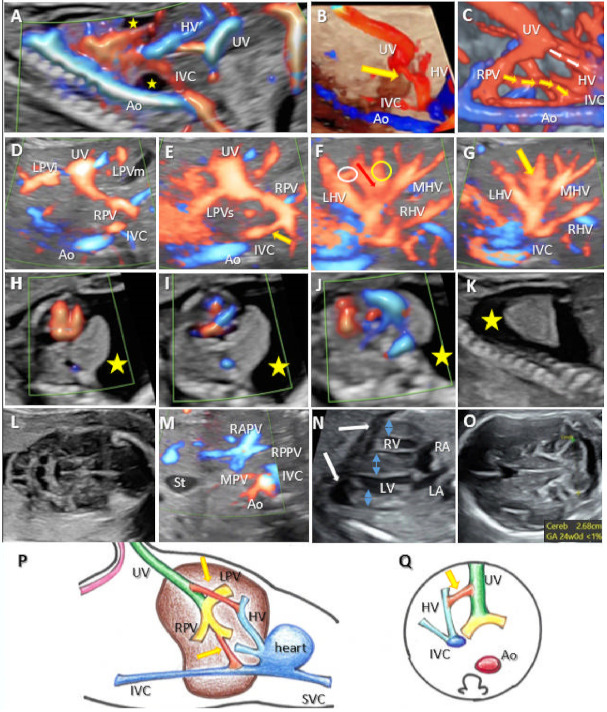
Aims: To share our experience in the prenatal diagnosis of umbilical-portal-systemic venous shunts (UPSVS) and to study the prognostic factors for proper prenatal and perinatal management. Material and Methods: A five-year prospective study regarding the detection of UPSVS was conducted in two referral centers, Medgin Ginecho Clinic and the Prenatal Diagnostic Unit of the tertiary center, University Emergency County Hospital Craiova, Romania. We included in the analysis a series of agenesis of ductus venosus (ADV) cases previously reported by our center. We analyzed the incidence of the UPSVS types, their associations, and outcome predictors. Results: UPSVS were diagnosed in all 16 cases that were presented to our center at the time of first trimester anomaly scan, except one (94.12%). We diagnosed: 19 type I (61.2%), 4 type II (12.9%) and 5 type IIIa (16.1%) UPSVS. In three cases (9.6%) we noted multiple shunts, which we referred to as type IV (a new UPSVS type). Type IIIa-associated fetal growth restriction (FGR) was found in 60% of cases. Major anomalies worsened the outcome. Of the UPVSS cases, 57.1% were associated with PVS anomalies. Genetic anomalies were present in 40% of the tested cases. Conclusions: The incidence of UPSVS in our study was 0.2%. Early detection is feasible. The postnatal outcome mainly depends on the presence of structural, genetic and PVS anomalies. FGR may be associated. The new category presented a poor outcome secondary to poor hemodynamic and major associated anomalies.
Keywords: agenesis of ductus venosus; color Doppler; fetal venous shunt; portal system; prenatal diagnosis; umbilical drainage; umbilical–portal–systemic venous shunt; venous anomalies.
Conflict of interest statement
The authors declare no conflict of interest.
Figures
References
-
- Fasouliotis S.J., Achiron R., Kivilevitch Z., Yagel S. The human fetal venous system: Normal embryologic, anatomic, and physiologic characteristics and developmental abnormalities. J. Ultrasound Med. Off. J. Am. Inst. Ultrasound Med. 2002;21:1145–1158. doi: 10.7863/jum.2002.21.10.1145. - DOI - PubMed
-
- Kanamori Y., Hashizume K., Kitano Y., Sugiyama M., Motoi T., Tange T. Congenital extrahepatic portocaval shunt (Abernethy type 2), huge liver mass, and patent ductus arteriosus—A case report of its rare clinical presentation in a young girl. J. Pediatr. Surg. 2003;38:E15. doi: 10.1053/jpsu.2003.50153. - DOI - PubMed
-
- Murray C.P., Yoo S.J., Babyn P.S. Congenital extrahepatic portosystemic shunts. Pediatr. Radiol. 2003;33:614–620. - PubMed
LinkOut - more resources
Full Text Sources
Research Materials
Miscellaneous
