. 2022 Apr 6;12(4):543.
doi: 10.3390/life12040543.

Long-Term Progression and Rapid Decline in Hearing Loss in Patients with a Point Mutation at Nucleotide 3243 of the Mitochondrial DNA

Affiliations

Long-Term Progression and Rapid Decline in Hearing Loss in Patients with a Point Mutation at Nucleotide 3243 of the Mitochondrial DNA

Aki Sakata et al. Life (Basel). .

Abstract

Patients with m.3243A>G mutation of mitochondrial DNA develop bilaterally symmetric sensorineural hearing loss. However, it is unclear how fast their hearing loss progresses over time, and whether they experience rapid progression of hearing loss. In the present study, we conducted a long-term hearing evaluation in patients with MELAS or MIDD who harbored the m.3243A>G mutation of mitochondrial DNA. A retrospective chart review was performed on 15 patients with this mutation who underwent pure-tone audiometry at least once a year for more than two years. The mean follow-up period was 12.8 years. The mean progression rate of hearing loss was 5.5 dB per year. Hearing loss progressed rapidly to be profoundly deaf in seven patients during the observation period. Heteroplasmy and age-corrected heteroplasmy levels correlated with the age of onset of hearing loss. These results indicate that patients with m.3243A>G mutation have a gradual progression of hearing loss in the early stages and rapid decline in hearing to be profoundly deaf in approximately half of the patients. Although it is possible to predict the age of onset of hearing loss from heteroplasmy and age-corrected heteroplasmy levels, it is difficult to predict whether and when the rapid hearing loss will occur.

Keywords: diabetes; disequilibrium; dizziness; hearing loss; mitochondrial gene mutations.


Conflict of interest statement

The authors declare no conflict of interest. The funders had no role in the design of the study; in the collection, analyses, or interpretation of data; in the writing of the manuscript; in the decision to publish the results.

Figures
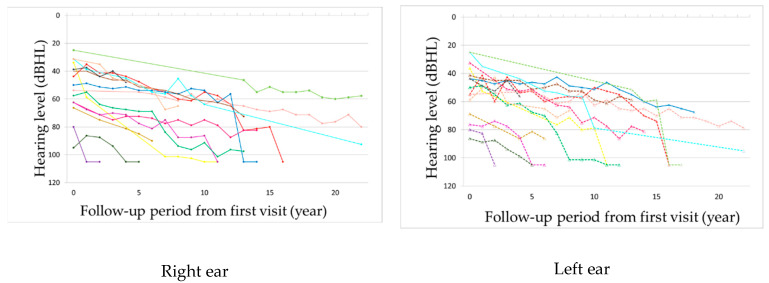
Figure 1
Figure 1
Chronological progression of hearing level from the first visit. The different color indicates the different patient, and the same color indicates the same patient.
Figure 2
Figure 2
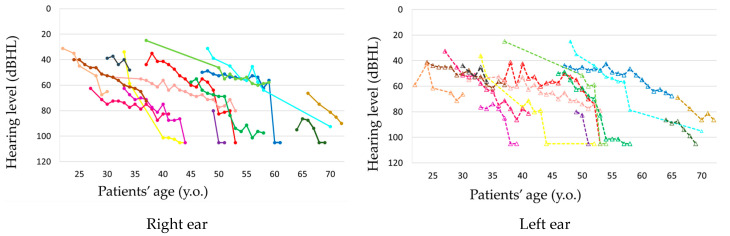
Relationship between patients’ age and progression of their hearing loss. The different color indicates the different patient, and the same color indicates the same patient.
Figure 3
Figure 3
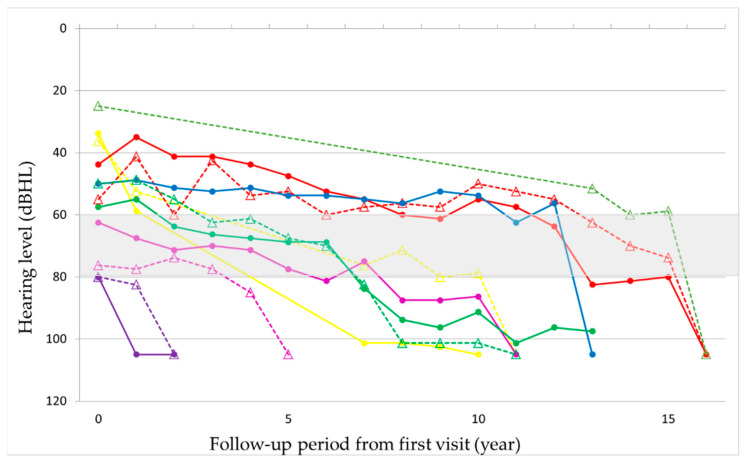
Chronological change in hearing level from the first visit in patients who showed a rapid decline in hearing. The different color indicates the different patient, and the same color indicates the same patient. The solid lines with the shaped mark: right ear. The dashed line with the triangle mark: left ear. Two patients (light green and blue) only have one ear shown because the rapid decline was only seen in one ear.
Figure 4
Figure 4
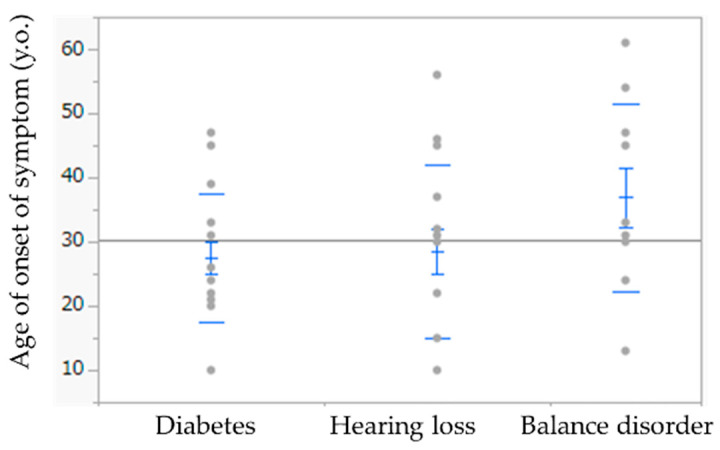
Age of the onset of diabetes, hearing loss, and balance disorder. Blue upper long bar, upper whisker; blue upper short bar, upper quartile; blue center short bar, median; blue lower short bar, lower quartile; blue lower long bar, lower whisker.
Figure 5
Figure 5
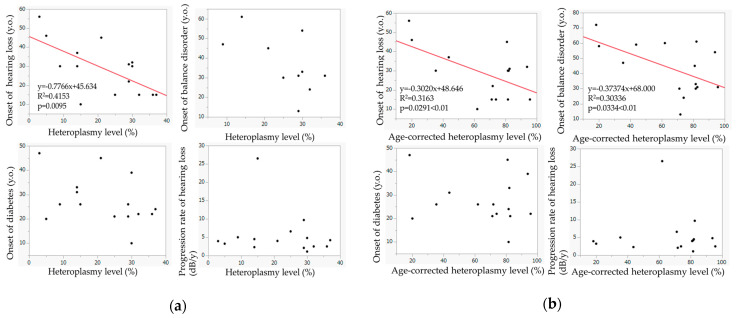
(a) Relationship between heteroplasmy level and the onset of hearing loss, balance–gait disorders, and diabetes mellitus and the progression rate of hearing loss; (b) relationship between age-corrected heteroplasmy level and the onset of hearing loss, balance disorders, and diabetes mellitus and the progression rate of hearing loss. The red lines: the regression lines.

References

    1. Wallace D.C. Diseases of the mitochondrial DNA. Annu. Rev. Biochem. 1992;61:1175–1212. doi: 10.1146/annurev.bi.61.070192.005523. - DOI - PubMed
    1. Pavlakis S.G., Phillips P.C., DiMauro S., De Vivo D.C., Rowland L.P. Mitochondrial myopathy, encephalopathy, lactic acidosis, and strokelike episodes: A distinctive clinical syndrome. Ann. Neurol. 1984;16:481–488. doi: 10.1002/ana.410160409. - DOI - PubMed
    1. Durand-Dubief F., Ryvlin P., Mauguière F. Polymorphism of epilepsy associated with the A3243G mutation of mitochondrial DNA (MELAS): Reasons for delayed diagnosis. Rev. Neurol. 2004;160:824–829. doi: 10.1016/S0035-3787(04)71038-3. - DOI - PubMed
    1. Scarpelli M., Zappini F., Filosto M., Russignan A., Tonin P., Tomelleri G. Mitochondrial Sensorineural Hearing Loss: A Retrospective Study and a Description of Cochlear Implantation in a MELAS Patient. Genet. Res. Int. 2012;2012:287432. doi: 10.1155/2012/287432. - DOI - PMC - PubMed
    1. DiMauro S., Schon E.A. Mitochondrial respiratory-chain diseases. N. Engl. J. Med. 2003;348:2656–2668. doi: 10.1056/NEJMra022567. - DOI - PubMed

LinkOut - more resources