. 2022 Mar 25;12(4):529.
doi: 10.3390/jpm12040529.

Healthcare Professional Perspectives on the Use of Remote Patient-Monitoring Platforms during the COVID-19 Pandemic: A Cross-Sectional Study

Affiliations

Healthcare Professional Perspectives on the Use of Remote Patient-Monitoring Platforms during the COVID-19 Pandemic: A Cross-Sectional Study

Khayreddine Bouabida et al. J Pers Med. .

Abstract

The COVID-19 pandemic created an urgent need to act to reduce the spread of the virus and alleviate congestion in healthcare services, protect health professionals, and help them maintain satisfactory quality and safety of care. Remote monitoring platforms (RPM) emerged as potential solutions. In this study, we evaluate, from health professionals' perspectives, the capacity and contribution of two different digital platforms to maintain quality, safety, and patient engagement in care. A cross-sectional study was conducted using a survey in which a total of 491 health professionals participated. The results show that, in general, user perceptions of the quality and safety of care provided through the platforms were positive. The ease of access to health professionals' services in general and shorter waiting times for patients were the two main features that were highly appreciated by most participants. However, some problems were encountered during the use of these two platforms, such as a lack of training and/or direct support for users. To improve the two platforms and maximize their use, the areas for improvement and the issues identified should be addressed as part of a collaborative process involving health professionals and patients as well as health system leaders, decision-makers, and digital platform providers.

Keywords: COVID-19; health professionals; remote monitoring; survey; telehealth.


Conflict of interest statement

The authors declare no conflict of interest.

Figures
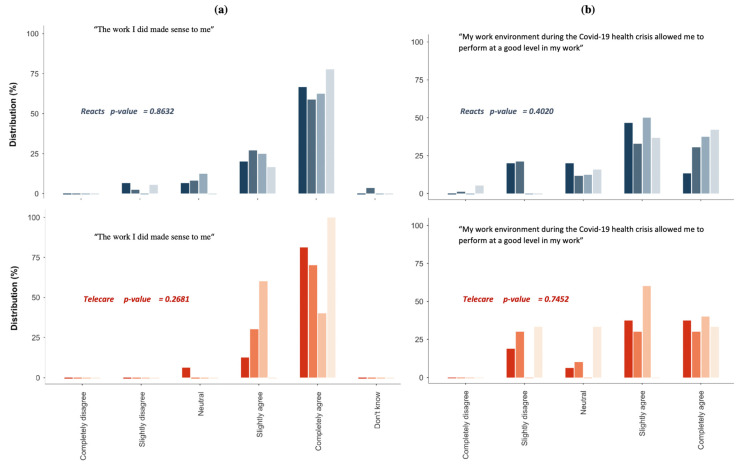
Figure 1
Figure 1
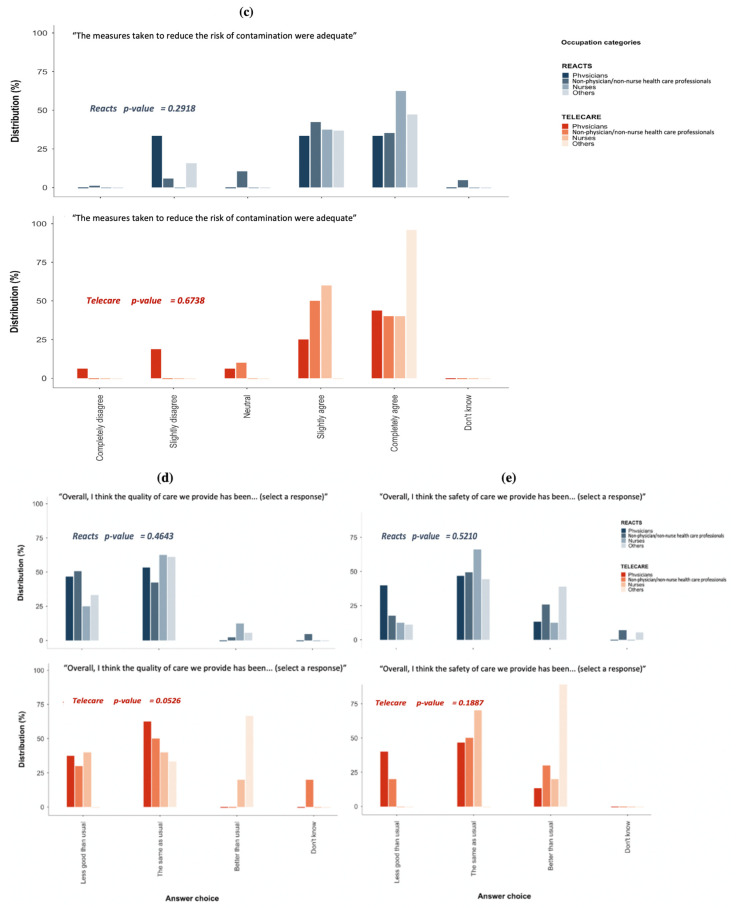
Perceptions of the performance, quality, and safety of care. Figure 1 (a). Respondents’ perception of sense of work provided on REACTS platform vs. TELECARE Platform; (b). Respondents’ perception of work environment and performance provided on REACTS platform vs. TELECARE Platform Figure 1; (c). Respondents’ perception of reducing contamination measures provided on REACTS platform vs. TELECARE Platform; (d). Respondents’ perception of quality of care provided on REACTS platform vs. TELECARE Platform; (e). Respondents’ perception of safety of care provided on REACTS platform vs. TELECARE Platform.
Figure 1
Figure 1
Perceptions of the performance, quality, and safety of care. Figure 1 (a). Respondents’ perception of sense of work provided on REACTS platform vs. TELECARE Platform; (b). Respondents’ perception of work environment and performance provided on REACTS platform vs. TELECARE Platform Figure 1; (c). Respondents’ perception of reducing contamination measures provided on REACTS platform vs. TELECARE Platform; (d). Respondents’ perception of quality of care provided on REACTS platform vs. TELECARE Platform; (e). Respondents’ perception of safety of care provided on REACTS platform vs. TELECARE Platform.
Figure 2
Figure 2
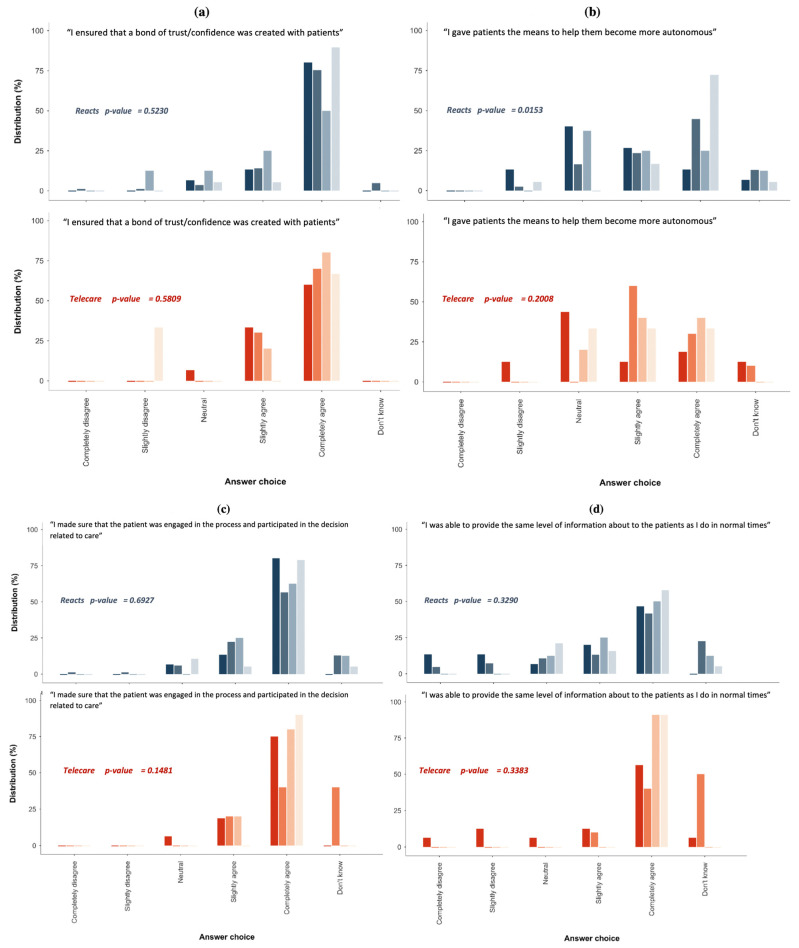
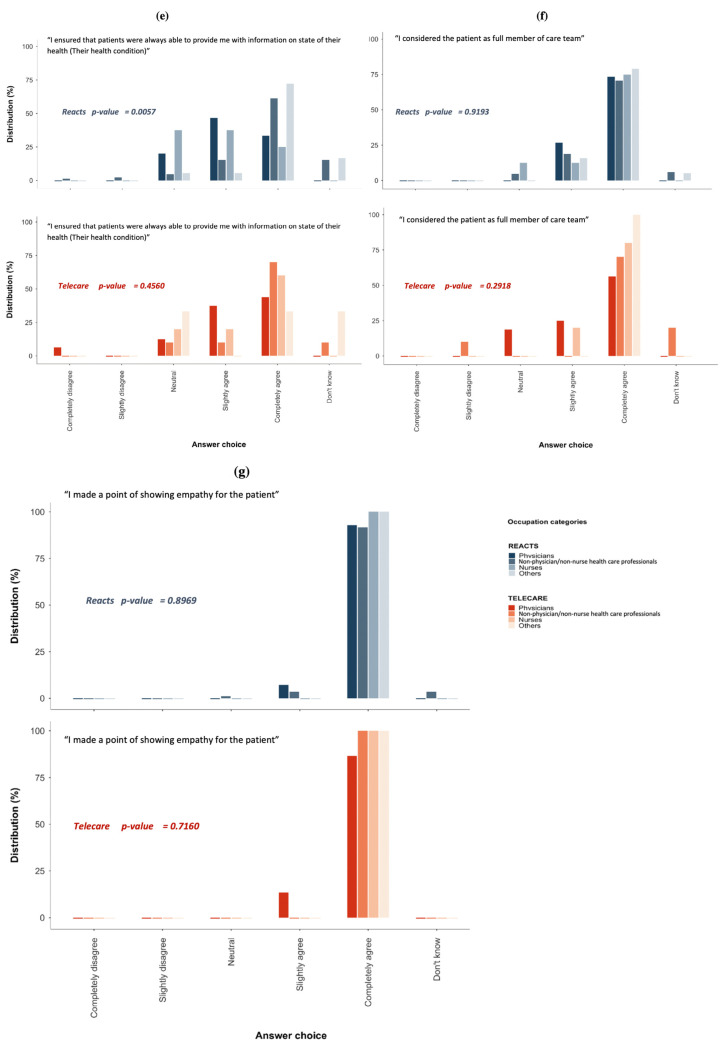
Perceptions of patient engagement in care and the relationship with the care team. Figure 2 (a). Respondents’ perception of the bond of trust and confidence created with patients provided on REACTS platform vs. TELECARE Platform; (b). Respondents’ perception of the means given to help patients to become autonomous provided on REACTS platform vs. TELECARE Platform; (c). Respondents’ perception of the patient engagement in the decision-making process of care provided on REACTS platform vs. TELECARE Platform; (d). Respondents’ perception of the level of information to patients provided on REACTS platform vs. TELECARE Platform; (e). Respondents’ perception of the level of information given by patients to healthcare professionals provided on REACTS platform vs. TELECARE Platform; (f). Respondents’ perception of the patients’ consideration as a full member of care team provided on REACTS platform vs. TELECARE Platform; (g). Respondents’ perception of the level of empathy shown to patients provided on REACTS platform vs. TELECARE Platform.
Figure 2
Figure 2
Perceptions of patient engagement in care and the relationship with the care team. Figure 2 (a). Respondents’ perception of the bond of trust and confidence created with patients provided on REACTS platform vs. TELECARE Platform; (b). Respondents’ perception of the means given to help patients to become autonomous provided on REACTS platform vs. TELECARE Platform; (c). Respondents’ perception of the patient engagement in the decision-making process of care provided on REACTS platform vs. TELECARE Platform; (d). Respondents’ perception of the level of information to patients provided on REACTS platform vs. TELECARE Platform; (e). Respondents’ perception of the level of information given by patients to healthcare professionals provided on REACTS platform vs. TELECARE Platform; (f). Respondents’ perception of the patients’ consideration as a full member of care team provided on REACTS platform vs. TELECARE Platform; (g). Respondents’ perception of the level of empathy shown to patients provided on REACTS platform vs. TELECARE Platform.

References

    1. World Health Organization (WHO) WHO Coronavirus (COVID-19) Dashboard. [(accessed on 8 February 2022)]. Available online: https://covid19.who.int.
    1. Government of Canada COVID-19 Daily Epidemiology Update. [(accessed on 8 February 2022)]. Available online: https://health-infobase.canada.ca/covid-19/epidemiological-summary-covid....
    1. Gouvernement du Québec Données sur la COVID-19 au Québec. [(accessed on 8 February 2022)]. Available online: https://www.quebec.ca/sante/problemes-de-sante/a-z/coronavirus-2019/situ....
    1. World Health Organization (WHO) Coronavirus Disease (COVID-19) Pandemic. [(accessed on 8 February 2022)]. Available online: https://www.who.int/emergencies/diseases/novel-coronavirus-2019.
    1. Brooks S.K., Webster R.K., Smith L.E., Woodland L., Wessely S., Greenberg N., Rubin G.J. The Psychological Impact of Quarantine and How to Reduce It: Rapid Review of the Evidence. Lancet. 2020;395:912–920. doi: 10.1016/S0140-6736(20)30460-8. - DOI - PMC - PubMed

LinkOut - more resources