


Emerging Biomarkers for Early Detection of Chronic Kidney Disease
- PMID: 35455664
- PMCID: PMC9025702
- DOI: 10.3390/jpm12040548
Emerging Biomarkers for Early Detection of Chronic Kidney Disease
Abstract
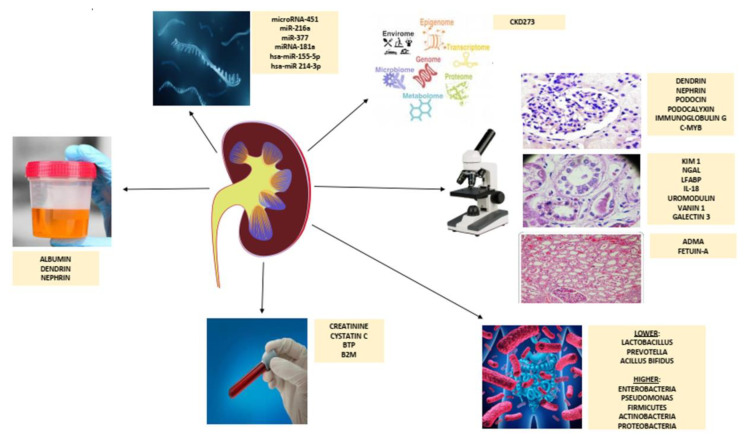
Chronic kidney disease (CKD) is a major and serious global health problem that leads to kidney damage as well as multiple systemic diseases. Early diagnosis and treatment are two major measures to prevent further deterioration of kidney function and to delay adverse outcomes. However, the paucity of early, predictive and noninvasive biomarkers has undermined our ability to promptly detect and treat this common clinical condition which affects more than 10% of the population worldwide. Despite all limitations, kidney function is still measured by serum creatinine, cystatin C, and albuminuria, as well as estimating glomerular filtration rate using different equations. This review aims to provide comprehensive insight into diagnostic methods available for early detection of CKD. In the review, we discuss the following topics: (i) markers of glomerular injury; (ii) markers of tubulointerstitial injury; (iii) the role of omics; (iv) the role of microbiota; (v) and finally, the role of microRNA in the early detection of CKD. Despite all novel findings, none of these biomarkers have met the criteria of an ideal early marker. Since the central role in CKD progression is the proximal tubule (PT), most data from the literature have analyzed biomarkers of PT injury, such as KIM-1 (kidney injury molecule-1), NGAL (neutrophil gelatinase-associated lipocalin), and L-FABP (liver fatty acid-binding protein).
Keywords: biomarker; chronic kidney disease; diagnosis; early detection.
Conflict of interest statement
The authors declare no conflict of interest.
Figures
References
Publication types
LinkOut - more resources
Full Text Sources
Other Literature Sources
Miscellaneous
