


Why Percussive Massage Therapy Does Not Improve Recovery after a Water Rescue? A Preliminary Study with Lifeguards
- PMID: 35455870
- PMCID: PMC9031405
- DOI: 10.3390/healthcare10040693
Why Percussive Massage Therapy Does Not Improve Recovery after a Water Rescue? A Preliminary Study with Lifeguards
Abstract
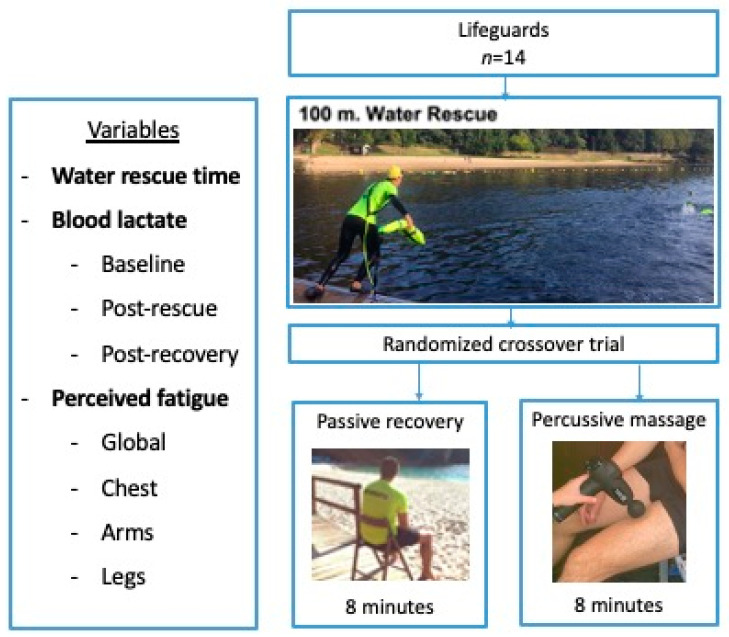
The aim of this study was to analyze the effects of percussive massage therapy (PMT) on lifeguards’ recovery after a water rescue, in comparison with passive recovery. Methods: A quasi-experimental crossover design was conducted to compare passive recovery (PR) and a PMT protocol. A total of 14 volunteer lifeguards performed a simulated 100 m water rescue and perceived fatigue and blood lactate were measured as recovery variables after the rescue and after the 8-min recovery process. Results: There were no differences between PMT and PR in lactate clearance (p > 0.05), finding in both modalities a small but not significant decrease in blood lactate. In perceived fatigue, both methods decreased this variable significantly (p < 0.001), with no significant differences between them (p > 0.05). Conclusions: PMT does not enhance recovery after a water rescue, in comparison with staying passive. Despite PMT appearing to be adequate for recovery in other efforts, it is not recommended for lifeguards’ recovery after a water rescue.
Keywords: drowning; extra-hospital care; lifesaving; recovery modalities.
Conflict of interest statement
The authors declare no conflict of interest.
Figures
References
-
- Barcala-Furelos R., González-Represas A., Rey E., Martínez-Rodríguez A., Kalén A., Marques O., Rama L. Is Low-Frequency Electrical Stimulation a Tool for Recovery after a Water Rescue? A Cross-Over Study with Lifeguards. Int. J. Environ. Res. Public Health. 2020;17:5854. doi: 10.3390/ijerph17165854. - DOI - PMC - PubMed
LinkOut - more resources
Full Text Sources
Research Materials
