Case Reports
. 2022 Apr 11;10(4):708.
doi: 10.3390/healthcare10040708.

Mixed Neuroendocrine Non-Neuroendocrine Neoplasms of the Gastrointestinal Tract: A Case Series

Affiliations
Case Reports

Mixed Neuroendocrine Non-Neuroendocrine Neoplasms of the Gastrointestinal Tract: A Case Series

Luigi Pio Guerrera et al. Healthcare (Basel). .

Abstract

Mixed neuroendocrine non-neuroendocrine neoplasms (MiNENs) refer to heterogenous rare neoplasms constituted of at least a neuroendocrine population-either well-differentiated, or more frequently poorly differentiated-and a non-neuroendocrine population, both accounting for at least 30% of the whole tumor mass. Several studies recently focused on the key genetic and epigenetic changes underlying MiNENs to better understand how they develop, and explore biological similarities among the two components and their pure counterparts. However, their molecular landscape still remains poorly understood. NGS may represent a useful tool to study this orphan disease by detecting the main genetic alterations and possible therapeutic targets. NGS analysis on tissue and/or blood samples through the Foundation One (F1) platform was performed on consecutive samples collected from four patients diagnosed with MiNENs of the gastroenteric tract. Several genetic alterations were shared among samples from the same patients, thus suggesting a common origin between them, although morphology sometimes changed at histopathological evaluation. Common molecular alterations among samples from different patients that had not been previously described to our knowledge were also detected. Finally, it is of the utmost importance to clarify if the maintenance of the 30% cut-off is still essential in defining MiNENs and really manages to include all of the mixed neoplasms.

Keywords: Foundation One (F1); MiNENs; NGS analysis; gastrointestinal tumors; mixed neuroendocrine/non-neuroendocrine neoplasms.


Conflict of interest statement

The authors declare no conflict of interest.

Figures
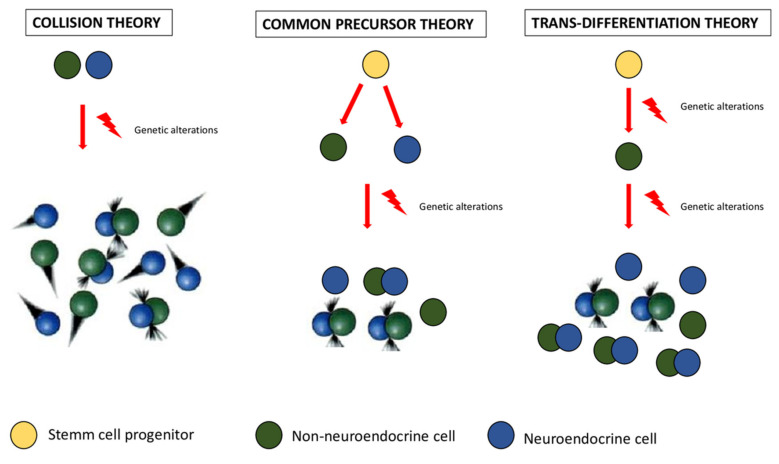
Figure 1
Figure 1
A comprehensive representation of the three main theories about MiNENs’ origin proposed to date. From the left to the right, collision theory, common precursor theory, and trans-differentiation theory are illustrated respectively. As mentioned in the text, the first one suggests that neuroendocrine and non-neuroendocrine components arise independently from distinct precursor cells, the second one postulates a common origin from a pluripotent stem cell progenitor, which differentiates towards both components; finally, the third one assumes that neuroendocrine differentiation is the result of progressive accumulation of genetic alterations in an initially non-neuroendocrine cell phenotype.
Figure 2
Figure 2
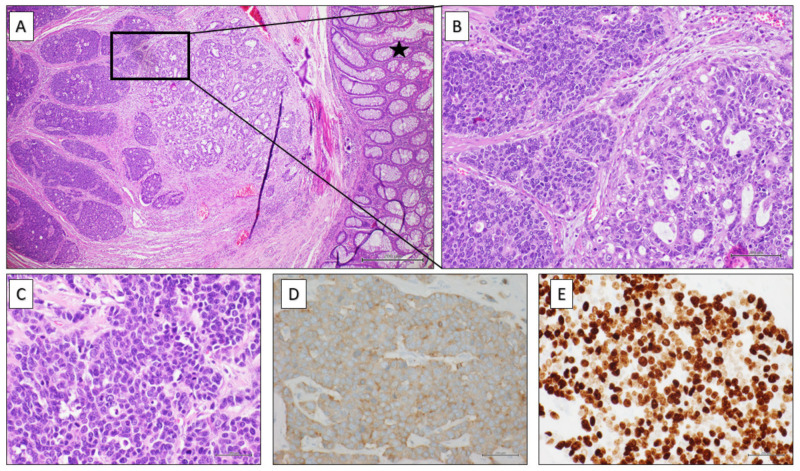
(A) Colonic segment partially covered by normal mucosa (black star) showing infiltration, on the left side of the image, by a carcinoma with a double component: neuroendocrine and adenocarcinomatous one (H&E 4× magnification). (B) A detail of image (A) showing at higher magnification the neuroendocrine population (on the left side) arranged in pseudo-rosettes or trabeculae, composed of medium-sized cells with irregular nuclei and granular chromatin and the adenocarcinomatous component (on the right side) with evident glandular structures made up of atypical cylindrical cells (H&E 20× magnification). (C) High mitotic index typical of neuroendocrine carcinomas (H&E 40× magnification). (D) Strong positivity for synaptophysin at immunohistochemistry (40× magnification). (E) High proliferative index (Ki67) at immunohistochemical assay (40× magnification).
Figure 3
Figure 3
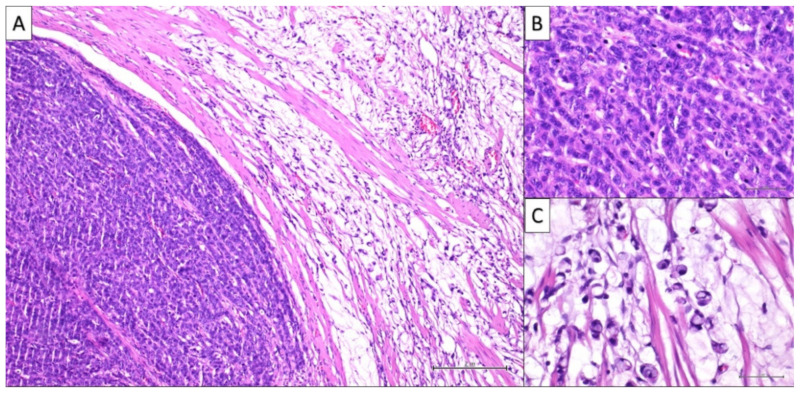
(A) Histologically, a carcinoma with a double component is observed: a neuroendocrine population (on the left side), and a poorly differentiated adenocarcinoma (on the right side) are clearly recognizable (H&E 10× magnification). (B) A detail of the neuroendocrine component at higher magnification showing a neoplastic population with cord architecture, medium-sized elements with scant cytoplasm, atypical nuclei, and numerous mitotic figures (H&E 20× magnification). (C) A detail of the adenocarcinomatous counterpart at higher magnification showing abundant mucus lakes with ‘floating’ scattered signet ring cells (H&E 20× magnification).

References

    1. De Mestier L., Cros J., Neuzillet C., Hentic O., Egal A., Muller N., Bouché O., Cadiot G., Ruszniewski P., Couvelard A., et al. Digestive System Mixed Neuroendocrine-Non-Neuroendocrine Neoplasms. Neuroendocrinology. 2017;105:412–425. doi: 10.1159/000475527. - DOI - PubMed
    1. Lloyd R.V., Osamura R.Y., Klöppel G., Rosai J. Who Classification of Tumours of Endocrine Organs. 4th ed. International Agency for Research on Cancer (IARC); Lyon, France: 2017.
    1. WHO Classification of Tumours Editorial Board . WHO Classification of Tumours. Digestive System Tumours. 5th ed. International Agency for Research on Cancer (IARC); Lyon, France: 2019.
    1. Brathwaite S.A., Smith S.M., Wai L., Frankel W., Hays J., Yearsley M.M., Abdel-Misih S. Mixed adenoneuroendocrine carcinoma: A review of pathologic characteristics. Hum. Pathol. 2018;73:184–191. doi: 10.1016/j.humpath.2017.12.009. - DOI - PubMed
    1. Frizziero M., Chakrabarty B., Nagy B., Lamarca A., Hubner R.A., Valle J.W., McNamara M.G. Mixed Neuroendocrine Non-Neuroendocrine Neoplasms: A Systematic Review of a Controversial and Underestimated Diagnosis. J. Clin. Med. 2020;9:273. doi: 10.3390/jcm9010273. - DOI - PMC - PubMed

Publication types

LinkOut - more resources