Review
. 2022 Apr 8;11(8):1261.
doi: 10.3390/cells11081261.

GBA Variants and Parkinson Disease: Mechanisms and Treatments

Affiliations
Review

GBA Variants and Parkinson Disease: Mechanisms and Treatments

Laura Smith et al. Cells. .

Abstract

The GBA gene encodes for the lysosomal enzyme glucocerebrosidase (GCase), which maintains glycosphingolipid homeostasis. Approximately 5-15% of PD patients have mutations in the GBA gene, making it numerically the most important genetic risk factor for Parkinson disease (PD). Clinically, GBA-associated PD is identical to sporadic PD, aside from the earlier age at onset (AAO), more frequent cognitive impairment and more rapid progression. Mutations in GBA can be associated with loss- and gain-of-function mechanisms. A key hallmark of PD is the presence of intraneuronal proteinaceous inclusions named Lewy bodies, which are made up primarily of alpha-synuclein. Mutations in the GBA gene may lead to loss of GCase activity and lysosomal dysfunction, which may impair alpha-synuclein metabolism. Models of GCase deficiency demonstrate dysfunction of the autophagic-lysosomal pathway and subsequent accumulation of alpha-synuclein. This dysfunction can also lead to aberrant lipid metabolism, including the accumulation of glycosphingolipids, glucosylceramide and glucosylsphingosine. Certain mutations cause GCase to be misfolded and retained in the endoplasmic reticulum (ER), activating stress responses including the unfolded protein response (UPR), which may contribute to neurodegeneration. In addition to these mechanisms, a GCase deficiency has also been associated with mitochondrial dysfunction and neuroinflammation, which have been implicated in the pathogenesis of PD. This review discusses the pathways associated with GBA-PD and highlights potential treatments which may act to target GCase and prevent neurodegeneration.

Keywords: GBA; Parkinson disease; alpha-synuclein; autophagy; lipids; unfolded protein response.


Conflict of interest statement

The authors declare no conflict of interest.

Figures
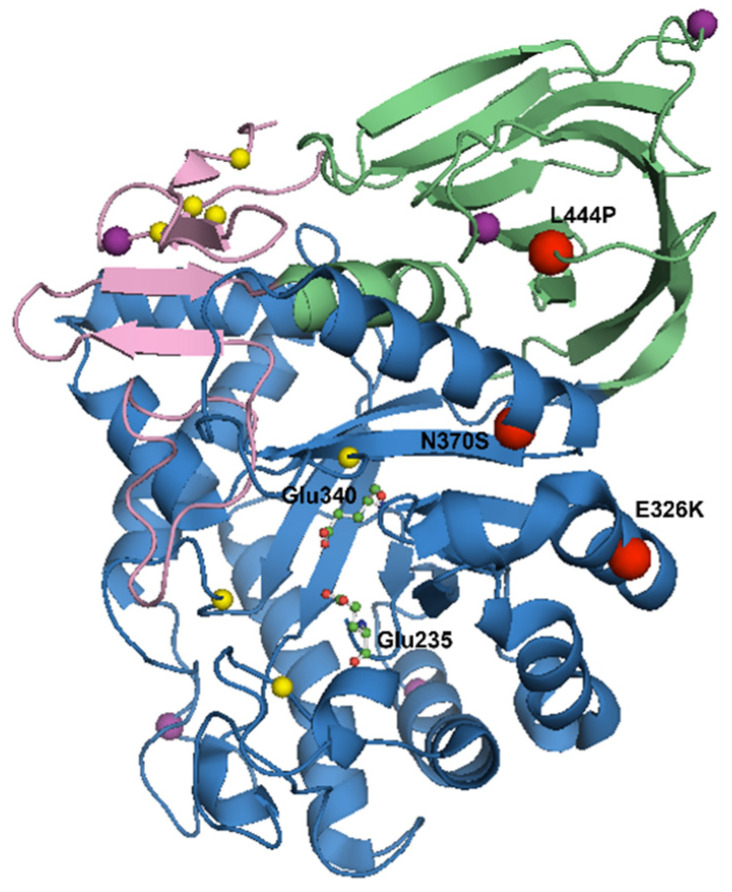
Figure 1
Figure 1
Crystal structure of glucocerebrosidase at pH 5.5 (PDB code 3GXI). Domain I is shown in pink. Domain II is shown in green. Domain III is shown in blue. The active site catalytic residues Glu 235 and Glu 340 are shown as ball-and-stick models. The five N-linked glycosylation sites (Asn 19, Asn 59, Asn 146, Asn 270 and Asn 462) are shown as purple spheres. The free cysteine residues are shown as yellow spheres. The three most common GBA mutations, L444P, N370S and E326K, are labelled as red spheres. Figure created using The PyMOL Molecular Graphics System, Version 1.2r3pre, Schrödinger, LLC .
Figure 2
Figure 2
Possible mechanisms underlying the link between GCase, alpha-synuclein and PD. (A) GBA mutations result in misfolded GCase protein, which is retained in the ER, not trafficked to the lysosome, and activates ER stress pathways such as the UPR. (B) Reduced GCase in the lysosome results in lysosomal dysfunction and subsequent impairment of the autophagic-lysosomal pathway. This leads to the accumulation of lipid substrates, GlcCer and GlcSph, and alpha-synuclein. This accumulation can block the trafficking of newly synthesised GCase from the ER/Golgi to the lysosome and further exacerbates lysosomal dysfunction. Impaired degradation of alpha-synuclein through defective lysosomal and autophagic machinery can also lead to an increase in the exosome-mediated release of alpha-synuclein. This mechanism allows alpha-synuclein pathology to propagate through the brain. (C) A deficiency in GCase activity at the lysosome can lead to the accumulation of glycosphingolipids, as well as other lipid forms. Aberrant lipid accumulation can affect lipid membrane composition and may enhance the aggregation of alpha-synuclein. (D) Defective clearance of mitochondria may occur as a consequence of a GCase deficiency and reduced ALP function. This can lead to the accumulation of defective mitochondria. A GCase deficiency has also been associated with oxidative stress, reduced ATP production and abnormal mitochondrial morphology. (E) A GCase deficiency has been linked to neuroinflammation. An accumulation of lipids or alpha-synuclein may activate microglia. Alpha-synuclein released into the extracellular space may also directly bind and active microglia. Created with BioRender.com (accessed on 4 March 2022).

References

    1. Braak H. Neuropathological Staging of Brain Pathology in Sporadic Parkinson’s disease: Separating the Wheat from the Chaff. J. Park. Dis. 2017;7:S71–S85. doi: 10.3233/JPD-179001. - DOI - PMC - PubMed
    1. Turpin J.C., Dubois G., Brice A., Masson M., Nadaud M.C., Boutry J.M., Schram A.W., Tager J.M., Baumann N. Parkinsonian Symptomatology in a Patient with Type I (Adult) Gaucher’s Disease. Springer US; Boston, MA, USA: 1988. pp. 103–105.
    1. McKeran R.O., Bradbury P., Taylor D., Stern G. Neurological involvement in type 1 (adult) Gaucher’s disease. J. Neurol. Neurosurg. Psychiatry. 1985;48:172–175. doi: 10.1136/jnnp.48.2.172. - DOI - PMC - PubMed
    1. Sidransky E., Lopez G. The link between the GBA gene and parkinsonism. Lancet Neurol. 2012;11:986–998. doi: 10.1016/S1474-4422(12)70190-4. - DOI - PMC - PubMed
    1. Bultron G., Kacena K., Pearson D., Boxer M., Yang R., Sathe S., Pastores G., Mistry P.K. The risk of Parkinson’s disease in type 1 Gaucher disease. J. Inherit. Metab. Dis. 2010;33:167–173. doi: 10.1007/s10545-010-9055-0. - DOI - PMC - PubMed

Publication types

MeSH terms
