Review
. 2022 Apr 14;11(8):1338.
doi: 10.3390/cells11081338.

Ibrutinib in the Treatment of Solid Tumors: Current State of Knowledge and Future Directions

Affiliations
Review

Ibrutinib in the Treatment of Solid Tumors: Current State of Knowledge and Future Directions

Katarzyna Szklener et al. Cells. .

Abstract

Bruton's Tyrosine Kinase (BTK) is considered crucial in the activation and survival of both physiological and malignant B-cells. In recent years, ibrutinib, an oral BTK inhibitor, became a breakthrough therapy for hematological malignancies, such as chronic lymphocytic. However, ibrutinib's feasibility might not end there. Several other kinases with established involvement with solid malignancies (i.e., EGFR, HER2) have been found to be inhibited by this agent. Recent discoveries indicate that BTK is a potential anti-solid tumor therapy target. Consequently, ibrutinib, a BTK-inhibitor, has been studied as a therapeutic option in solid malignancies. While most preclinical studies indicate ibrutinib to be an effective therapeutic option in some specific indications, such as NSCLC and breast cancer, clinical trials contradict these observations. Nevertheless, while ibrutinib failed as a monotherapy, it might become an interesting part of a multidrug regime: not only has a synergism between ibrutinib and other compounds, such as trametinib or dactolisib, been observed in vitro, but this BTK inhibitor has also been established as a radio- and chemosensitizer. This review aims to describe the milestones in translating BTK inhibitors to solid tumors in order to understand the future potential of this agent better.

Keywords: BTK inhibitor; Bruton’s tyrosine kinase; cancer; ibrutinib; solid tumor.


Conflict of interest statement

The authors declare no conflict of interest.

Figures
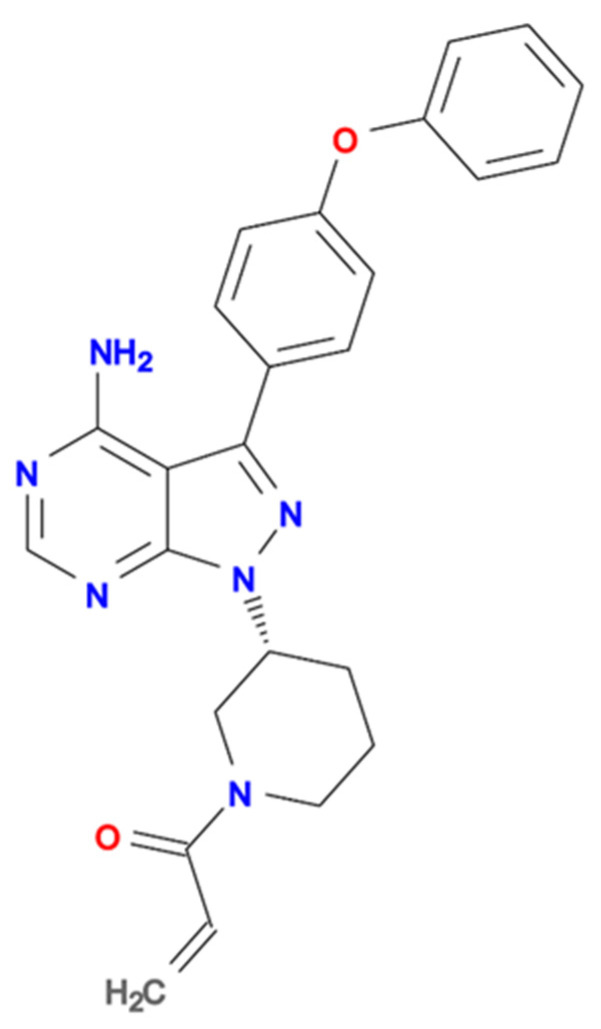
Figure 1
Figure 1
Ibrutinib; orally bioavailable, irreversible inhibitor of Bruton’s Tyrosine Kinase; molecular formula C25H24N6O2; chemical name 1-[(3R)-3-[4-amino-3-(4-phenoxyphenyl)pyrazolo[3,4-d]pyrimidin-1-yl]piperidin-1-yl]prop-2-en-1-one; molecular weight-440.50 Da [10,11].
Figure 2
Figure 2
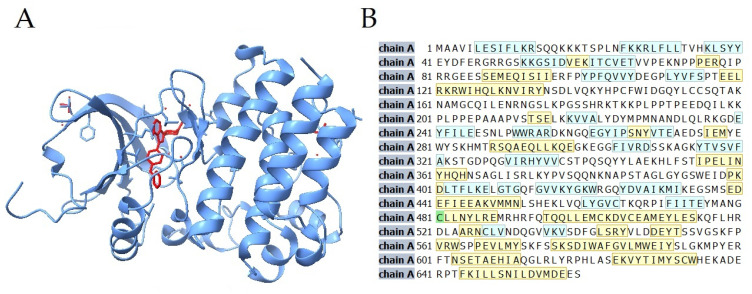
(A) Molecular structure of ibrutinib binding Bruton’s Tyrosine Kinase. Shown in color red is ibrutinib; blue represents the kinase [51,52,53]; (B) Sequence of Bruton’s Tyrosine Kinase. BTK is a 659 amino-acid protein. Ibrutinib inhibits BTK by irreversibly binding to cysteine-481, which is marked with the color green. Structure strands are marked with the color blue; structure helices are marked with the color yellow [54,55,56].
Figure 3
Figure 3
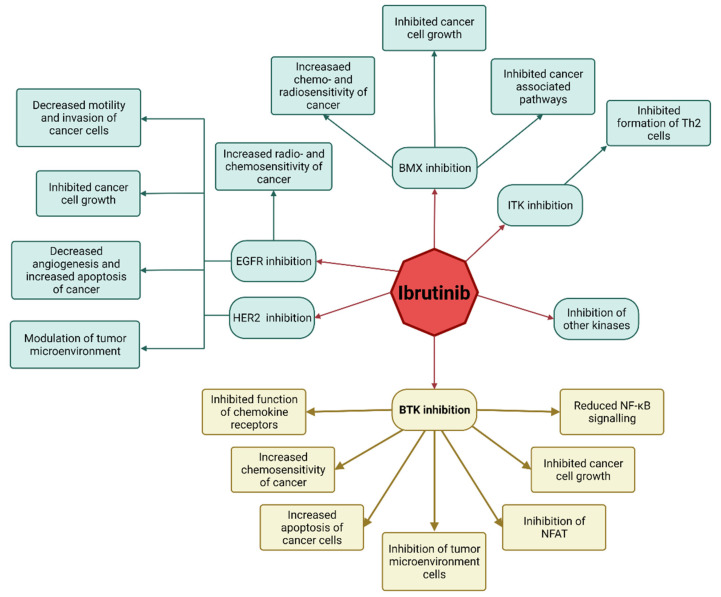
Ibrutinib as an anti-solid tumor drug. Ibrutinib exerts its action as an anti-solid tumor drug through its ability to inhibit both BTK and other cancer-associated kinases. In this figure, we focus on the kinases most relevant to the subject of this study: BMX, ITK, EGFR and HER2. BTK inhibition results in reduced NF-κB signaling, decreasing the promotion and progression of cancer cells and a reduced function of CXCR4 and CXCR5, leading to reduced cancer’s ability to induce metastases and evade host immunity, decreased cancer cell growth, increased apoptosis and chemosensitivity of cancer cells through the inhibition of novel, oncogenic isoform of BTK present on the cancer cells. The inhibition of BTK expressing tumor microenvironment cells (MDSC, mast cells and monocytes) results in the decreased survival of cancer cells. Through the inhibition of ITK, it causes a limited activation of Th2 cells, subsequently increasing the number of anti-cancer Th1 cells due to their expression of RLK, which is not expressed on Th2 cells [62,63]. The inhibition of BMX has been discovered to sensitize cancer to doxorubicin as well as chemo- and radiotherapy in prostate cancer; BMX-inhibition has been discovered to inhibit cancer cell growth in glioblastoma and to downregulate the activation of PI3K/Akt, STAT and NF-κB pathways [78]. Ibrutinib joins Cys797 residue of EGFR, thus inhibiting it, while HER2 inhibition occurs due to the key role of BTK in the AKT-ERK intracellular signaling. As a result, inhibition of EGFR and HER2 causes decreased angiogenesis, motility, invasion, and growth of cancer, while EGFR inhibition additionally increases the s radio- and chemosensitivity of cancer [48]. BTK, Bruton’s tyrosine kinase; EGFR, epidermal growth factor receptor; HER2, human epidermal growth factor receptor 2; ITK, Interleukin-2-inducible T-cell Kinase; JAK3, Janus kinase 3; NF-κB, nuclear factor kappa-light-chain-enhancer of activated B-cells; NFAT, nuclear factor of activated T-cells.

References

    1. Bray F., Ferlay J., Soerjomataram I., Siegel R.L., Torre L.A., Jemal A. Global Cancer Statistics 2018: GLOBOCAN Estimates of Incidence and Mortality Worldwide for 36 Cancers in 185 Countries. CA Cancer J. Clin. 2018;68:394–424. doi: 10.3322/caac.21492. - DOI - PubMed
    1. Roth G.A., Abate D., Abate K.H., Abay S.M., Abbafati C., Abbasi N., Abbastabar H., Abd-Allah F., Abdela J., Abdelalim A., et al. Global, Regional, and National Age-Sex-Specific Mortality for 282 Causes of Death in 195 Countries and Territories, 1980–2017: A Systematic Analysis for the Global Burden of Disease Study 2017. Lancet. 2018;392:1736–1788. doi: 10.1016/S0140-6736(18)32203-7. - DOI - PMC - PubMed
    1. Sung H., Ferlay J., Siegel R.L., Laversanne M., Soerjomataram I., Jemal A., Bray F. Global Cancer Statistics 2020: GLOBOCAN Estimates of Incidence and Mortality Worldwide for 36 Cancers in 185 Countries. CA Cancer J. Clin. 2021;71:209–249. doi: 10.3322/caac.21660. - DOI - PubMed
    1. Omran A.R. The Epidemiologic Transition: A Theory of the Epidemiology of Population Change. Milbank Mem. Fund Q. 1971;49:509. doi: 10.2307/3349375. - DOI - PubMed
    1. Schwarzbich M.-A., Witzens-Harig M. Ibrutinib. In: Martens U.M., editor. Small Molecules in Oncology. Volume 201. Springer; Berlin/Heidelberg, Germany: 2014. pp. 259–267. Recent Results in Cancer Research.

Publication types