. 2022 Apr 17;13(4):707.
doi: 10.3390/genes13040707.

A target Capture Probe Set Useful for Deep- and Shallow-Level Phylogenetic Studies in Cactaceae

Affiliations

A target Capture Probe Set Useful for Deep- and Shallow-Level Phylogenetic Studies in Cactaceae

Monique Romeiro-Brito et al. Genes (Basel). .

Abstract

The molecular phylogenies of Cactaceae have enabled us to better understand their systematics, biogeography, and diversification ages. However, most of the phylogenetic relationships within Cactaceae major groups remain unclear, largely due to the lack of an appropriate set of molecular markers to resolve its contentious relationships. Here, we explored the genome and transcriptome assemblies available for Cactaceae and identified putative orthologous regions shared among lineages of the subfamily Cactoideae. Then we developed a probe set, named Cactaceae591, targeting both coding and noncoding nuclear regions for representatives from the subfamilies Pereskioideae, Opuntioideae, and Cactoideae. We also sampled inter- and intraspecific variation to evaluate the potential of this panel to be used in phylogeographic studies. We retrieved on average of 547 orthologous regions per sample. Targeting noncoding nuclear regions showed to be crucial to resolving inter- and intraspecific relationships. Cactaceae591 covers 13 orthologous genes shared with the Angiosperms353 kit and two plastid regions largely used in Cactaceae studies, enabling the phylogenies generated by our panel to be integrated with angiosperm and Cactaceae phylogenies, using these sequences. We highlighted the importance of using coalescent-based species tree approaches on the Cactaceae591 dataset to infer accurate phylogenetic trees in the presence of extensive incomplete lineage sorting in this family.

Keywords: cacti; coalescent inference; phylogenomics; rapid radiation; target capture sequencing.


Conflict of interest statement

The authors declare no conflict of interest.

Figures
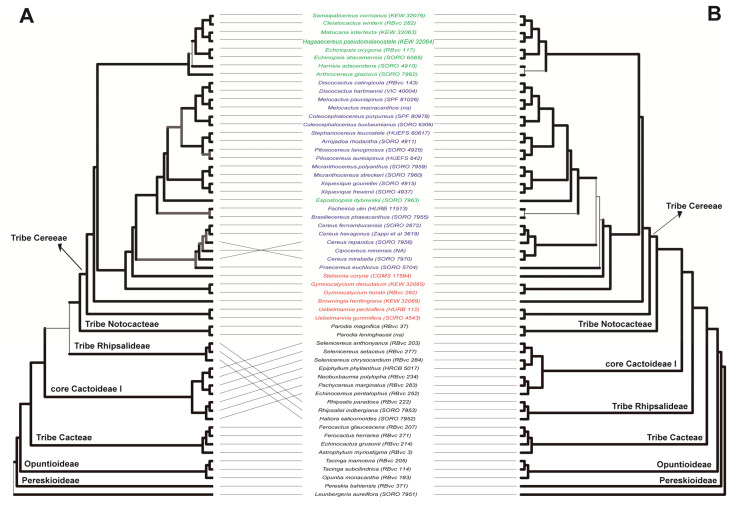
Figure 1
Figure 1
Comparison of coalescent-based species trees of Cactaceae estimated with Cactaceae-coding (A) and Cactaceae-all (B) sub-datasets. Cactaceae-coding and Cactaceae-all sub-datasets included 290 and 512 nuclear regions, respectively. The branches with high support (LPP > 0.95) are colored with thick dark lines, the branches with moderate support (LPP 0.95–0.70) are colored with thick gray lines, and the branches with low support (LPP < 0.70) are shown as thin light lines. Voucher number of each accession is provided in parenthesis after species names. Species from the subtribes Rebutinae, Trichocereinae, and Cereinae are colored red, green, and blue, respectively (sensu Nyffeler and Eggli [48]). LPP: local posterior probability.
Figure 2
Figure 2
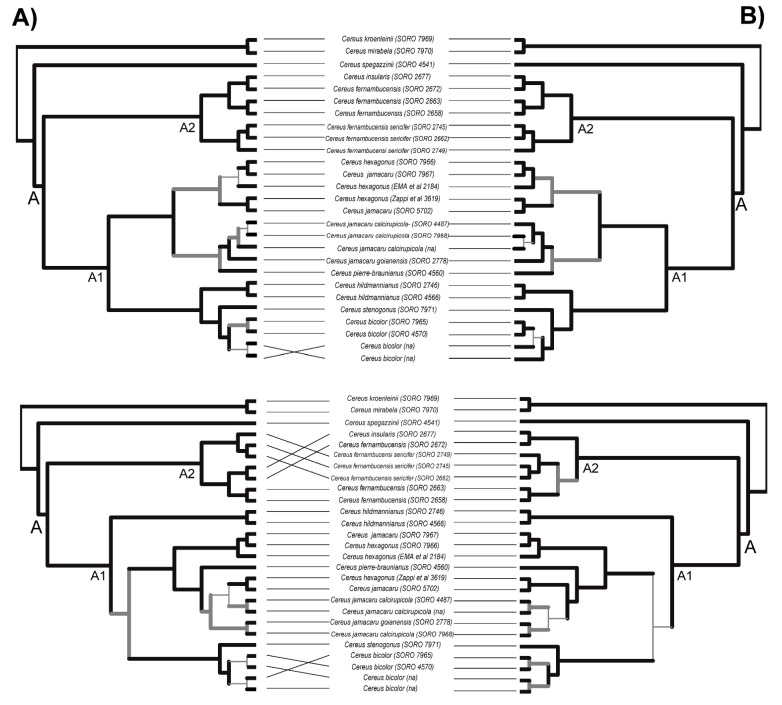
Comparison of phylogenies of Cereus clade A inferred with Cereus-noncoding (A) and Cereus-all (B) sub-datasets, using coalescent-based (upper) and ML concatenated (down) approaches. The branches with high support (LPP > 0.95 and BS > 95) are highlighted with thick branch lines, the branches with moderate support (LPP 0.95–0.70 and BS 95–70) are colored with thick gray lines, and the branches with low support (LPP < 0.70 and BS < 70) are shown as thin light lines. LPP, local posterior probability; BS, ultrafast bootstrap. Voucher number of each accession is provided in parenthesis after species names.

References

    1. Guerrero P., Majure L.C., Cornejo-Romero A., Hernández-Hernández T. Phylogenetic Relationships and Evolutionary Trends in the Cactus Family. J. Hered. 2018;110:4–21. doi: 10.1093/jhered/esy064. - DOI - PubMed
    1. Franco F.F., Amaral D.T., Bonatelli I.A.S., Romeiro-Brito M., Telhe M.C., Moraes E.M. Evolutionary Genetics of Cacti: Research Biases, Advances and Prospects. Genes. 2022;13:452. doi: 10.3390/genes13030452. - DOI - PMC - PubMed
    1. Ritz C.M., Martins L., Mecklenburg R., Goremykin V., Hellwig F.H. The molecular phylogeny of Rebutia (Cactaceae) and its allies demonstrates the influence of paleogeography on the evolution of South American mountain cacti. Am. J. Bot. 2007;94:1321–1332. doi: 10.3732/ajb.94.8.1321. - DOI - PubMed
    1. Bárcenas R.T., Yesson C., Hawkins J.A. Molecular systematics of the Cactaceae. Cladistics. 2011;27:470–489. doi: 10.1111/j.1096-0031.2011.00350.x. - DOI - PubMed
    1. Hernández-Hernández T., Hernández H.M., De-Nova J.A., Puente R., Eguiarte L.E., Magallón S. Phylogenetic relationships and evolution of growth form in Cactaceae (Caryophyllales; Eudicotyledoneae) Am. J. Bot. 2011;98:44–61. doi: 10.3732/ajb.1000129. - DOI - PubMed

Publication types

LinkOut - more resources