


Dual Responsive poly(vinyl caprolactam)-Based Nanogels for Tunable Intracellular Doxorubicin Delivery in Cancer Cells
- PMID: 35456685
- PMCID: PMC9029372
- DOI: 10.3390/pharmaceutics14040852
Dual Responsive poly(vinyl caprolactam)-Based Nanogels for Tunable Intracellular Doxorubicin Delivery in Cancer Cells
Abstract
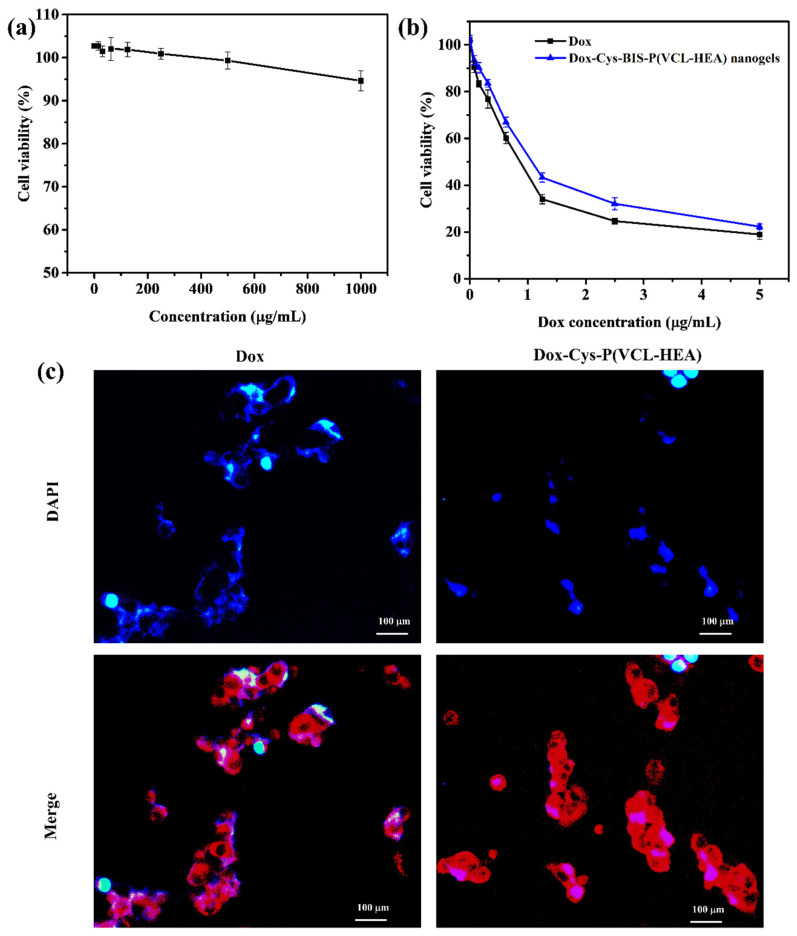
In this work, doxorubicin (Dox)-encapsulated poly(vinyl caprolactam) (PVCL)-based three-dimensional nanogel networks were developed and were crosslinked with disulfide linkages. The nanogels degrade rapidly to low molecular weight chains in the presence of the typical intracellular concentration of glutathione. Doxorubicin (Dox) was successfully encapsulated into these nanogels. The nanogels have a high drug loading of 49% and can be tailored to 182 nm to deliver themselves to the targeted cells and release Dox under dual stimuli conditions, such as redox and temperature. By evaluating cell viability in the HepG2 cell line, we observed that Dox-loaded nanogels effectively killed the cancer cell. Fluorescence microscopy results show that the nanogels could easily be internalized with HepG2 cells. The results confirm that the nanogels destabilized in intracellular cytosol via degradation of disulfide bonds in nanogels networks and release of the Dox nearby the nucleus. These carriers could be promising for cancer drug delivery.
Keywords: cancer cells; drug release; dual responsive; intracellular triggered; nanogels; poly(vinyl caprolactam).
Conflict of interest statement
The authors declare no conflict of interest.
Figures
References
-
- Fucic A., Gamulin M., Ferencic Z., Katic J., Krayer von Krauss M., Bartonova A., Merlo D.F. Environmental exposure to xenoestrogens and oestrogen related cancers: Reproductive system, breast, lung, kidney, pancreas, and brain. J. Environ. Health. 2012;11:S8. doi: 10.1186/1476-069X-11-S1-S8. - DOI - PMC - PubMed
-
- Adam R., Delvart V., Pascal G., Valeanu A., Castaing D., Azoulay D., Giacchetti S., Paule B., Kunstlinger F., Ghémard O., et al. Rescue surgery for unresectable colorectal liver metastases downstaged by chemotherapy: A model to predict long-term survival. Ann. Surg. 2004;240:644–657. doi: 10.1097/01.sla.0000141198.92114.f6. - DOI - PMC - PubMed
Grants and funding
LinkOut - more resources
Full Text Sources
