


Colonization of Dogs and Their Owners with Staphylococcus aureus and Staphylococcus pseudintermedius in Households, Veterinary Practices, and Healthcare Facilities
- PMID: 35456729
- PMCID: PMC9024920
- DOI: 10.3390/microorganisms10040677
Colonization of Dogs and Their Owners with Staphylococcus aureus and Staphylococcus pseudintermedius in Households, Veterinary Practices, and Healthcare Facilities
Abstract
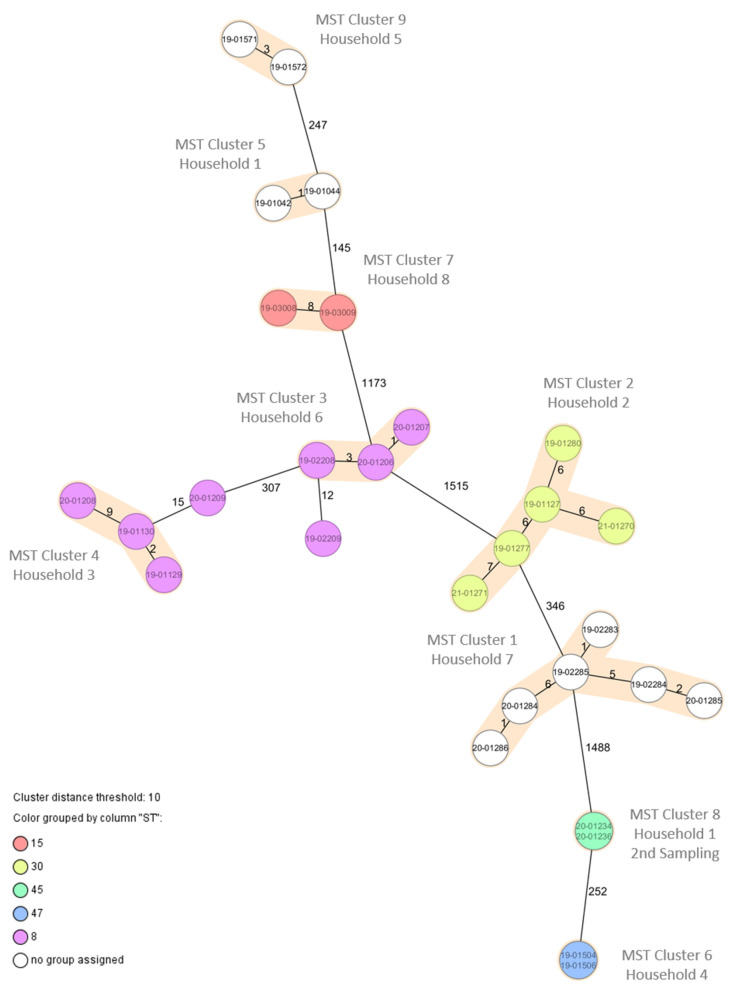
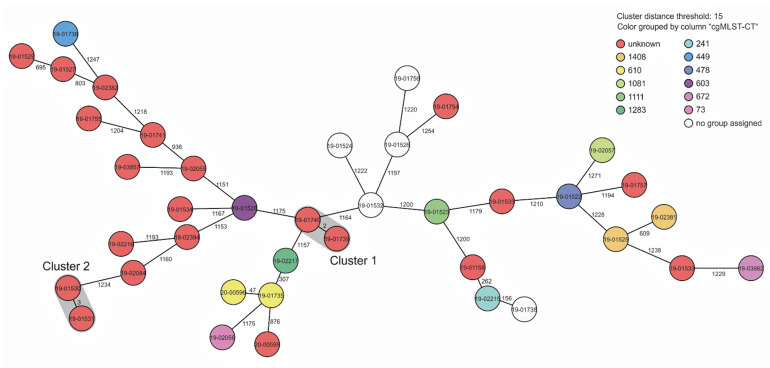
There are uncertainties with respect to the transmission of methicillin-susceptible and methicillin-resistant Staphylococcus aureus (MSSA and MRSA) and Staphylococcus pseudintermedius between dogs and humans. In this study, we investigated concomitant nasal colonization of dogs and humans in three cohorts. Cohort I, households owning dogs: In 42 of 84 households, 66 humans (36.9%) and 10 dogs (8.9%) carried S. aureus. MRSA, attributed to sequence type (ST) 22 and ST130, were detected in two (1.1%) of the humans but in none of the dogs. Typing by means of spa-typing and whole-genome sequencing (WGS) indicated eight transmissions of S. aureus between humans and dogs in 8 of 42 (19.0%) households with human S. aureus carriers, whereas in 11 of 38 (29.0%) households with ≥two persons and S. aureus colonization of humans, 15 human-to-human transmissions were observed (p = 0.43). S. pseudintermedius was isolated from 42 dogs (37.5%), but from only one human (0.6%). In this case, WGS-based typing indicated strong relatedness of this isolate with a canine isolate from the same household. Cohort II, dogs and their owners visiting a veterinary practice: Among 17 humans and 17 dogs attending a veterinary practice, MSSA was detected in three humans and two dogs, and S. pseudintermedius in only six dogs. Cohort III, dogs used for animal-assisted interventions in human healthcare facilities and their owners: MSSA was obtained in 1 of 59 dogs (1.7%) and in 17 of 60 (28.3%) of the dog owners, while S. pseudintermedius was isolated from seven (12%) dogs and one (1.7%) human owner. We conclude that the risk of exchanging S. aureus/MRSA between humans and dogs is higher than that for S. pseudintermedius.
Keywords: dogs; household contacts; humans; transmission of Staphylococcus aureus; zoonosis.
Conflict of interest statement
The authors declare no conflict of interest to disclose for this manuscript.
Figures
References
-
- Mehraj J., Witte W., Akmatov M.K., Layer F., Werner G., Krause G. Epidemiology of Staphylococcus aureus nasal carriage patterns in the community. Curr. Top. Microbiol. Immunol. 2016;398:55–87. - PubMed
Grants and funding
LinkOut - more resources
Full Text Sources
