. 2022 Apr 14;19(8):4726.
doi: 10.3390/ijerph19084726.

Trends in the Prevalence of Cardiometabolic Multimorbidity in the United States, 1999-2018

Affiliations

Trends in the Prevalence of Cardiometabolic Multimorbidity in the United States, 1999-2018

Xunjie Cheng et al. Int J Environ Res Public Health. .

Abstract

Cardiometabolic multimorbidity (co-existence of ≥1 cardiometabolic diseases) is increasingly common, while its prevalence in the U.S. is unknown. We utilized data from 10 National Health and Nutrition Examination Survey (NHANES) two-year cycles in U.S. adults from 1999 to 2018. We reported the age-standardized prevalence of cardiometabolic multimorbidity in 2017-2018 and analyzed their trends during 1999-2018 with joinpoint regression models. Stratified analyses were performed according to gender, age, and race/ethnicity. In 2017-2018, the prevalence of cardiometabolic multimorbidity was 14.4% in the U.S., and it was higher among male, older, and non-Hispanic Black people. The three most common patterns were hypertension and diabetes (7.5%); hypertension, diabetes, and CHD (2.2%); and hypertension and CHD (1.8%). During 1999-2018, the prevalence of cardiometabolic multimorbidity in U.S. adults increased significantly, with an averaged two-year cycle percentage change (AAPC) of 3.6 (95% CI: 2.1 to 5.3). The increasing trend was significant for both genders, most age groups except for 60-79 years, and non-Hispanic White people. For common patterns, the trend was increasing for hypertension and diabetes and hypertension, diabetes, and CHD, while it was decreasing for hypertension and CHD. Our findings provide evidence that cardiometabolic multimorbidity has risen as an austere issue of public health in the U.S.

Keywords: NHANES; cardiometabolic disease; epidemiology; multimorbidity.


Conflict of interest statement

The authors declare no conflict of interest.

Figures
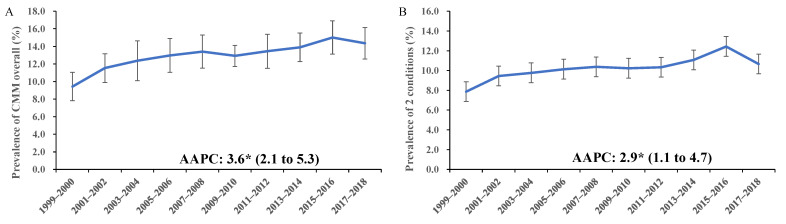
Figure 1
Figure 1
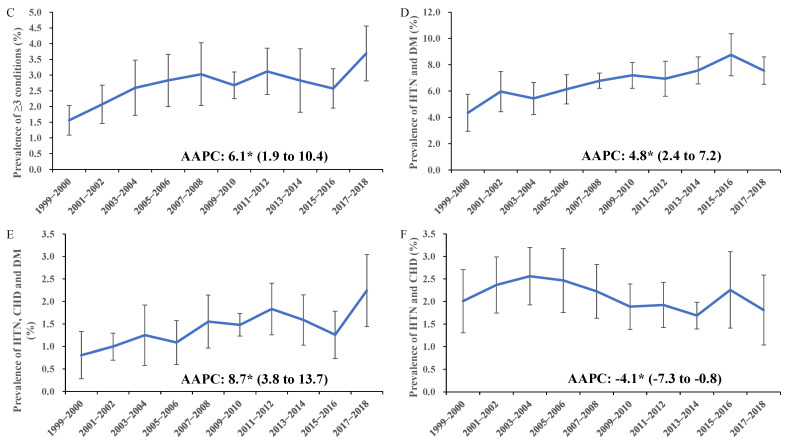
Trends in the age-adjusted prevalence of cardiometabolic multimorbidity and specific patterns among U.S. adults, 1999–2018. Notes: The AAPC was derived from joinpoint regression models to assess the averaged trends in the prevalence of comorbidity. Panel (A): For CMM overall; Panel (B): For two concurrent cardiometabolic diseases; Panel (C): For ≥three concurrent cardiometabolic diseases; Panel (D): For CMM pattern, HTN, and DM; Panel (E): For CMM pattern, HTN, CHD, and DM; Panel (F): For CMM pattern, HTN, and CHD. CMM, cardiometabolic multimorbidity; HTN, hypertension; DM, diabetes mellitus; CHD, coronary heart disease; AAPC, averaged two-year cycle percentage change. * p for trend <0.05.
Figure 1
Figure 1
Trends in the age-adjusted prevalence of cardiometabolic multimorbidity and specific patterns among U.S. adults, 1999–2018. Notes: The AAPC was derived from joinpoint regression models to assess the averaged trends in the prevalence of comorbidity. Panel (A): For CMM overall; Panel (B): For two concurrent cardiometabolic diseases; Panel (C): For ≥three concurrent cardiometabolic diseases; Panel (D): For CMM pattern, HTN, and DM; Panel (E): For CMM pattern, HTN, CHD, and DM; Panel (F): For CMM pattern, HTN, and CHD. CMM, cardiometabolic multimorbidity; HTN, hypertension; DM, diabetes mellitus; CHD, coronary heart disease; AAPC, averaged two-year cycle percentage change. * p for trend <0.05.
Figure 2
Figure 2
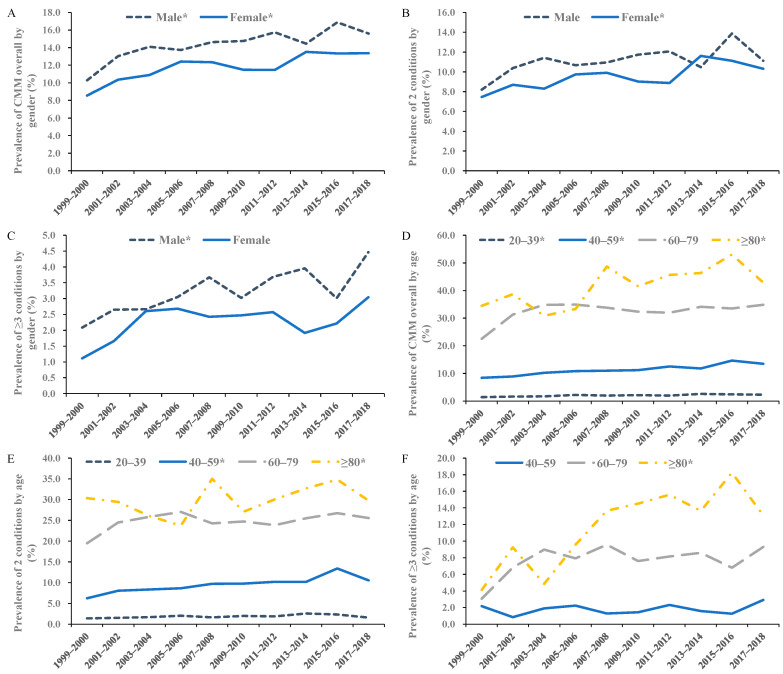
Trends in the age-adjusted prevalence of cardiometabolic multimorbidity by gender and age among U.S. adults, 1999–2018. Notes: The averaged trends were estimated with AAPC derived from joinpoint regression models. Panel (A): For CMM overall by gender; Panel (B): For concurrent two cardiometabolic diseases by gender; Panel (C): For ≥three concurrent cardiometabolic diseases by gender; Panel (D): For CMM overall by age; Panel (E): For two concurrent cardiometabolic diseases by age; Panel (F): For ≥three concurrent cardiometabolic diseases by age. The prevalence of 20–39 years subgroup for ≥three conditions during 1999–2018 was too low to be estimated, which hindered the estimation of AAPC with joinpoint regression models, so the related trend is not shown in the figure. CMM, cardiometabolic multimorbidity; AAPC, averaged two-year cycle percentage change. * p for trend <0.05.
Figure 3
Figure 3
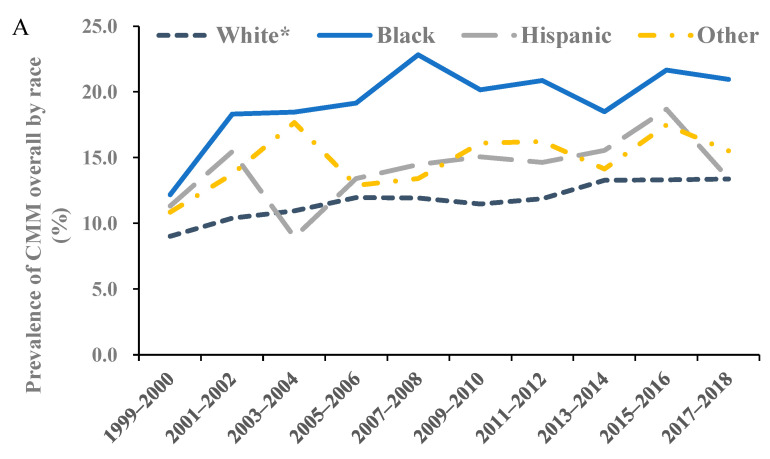
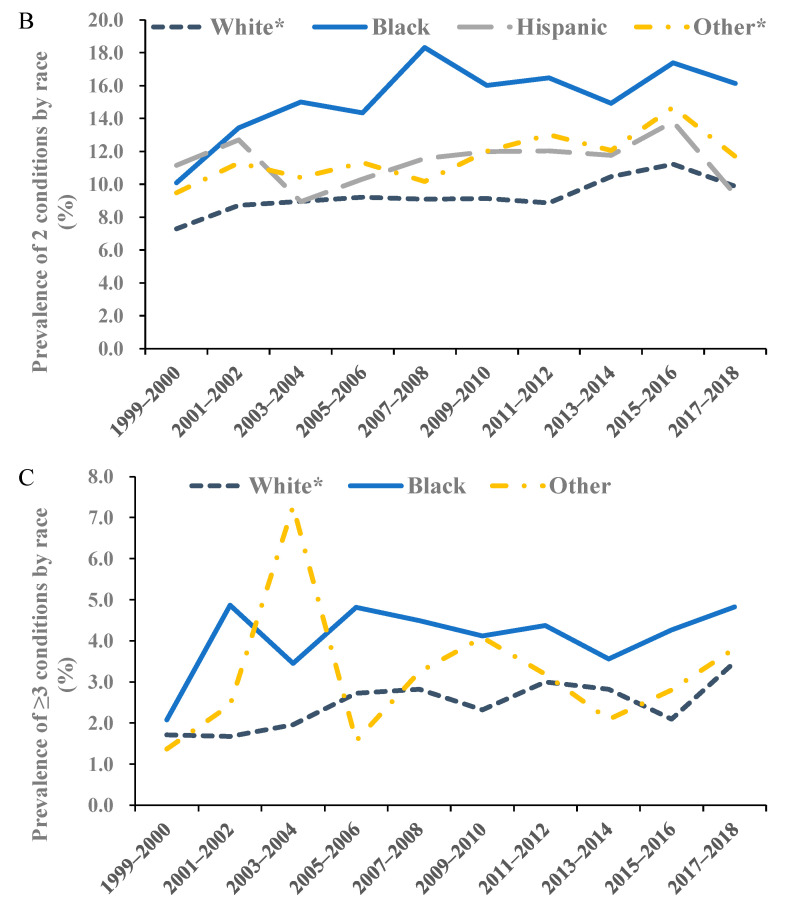
Trends in the age-adjusted prevalence of cardiometabolic multimorbidity by race/ethnicity among U.S. adults, 1999–2018. Notes: The averaged trends were estimated with AAPC derived from joinpoint regression models. Panel (A): For CMM overall by race/ethnicity; Panel (B): For two concurrent cardiometabolic diseases by race/ethnicity; Panel (C): For ≥three concurrent cardiometabolic diseases by race/ethnicity. The prevalence of Hispanic subgroup for ≥three conditions during 1999–2018 was too low to be estimated, which hindered the estimation of AAPC with joinpoint regression models, so the related trend is not shown in the figure. CMM, cardiometabolic multimorbidity; AAPC, averaged two-year cycle percentage change. * p for trend <0.05.
Figure 3
Figure 3
Trends in the age-adjusted prevalence of cardiometabolic multimorbidity by race/ethnicity among U.S. adults, 1999–2018. Notes: The averaged trends were estimated with AAPC derived from joinpoint regression models. Panel (A): For CMM overall by race/ethnicity; Panel (B): For two concurrent cardiometabolic diseases by race/ethnicity; Panel (C): For ≥three concurrent cardiometabolic diseases by race/ethnicity. The prevalence of Hispanic subgroup for ≥three conditions during 1999–2018 was too low to be estimated, which hindered the estimation of AAPC with joinpoint regression models, so the related trend is not shown in the figure. CMM, cardiometabolic multimorbidity; AAPC, averaged two-year cycle percentage change. * p for trend <0.05.

References

    1. Glynn L.G. Multimorbidity: Another key issue for cardiovascular medicine. Lancet. 2009;374:1421–1422. doi: 10.1016/S0140-6736(09)61863-8. - DOI - PubMed
    1. Lyall D.M., Celis-Morales C.A., Anderson J., Gill J.M., Mackay D.F., McIntosh A.M., Smith D.J., Deary I.J., Sattar N., Pell J.P. Associations between single and multiple cardiometabolic diseases and cognitive abilities in 474 129 UK Biobank participants. Eur. Heart J. 2017;38:577–583. doi: 10.1093/eurheartj/ehw528. - DOI - PMC - PubMed
    1. Huang Z.T., Luo Y., Han L., Wang K., Yao S.S., Su H.X., Chen S., Cao G.Y., De Fries C.M., Chen Z.S., et al. Patterns of cardiometabolic multimorbidity and the risk of depressive symptoms in a longitudinal cohort of middle-aged and older Chinese. J. Affect. Disord. 2022;301:1–7. doi: 10.1016/j.jad.2022.01.030. - DOI - PubMed
    1. Maddaloni E., D’Onofrio L., Alessandri F., Mignogna C., Leto G., Pascarella G., Mezzaroma I., Lichtner M., Pozzilli P., Agro F.E., et al. Cardiometabolic multimorbidity is associated with a worse Covid-19 prognosis than individual cardiometabolic risk factors: A multicentre retrospective study (CoViDiab II) Cardiovasc. Diabetol. 2020;19:164. doi: 10.1186/s12933-020-01140-2. - DOI - PMC - PubMed
    1. McQueenie R., Foster H.M.E., Jani B.D., Katikireddi S.V., Sattar N., Pell J.P., Ho F.K., Niedzwiedz C.L., Hastie C.E., Anderson J., et al. Multimorbidity, polypharmacy, and COVID-19 infection within the UK Biobank cohort. PLoS ONE. 2020;15:e0238091. doi: 10.1371/journal.pone.0238091. - DOI - PMC - PubMed

Publication types