


Associations among Caesarean Section Birth, Post-Traumatic Stress, and Postpartum Depression Symptoms
- PMID: 35457767
- PMCID: PMC9025262
- DOI: 10.3390/ijerph19084900
Associations among Caesarean Section Birth, Post-Traumatic Stress, and Postpartum Depression Symptoms
Abstract
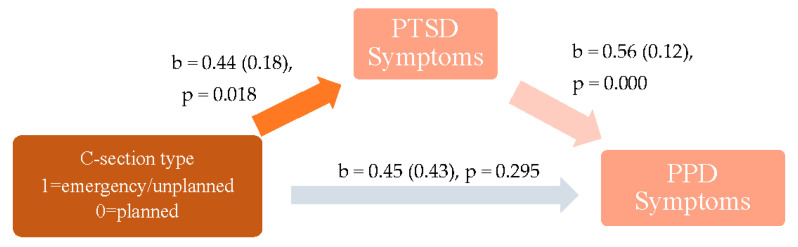
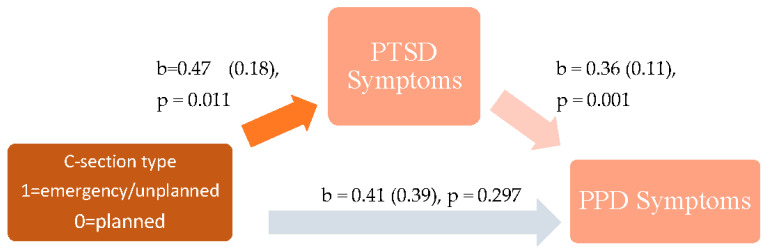
Caesarean section (C-section) deliveries account for nearly 30% of births annually with emergency C-sections accounting for 7-9% of all births. Studies have linked C-sections to postpartum depression (PPD). PPD is linked to reduced quality of parent-child interaction, and adverse effects on maternal and child health. New mothers' perceptions of more negative childbirth experiences, such as unplanned/emergency C-sections, are linked to post-traumatic stress disorder (PTSD), which in turn is related to PPD. Our objectives were to determine: (1) the association between C-section type (unplanned/emergency vs. planned) and PPD symptoms, and (2) if postnatal PTSD symptoms mediate this association. Employing secondary analysis of prospectively collected data from 354 mother-child dyads between 2009 and 2013 from the Alberta Pregnancy Outcomes and Nutrition (APrON) study, conditional process modeling was employed. The Edinburgh Postnatal Depression Scale (EPDS) and the Psychiatric Diagnostic Screening Questionnaire (PDSQ) were administered at three months postpartum, to assess for postpartum depressive and post-traumatic stress symptoms. The direct effect of emergency C-section on PPD symptoms was non-significant in adjusted and non-adjusted models; however, the indirect effect of emergency C-section on PPD symptoms with PTSD symptoms as a mediator was significant after controlling for prenatal depression symptoms, social support, and SES (β = 0.17 (SE = 0.11), 95% CI [0.03, 0.42]). This suggests that mothers who experienced an emergency or unplanned C-section had increased PTSD scores of nearly half a point (0.47) compared to mothers who underwent a planned C-section, even after adjustment. Overall, emergency C-section was indirectly associated with PPD symptoms, through PTSD symptoms. Findings suggest that PTSD symptoms may be a mechanism through which emergency C-sections are associated with the development of PPD symptoms.
Keywords: APrON study; caesarean section; conditional process modeling; maternal mental health; mode of delivery; post-traumatic stress disorder; postpartum depression.
Conflict of interest statement
The authors declare no conflict of interest.
Figures
References
-
- World Health Organization WHO Recommendations Non-Clinic Interventions to Reduce Unnecessary Caesarean Sections. [(accessed on 3 January 2022)]. Available online: https://apps.who.int/iris/bitstream/handle/10665/275377/9789241550338-en....
MeSH terms
Grants and funding
LinkOut - more resources
Full Text Sources
Medical
