


Plant-Based Dietary Patterns for Human and Planetary Health
- PMID: 35458176
- PMCID: PMC9024616
- DOI: 10.3390/nu14081614
Plant-Based Dietary Patterns for Human and Planetary Health
Abstract
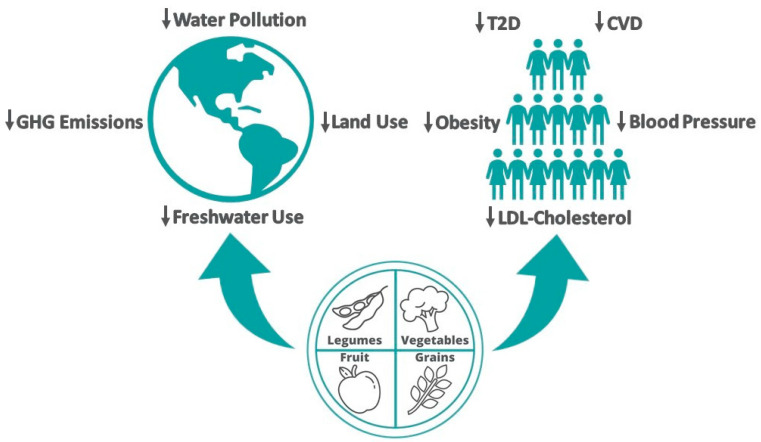
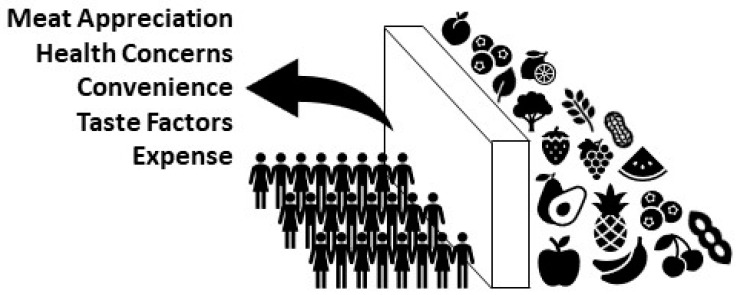
The coronavirus pandemic has acted as a reset on global economies, providing us with the opportunity to build back greener and ensure global warming does not surpass 1.5 °C. It is time for developed nations to commit to red meat reduction targets and shift to plant-based dietary patterns. Transitioning to plant-based diets (PBDs) has the potential to reduce diet-related land use by 76%, diet-related greenhouse gas emissions by 49%, eutrophication by 49%, and green and blue water use by 21% and 14%, respectively, whilst garnering substantial health co-benefits. An extensive body of data from prospective cohort studies and controlled trials supports the implementation of PBDs for obesity and chronic disease prevention. The consumption of diets high in fruits, vegetables, legumes, whole grains, nuts, fish, and unsaturated vegetable oils, and low in animal products, refined grains, and added sugars are associated with a lower risk of all-cause mortality. Meat appreciation, health concerns, convenience, and expense are prominent barriers to PBDs. Strategic policy action is required to overcome these barriers and promote the implementation of healthy and sustainable PBDs.
Keywords: chronic disease prevention; human health; planetary health; plant-based diet; sustainability.
Conflict of interest statement
F.P.C.: Past president, the British and Irish Hypertension Society (2017-9) (unpaid); Member, Action on Salt and World Action on Salt, Sugar and Health (unpaid); Head, World Health Organization (WHO) Collaborating Centre for Nutrition (unpaid); Senior Advisor, WHO (received travel, accommodation, per-diem, refund of expenses); OMRON Academy (received speaker fees, travel, accommodation, expenses); annual royalties from Oxford University Press (OUP) for two books on topics unrelated to salt. J.G. declares no conflict of interest.
Figures
References
-
- Stocker T.F., Qin D., Plattner G.-K., Tignor M., Allen S.K., Boschung J., Nauels A., Xia Y., Bex B., Midgley B.M. IPCC, 2013: Climate Change 2013: The Physical Science Basis. Contribution of Working Group I to the Fifth Assessment Report of the Intergovernmental Panel on Climate Change. Cambridge University Press; Cambridge, UK: New York, NY, USA: 2013.
-
- Horowitz C.A. Paris agreement. Int. Leg. Mater. 2016;55:740–755. doi: 10.1017/S0020782900004253. - DOI
-
- Schwab K., Malleret T. The Great Reset. World Economic Forum; Geneva, Switzerland: 2020.
-
- Johnson B. The Ten Point Plan for a Green Industrial Revolution. H.M. Government; London, UK: 2020.
Publication types
MeSH terms
LinkOut - more resources
Full Text Sources
