


The Extracellular Mass to Body Cell Mass Ratio as a Predictor of Mortality Risk in Hemodialysis Patients
- PMID: 35458220
- PMCID: PMC9029814
- DOI: 10.3390/nu14081659
The Extracellular Mass to Body Cell Mass Ratio as a Predictor of Mortality Risk in Hemodialysis Patients
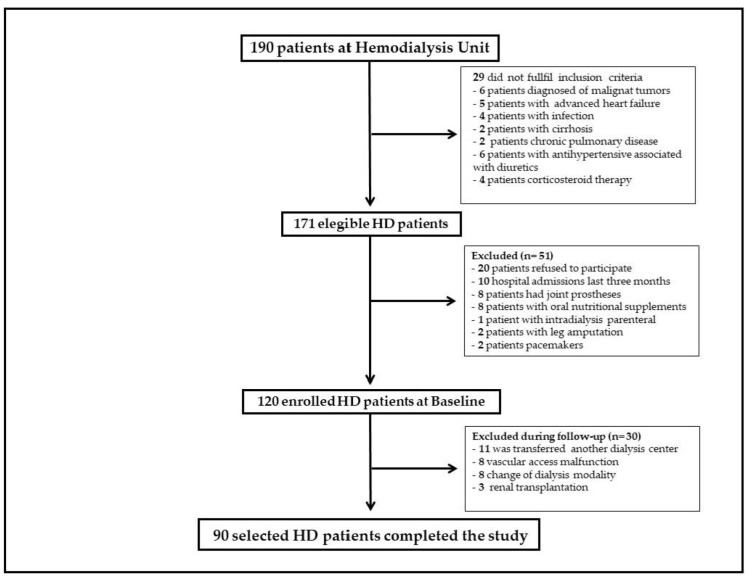
Abstract
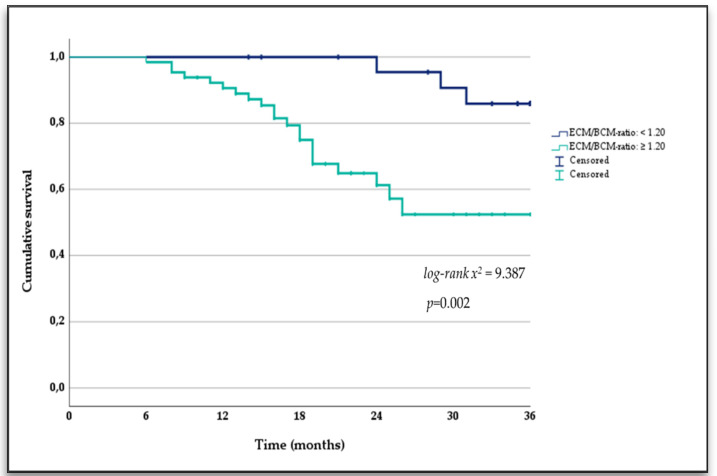
The extracellular mass/body cell mass ratio (ECM/BCM ratio) is a novel indicator of nutritional and hydration status in hemodialysis (HD) patients. This study aimed to explore the ECM/BCM ratio as a predictor of mortality risk with nutritional-inflammatory markers in HD patients. A prospective observational study was conducted in 90 HD patients (male: 52.2%; DM: 25.60%). Clinical and biochemical parameters [serum albumin, serum C-reactive protein (s-CRP), interleukine-6 (IL-6)] were analysed and bioelectrical impedance analysis (BIA) was performed. Protein-energy wasting syndrome (PEW) was diagnosed using malnutrition-inflammation score (MIS). Based on BIA-derived measurements, the ECM/BCM ratio with a cut-off point of 1.20 was used as a PEW-fluid overload indicator. Comorbidity by Charlson index and hospital admissions were measured. Out of 90 HD patients followed up for 36 months, 20 patients (22.22%) died. PEW was observed in 24 survivors (34.28%) and all non-survivors. The ECM/BCM ratio was directly correlated with MIS, s-CRP, Charlson index and hospital admissions but was negatively correlated with phase angle and s-albumin (all, p < 0.001). Values of the ECM/BCM ratio ≥ 1.20 were associated with higher probability of all-cause mortality (p = 0.002). The ECM/BCM ratio ≥ 1.20, IL-6 ≥ 3.1 pg/mL, s-CRP and s-albumin ≥ 3.8 g/dL and Charlson index were significantly associated with all-cause mortality risk in multivariate adjusted analysis. This study demonstrates that the ECM/BCM ratio ≥ 1.20 as a nutritional marker and/or fluid overload indicator had a significant prognostic value of death risk in HD patients.
Keywords: bioelectric impedance analysis; extracellular mass to body cell mass ratio; fluid overload; haemodialysis; interleukine-6; protein-energy wasting.
Conflict of interest statement
The authors declare no conflict of interest.
Figures
References
-
- Alves F.C., Sun J., Qureshi A.R., Dai L., Snaedal S., Barany P., Heimburger O., Lindholm B., Stenvinkel P. The higher mortality associated with low serum albumin is dependent on systemic inflammation in end-stage kidney disease. PLoS ONE. 2018;13:e0190410. doi: 10.1371/journal.pone.0190410. - DOI - PMC - PubMed
-
- Hecking M., Moissl U., Genser B., Rayner H., Dasgupta I., Stuard S., Stopper A., Chazot C., Maddux F.W., Canaud B., et al. Greater fluid overload and lower interdialytic weight gain are independently associated with mortality in a large international hemodialysis population. Nephrol. Dial. Transpl. 2018;33:1832–1842. doi: 10.1093/ndt/gfy083. - DOI - PMC - PubMed
-
- Fouque D., Kalantar-Zadeh K., Kopple J., Cano N., Chauveau P., Cuppari L., Franch H., Guarnieri G., Ikizler T.A., Kaysen G., et al. A proposed nomenclature and diagnostic criteria for protein-energy wasting in acute and chronic kidney disease. Kidney Int. 2008;73:391–398. doi: 10.1038/sj.ki.5002585. - DOI - PubMed
Publication types
MeSH terms
Substances
LinkOut - more resources
Full Text Sources
Medical
Research Materials
Miscellaneous
