Review
. 2022 Mar 28;14(4):702.
doi: 10.3390/v14040702.

RNA Viruses in Aquatic Ecosystems through the Lens of Ecological Genomics and Transcriptomics

Affiliations
Review

RNA Viruses in Aquatic Ecosystems through the Lens of Ecological Genomics and Transcriptomics

Sandra Kolundžija et al. Viruses. .

Abstract

Massive amounts of data from nucleic acid sequencing have changed our perspective about diversity and dynamics of marine viral communities. Here, we summarize recent metatranscriptomic and metaviromic studies targeting predominantly RNA viral communities. The analysis of RNA viromes reaffirms the abundance of lytic (+) ssRNA viruses of the order Picornavirales, but also reveals other (+) ssRNA viruses, including RNA bacteriophages, as important constituents of extracellular RNA viral communities. Sequencing of dsRNA suggests unknown diversity of dsRNA viruses. Environmental metatranscriptomes capture the dynamics of ssDNA, dsDNA, ssRNA, and dsRNA viruses simultaneously, unravelling the full complexity of viral dynamics in the marine environment. RNA viruses are prevalent in large size fractions of environmental metatranscriptomes, actively infect marine unicellular eukaryotes larger than 3 µm, and can outnumber bacteriophages during phytoplankton blooms. DNA and RNA viruses change abundance on hourly timescales, implying viral control on a daily temporal basis. Metatranscriptomes of cultured protists host a diverse community of ssRNA and dsRNA viruses, often with multipartite genomes and possibly persistent intracellular lifestyles. We posit that RNA viral communities might be more diverse and complex than formerly anticipated and that the influence they exert on community composition and global carbon flows in aquatic ecosystems may be underestimated.

Keywords: dsRNA sequencing; marine RNA virus; metaviromics; viral diversity; viral ecology; viral metatranscriptomics.


Conflict of interest statement

The authors declare no competing interests.

Figures
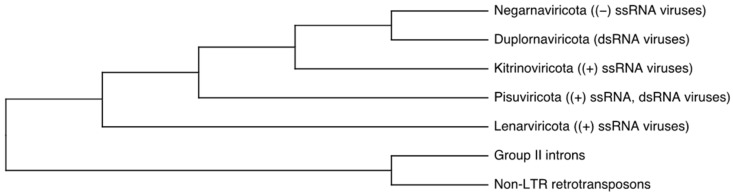
Figure 1
Figure 1
Phylogenetic analysis of RNA-dependent RNA polymerase (RdRp) of RNA viruses with reverse transcriptase (RT) used as an outgroup to root the tree. Five major branches have been assigned a phylum rank by Internationational Committee on Taxonomy of Viruses (ICTV): Branch 1 = Lenarviricota, Branch 2 = Pisuviricota, Branch 3 = Kitrinoviricota, Branch 4 = Duplornaviricota, and Branch 5 = Negarnaviricota. Adapted from [16].
Figure 2
Figure 2
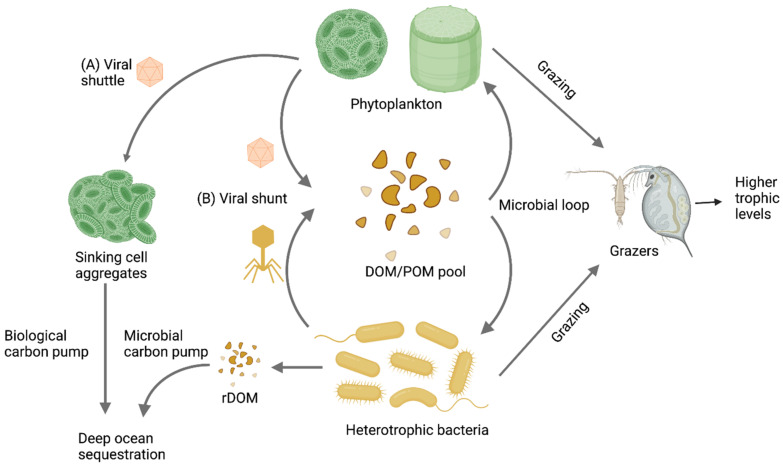
Marine viruses simultaneously control two processes in the carbon cycle: (A) the viral shuttle and (B) the viral shunt. In the viral shuttle, viral lysis of phytoplankton cells produces sticky aggregates with negative buoyancy that enhance the biological carbon pump by sequestrating carbon in the deep ocean. In the viral shunt, viral lysis of cells has the opposite effect—it diverts the organic matter into a dissolved organic matter (DOM) pool that is rapidly and continuously recycled in the surface waters, preventing its sequestration or uptake by higher trophic levels. Adapted from [4]. Created in BioRender.com.
Figure 3
Figure 3
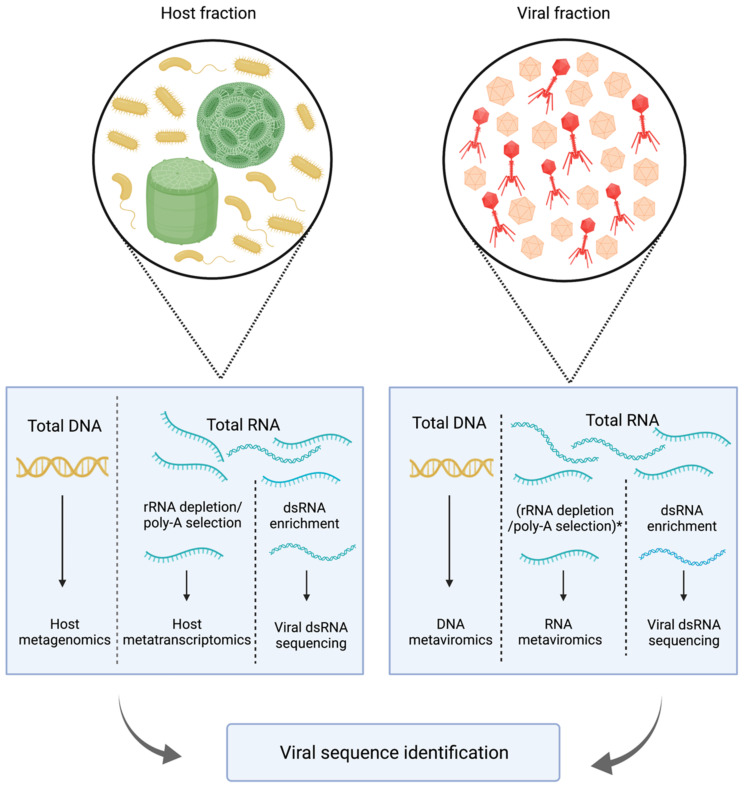
Most commonly used meta-omic sequencing approaches in marine virology. Host fraction (>0.22 µm) metagenomes and metatranscriptomes are mined for viruses, or DNA or RNA is extracted from the enriched viral fraction (<0.22 µm). * rRNA depletion or poly-A selection for RNA in the viral fraction is typically not performed due to low yields. An alternative approach that can enrich for replicative forms of RNA viruses inside the cells or for extracellular dsRNA viruses is dsRNA sequencing. Adapted from [30]. Created with BioRender.com.
Figure 4
Figure 4
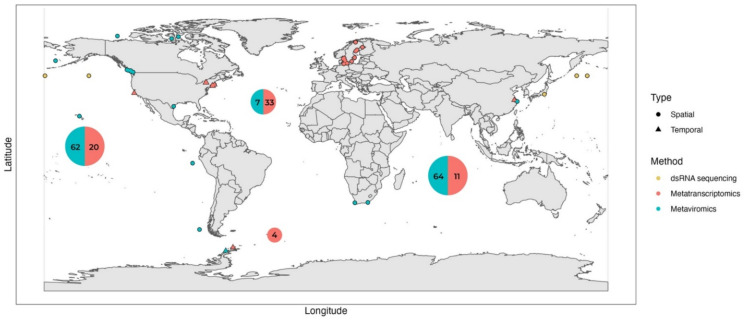
Geographic locations of aquatic metaviromic (blue), metatranscriptomic (coral), and dsRNA sequencing (yellow) studies focusing on RNA viruses reviewed in this paper. Spatially focused studies are represented with circles, and temporally focused studies are represented with triangles. Two global surveys with extensive geographic coverage, Dayang No. 1 cruises and Tara Oceans Expedition [51,57], are represented by large bubbles in each of the five oceans. The size of the bubble is proportional to the total number of samples collected from each ocean, with numbers of benthic virome samples from the Dayang No. 1 cruises [57] indicated in blue, and number of pelagic metatranscriptome samples from the Tara Oceans Expedition [51] in coral. Samples from the Mediterranean Sea were included in the counts of the Atlantic Ocean.

References

    1. Suttle C.A. Marine viruses—Major players in the global ecosystem. Nat. Rev. Microbiol. 2007;5:801–812. doi: 10.1038/nrmicro1750. - DOI - PubMed
    1. Fuhrman J. Marine viruses and their biogeochemical and ecological effects. Nature. 1999;399:541–548. doi: 10.1038/21119. - DOI - PubMed
    1. Weitz J.S., Wilhelm S.W. Ocean viruses and their effects on microbial communities and biogeochemical cycles. F1000 Biol. Rep. 2012;4:2–9. doi: 10.3410/B4-17. - DOI - PMC - PubMed
    1. Zimmerman A.E., Howard-Varona C., Needham D.M., John S.G., Worden A.Z., Waldbauer J.R., Coleman M.L. Metabolic and biogeochemical consequences of viral infection in aquatic ecosystems. Nat. Rev. Microbiol. 2020;18:21–34. doi: 10.1038/s41579-019-0270-x. - DOI - PubMed
    1. Burki F., Roger A.J., Brown M.W., Simpson A.G. The New Tree of Eukaryotes. Trends Ecol. Evol. 2020;35:43–55. doi: 10.1016/j.tree.2019.08.008. - DOI - PubMed

Publication types

Substances

LinkOut - more resources