Review
. 2022 Apr 14;14(4):812.
doi: 10.3390/v14040812.

Tumors and Cytomegalovirus: An Intimate Interplay

Affiliations
Review

Tumors and Cytomegalovirus: An Intimate Interplay

Georges Herbein. Viruses. .

Abstract

Human cytomegalovirus (HCMV) is a herpesvirus that alternates lytic and latent infection, infecting between 40 and 95% of the population worldwide, usually without symptoms. During its lytic cycle, HCMV can result in fever, asthenia, and, in some cases, can lead to severe symptoms such as hepatitis, pneumonitis, meningitis, retinitis, and severe cytomegalovirus disease, especially in immunocompromised individuals. Usually, the host immune response keeps the virus in a latent stage, although HCMV can reactivate in an inflammatory context, which could result in sequential lytic/latent viral cycles during the lifetime and thereby participate in the HCMV genomic diversity in humans and the high level of HCMV intrahost genomic variability. The oncomodulatory role of HCMV has been reported, where the virus will favor the development and spread of cancerous cells. Recently, an oncogenic role of HCMV has been highlighted in which the virus will directly transform primary cells and might therefore be defined as the eighth human oncovirus. In light of these new findings, it is critical to understand the role of the immune landscape, including the tumor microenvironment present in HCMV-harboring tumors. Finally, the oncomodulatory/oncogenic potential of HCMV could lead to the development of novel adapted therapeutic approaches against HCMV, especially since immunotherapy has revolutionized cancer therapeutic strategies and new therapeutic approaches are actively needed, particularly to fight tumors of poor prognosis.

Keywords: HCMV; PGCC; immunotherapy; oncogenesis; oncomodulation; polyploid giant cancer cells.


Conflict of interest statement

The author declares no conflict of interest.

Figures
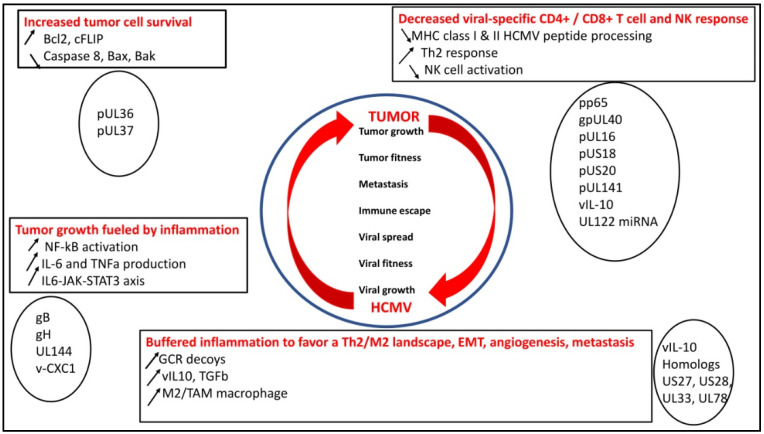
Figure 1
Figure 1
HCMV rewires the immune landscape to favor both HCMV fitness and tumor growth through several mechanisms: increased tumor cell survival, tumor growth fueled by inflammation parallel to the appearance of an M2/Th2 immune landscape, and escape from immune surveillance by decreased specific CD4+/CD8+ T-cell and NK responses.
Figure 2
Figure 2
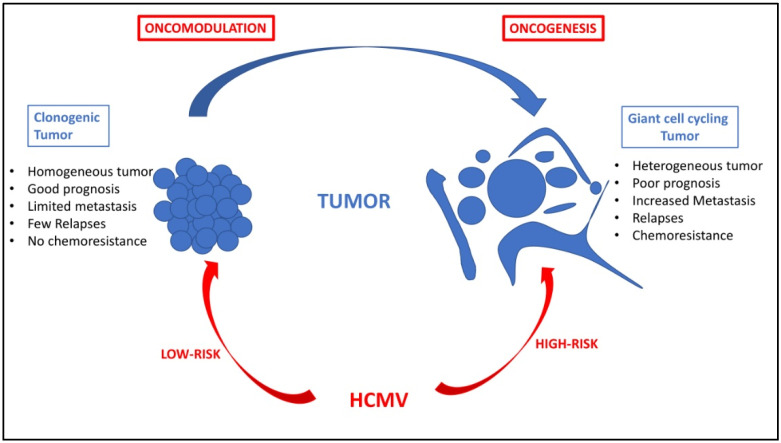
HCMV oncomodulation and oncogenesis: two paradigms for one tumor. Oncomodulation will result from the infection of tumor cells by HCMV strains (named low-risk strains), which will enhance the clonogenic development of the tumor and result in a tumor with quite controlled cell homogeneity, limited metastasis, few relapses, sensitivity to chemotherapy and radiotherapy, and an overall of good prognosis. In contrast, direct oncogenesis will result from the infection of primary cells by HCMV strains (named high-risk strains), which could participate in giant cell cycling with the appearance of polyploid giant cancer cells (PGCCs), in a tumor with highly heterogeneous cancer cells, increased risk of metastasis, more relapses, chemoresistance, and, ultimately, poor prognosis. Of note, the two paradigms, oncomodulation versus oncogenesis, might not be mutually exclusive but could coexist in the same patient depending on the fitness of the HCMV strain, which might vary over time.
Figure 3
Figure 3
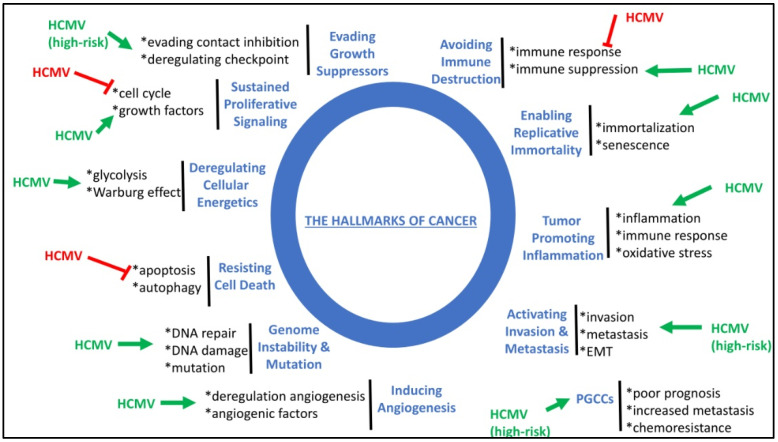
HCMV fulfills all the hallmarks of cancer and thereby could modulate the initiation and development of tumors. HCMV stimulates (green arrow) or blocks (red block) the molecular mechanisms involved in the hallmarks of cancer. The formation of PGCCs could be added as a new hallmark of cancer. High-risk HCMV strains might impact specifically some of the hallmarks of cancer where specified.

References

    1. Solana R., Tarazona R., Aiello A.E., Akbar A.N., Appay V., Beswick M., Bosch J.A., Campos C., Cantisán S., Cicin-Sain L., et al. CMV and Immunosenescence: From Basics to Clinics. Immun. Ageing. 2012;9:23. doi: 10.1186/1742-4933-9-23. - DOI - PMC - PubMed
    1. El Baba R., Herbein G. Immune Landscape of CMV Infection in Cancer Patients: From “Canonical” Diseases toward Virus-Elicited Oncomodulation. Front. Immunol. 2021;12:730765. doi: 10.3389/fimmu.2021.730765. - DOI - PMC - PubMed
    1. Cox M., Kartikasari A.E.R., Gorry P.R., Flanagan K.L., Plebanski M. Potential Impact of Human Cytomegalovirus Infection on Immunity to Ovarian Tumours and Cancer Progression. Biomedicines. 2021;9:351. doi: 10.3390/biomedicines9040351. - DOI - PMC - PubMed
    1. Cinatl J., Scholz M., Doerr H.W. Role of Tumor Cell Immune Escape Mechanisms in Cytomegalovirus-Mediated Oncomodulation. Med. Res. Rev. 2005;25:167–185. doi: 10.1002/med.20018. - DOI - PubMed
    1. Söderberg-Nauclér C., Geisler J., Vetvik K. The Emerging Role of Human Cytomegalovirus Infection in Human Carcinogenesis: A Review of Current Evidence and Potential Therapeutic Implications. Oncotarget. 2019;10:4333–4347. doi: 10.18632/oncotarget.27016. - DOI - PMC - PubMed