. 2022 Apr 11;27(8):2468.
doi: 10.3390/molecules27082468.

Attenuation of Scopolamine-Induced Amnesia via Cholinergic Modulation in Mice by Synthetic Curcumin Analogs

Affiliations

Attenuation of Scopolamine-Induced Amnesia via Cholinergic Modulation in Mice by Synthetic Curcumin Analogs

Haya Hussain et al. Molecules. .

Abstract

Alzheimer’s disease is an emerging health disorder associated with cognitive decline and memory loss. In this study, six curcumin analogs (1a−1f) were synthesized and screened for in vitro cholinesterase inhibitory potential. On the basis of promising results, they were further investigated for in vivo analysis using elevated plus maze (EPM), Y-maze, and novel object recognition (NOR) behavioral models. The binding mode of the synthesized compounds with the active sites of cholinesterases, and the involvement of the cholinergic system in brain hippocampus was determined. The synthesized curcumin analog 1d (p < 0.001, n = 6), and 1c (p < 0.01, n = 6) showed promising results by decreasing retention time in EPM, significantly increasing % SAP in Y-maze, while significantly (p < 0.001) enhancing the % discrimination index (DI) and the time exploring the novel objects in NORT mice behavioral models. A molecular docking study using MOE software was used for validation of the inhibition of cholinesterase(s). It has been indicated from the current research work that the synthesized curcumin analogs enhanced memory functions in mice models and could be used as valuable therapeutic molecules against neurodegenerative disorders. To determine their exact mechanism of action, further studies are suggested.

Keywords: Alzheimer’s disease; EPM; NORT; Y-maze; acetylcholinesterase; amnesia; butyrylcholinesterase; curcumin analogs; docking; hippocampus; scopolamine.


Conflict of interest statement

The authors declare no conflict of interest.

Figures
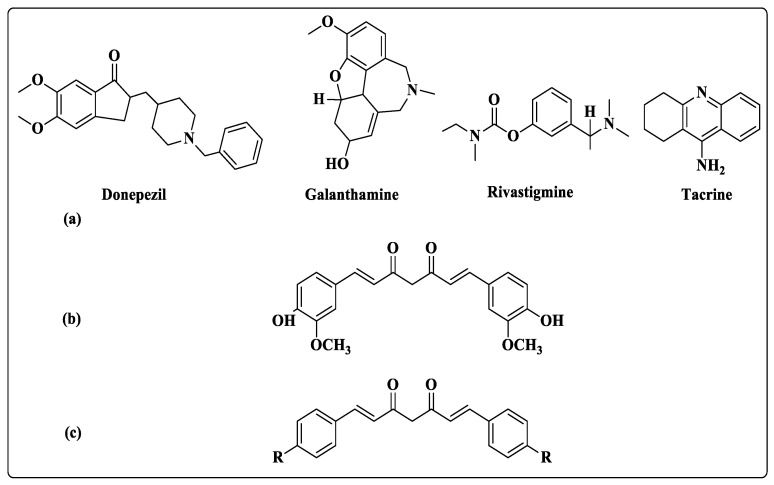
Figure 1
Figure 1
(a) Cholinesterase inhibitors (b) Chemical structure of natural curcumin (c) General structure of curcumin analogs.
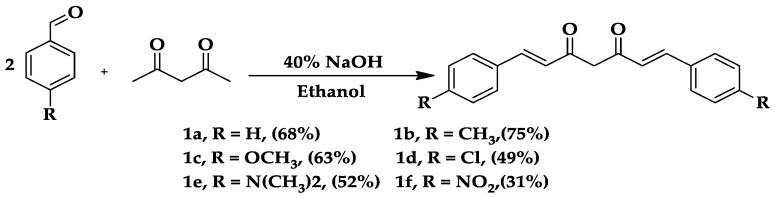
Scheme 1
Scheme 1
Synthesis of curcumin analogs 1a1f.
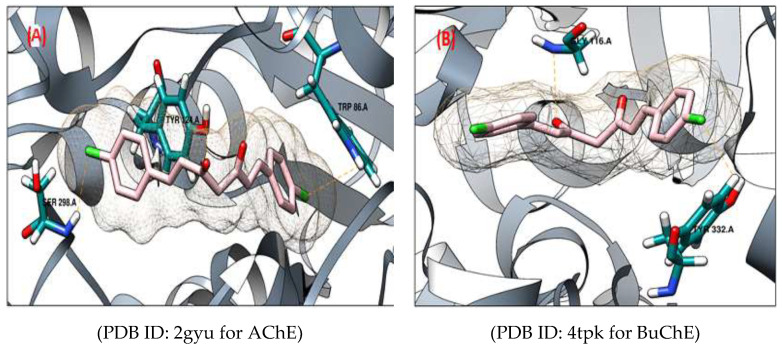
Figure 2
Figure 2
3D binding mode of compound (1d) against cholinesterase (A) AChE and (B) BuChE protein.
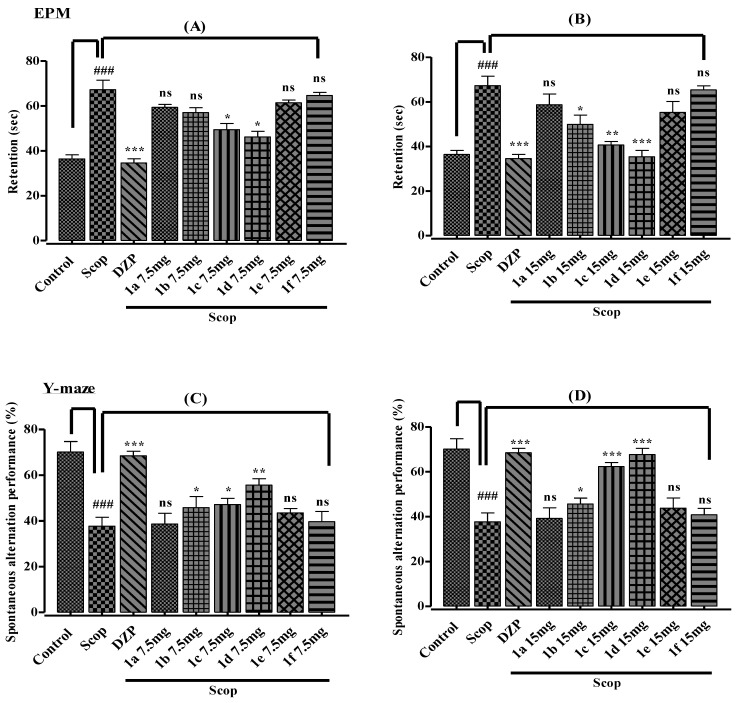
Figure 3
Figure 3
Effects of synthesized curcumin analogs (1a1f), (A) Transfer latency (seconds) at 7.5 mg/kg of the tested compounds and (B) Transfer latency (seconds) at 15 mg/kg of the tested compounds in EPM behavioral mice model versus scopolamine treated groups (1 mg/kg); (C) %Spontaneous alternation performance at 7.5 mg/kg of the tested compounds and (D) %Spontaneous alternation performance at 15 mg/kg of the tested compounds versus scopolamine (1 mg/kg) treated group in Y-maze behavioral mice model. Data were presented in (mean ± SEM), n = 6. ### p < 0.001 vs. normal control. Significantly different values were compared with amnesic group; ***, **, * and ns represents p-value < 0.001, <0.01, <0.05, >0.05 respectively.
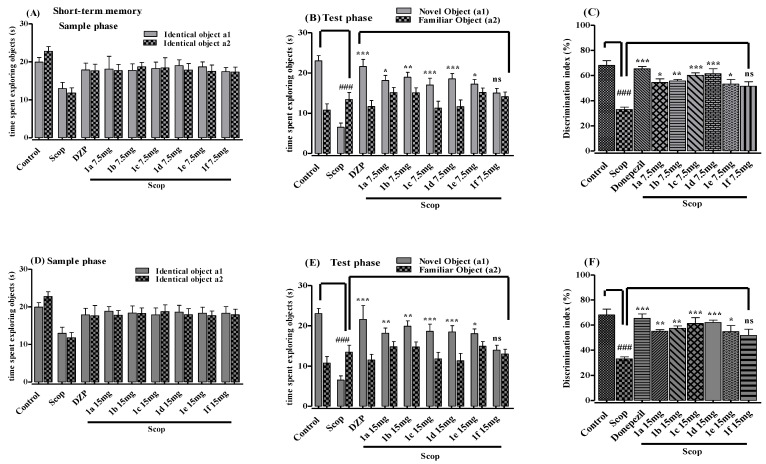
Figure 4
Figure 4
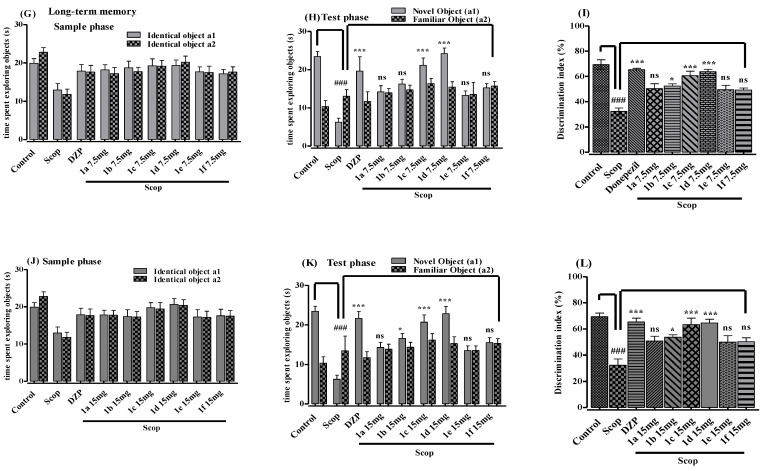
The effect of synthesized curcumin analogs for the evaluation of memory (1a–1f) in NORT (A) Time spent in the sample phase, (B) Time spent in the test phase, (C) Discrimination index (%) were measured in treated groups (7.5 mg/kg) versus scopolamine (1 mg/kg) treated group. (D) Time spent in the sample phase, (E) Time spent in the test phase, (F) Discrimination index (%) were measured in treated groups (15 mg/kg) versus scopolamine (1 mg/kg) treated group for measuring short-term memory in NORT behavioral mice model; (G) Time spent in the sample phase, (H) Time spent in the test phase, (I) Discrimination index (%) were measured in treated groups (7.5 mg/kg) versus scopolamine (1 mg/kg) treated group. (J) Time spent in the sample phase, (K) Time spent in the test phase, (L) Discrimination index (%) were measured in treated groups (15 mg/kg) versus scopolamine (1 mg/kg) treated group for measuring long-term memory in NORT behavioral mice model. Results were presented in (mean ± SEM), n = 6. ### p < 0.001 vs. normal control. Significantly different values were compared with amnesic group; ***, **, * and ‘ns’ represents p-value < 0.001, <0.01, <0.05, >0.05 respectively.
Figure 4
Figure 4
The effect of synthesized curcumin analogs for the evaluation of memory (1a–1f) in NORT (A) Time spent in the sample phase, (B) Time spent in the test phase, (C) Discrimination index (%) were measured in treated groups (7.5 mg/kg) versus scopolamine (1 mg/kg) treated group. (D) Time spent in the sample phase, (E) Time spent in the test phase, (F) Discrimination index (%) were measured in treated groups (15 mg/kg) versus scopolamine (1 mg/kg) treated group for measuring short-term memory in NORT behavioral mice model; (G) Time spent in the sample phase, (H) Time spent in the test phase, (I) Discrimination index (%) were measured in treated groups (7.5 mg/kg) versus scopolamine (1 mg/kg) treated group. (J) Time spent in the sample phase, (K) Time spent in the test phase, (L) Discrimination index (%) were measured in treated groups (15 mg/kg) versus scopolamine (1 mg/kg) treated group for measuring long-term memory in NORT behavioral mice model. Results were presented in (mean ± SEM), n = 6. ### p < 0.001 vs. normal control. Significantly different values were compared with amnesic group; ***, **, * and ‘ns’ represents p-value < 0.001, <0.01, <0.05, >0.05 respectively.
Figure 5
Figure 5
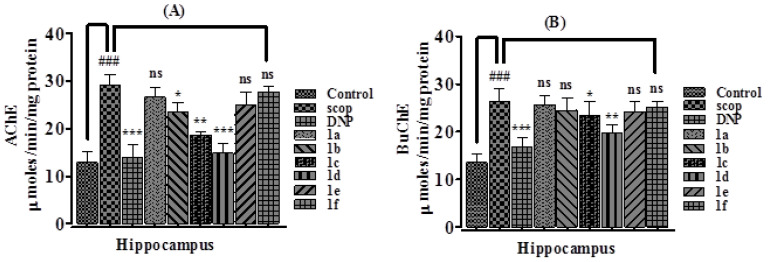
Ex vivo anticholinesterase effect of synthesized curcumin analogs (1a–1f) in AChE (A), BChE (B) in the hippocampus region of mice brains versus scopolamine treated group. Data were presented in (mean ± SEM), n = 6. ### p < 0.001 vs. normal control. Significantly different values were compared with amnesic group; ***, **, * and ns represents p-value < 0.001, < 0.01, <0.05, > 0.05 respectively.

References

    1. Elbini-Dhouib I., Doghri R., Ellefi A., Degrach I., Srairi-Abid N., Gati A. Curcumin attenuated neurotoxicity in sporadic animal model of alzheimer’s disease. Molecules. 2021;26:3011. doi: 10.3390/molecules26103011. - DOI - PMC - PubMed
    1. Hussain H., Ahmad S., Wadood S., Shah A., Ghias M., Ullah A., Rahman S.U., Kamal Z., Khan F.A., Khan N.M., et al. Neuroprotective Potential of Synthetic Mono-Carbonyl Curcumin Analogs Assessed by Molecular Docking Studies. Molecules. 2021;26:7168. doi: 10.3390/molecules26237168. - DOI - PMC - PubMed
    1. Chainoglou E., Hadjipavlou-litina D. Curcumin in Health and Diseases: Alzheimer’s Disease and Curcumin Analogues, Derivatives, and Hybrids. Int. J. Mol. Sci. 2020;21:1975. doi: 10.3390/ijms21061975. - DOI - PMC - PubMed
    1. Voulgaropoulou S.D., Van Amelsvoort T.A.M.J., Prickaerts J., Vingerhoets C. The effect of curcumin on cognition in Alzheimer’s disease and healthy aging: A systematic review of pre-clinical and clinical studies. Brain Res. 2019;1725:146476. doi: 10.1016/j.brainres.2019.146476. - DOI - PubMed
    1. Nazir N., Zahoor M., Nisar M., Karim N., Latif A., Ahmad S., Uddin Z. Evaluation of neuroprotective and antiamnesic effects of elaeagnus umbellate thunb. On scopolamine-induced memory impairment in mice. BMC Complement. Med. Ther. 2020;20:143. doi: 10.1186/s12906-020-02942-3. - DOI - PMC - PubMed

LinkOut - more resources