. 2022 Apr 16;27(8):2580.
doi: 10.3390/molecules27082580.

Development and Application of an LC-MS/MS Untargeted Exposomics Method with a Separated Pooled Quality Control Strategy

Affiliations

Development and Application of an LC-MS/MS Untargeted Exposomics Method with a Separated Pooled Quality Control Strategy

Gianfranco Frigerio et al. Molecules. .

Abstract

Pooled quality controls (QCs) are usually implemented within untargeted methods to improve the quality of datasets by removing features either not detected or not reproducible. However, this approach can be limiting in exposomics studies conducted on groups of exposed and nonexposed subjects, as compounds present at low levels only in exposed subjects can be diluted and thus not detected in the pooled QC. The aim of this work is to develop and apply an untargeted workflow for human biomonitoring in urine samples, implementing a novel separated approach for preparing pooled quality controls. An LC-MS/MS workflow was developed and applied to a case study of smoking and non-smoking subjects. Three different pooled quality controls were prepared: mixing an aliquot from every sample (QC-T), only from non-smokers (QC-NS), and only from smokers (QC-S). The feature tables were filtered using QC-T (T-feature list), QC-S, and QC-NS, separately. The last two feature lists were merged (SNS-feature list). A higher number of features was obtained with the SNS-feature list than the T-feature list, resulting in identification of a higher number of biologically significant compounds. The separated pooled QC strategy implemented can improve the nontargeted human biomonitoring for groups of exposed and nonexposed subjects.

Keywords: exposomics; liquid chromatography tandem mass spectrometry; pooled quality controls; untargeted metabolomics.


Conflict of interest statement

The authors declare no conflict of interest.

Figures

Figure 1
Figure 1
Bar plots representing the number of features (y axis) for each analytical condition (reverse-phase liquid chromatography, RPLC, and hydrophilic-interaction liquid chromatography, HILIC) with negative (NEG) and positive (POS) ionisation mode (x axis), and within a plot, different sample preparations (solvent or water-sample dilution). Each bar represents the mean number of features of three different replicates, and the error bars represent the standard deviations. Solv1: 250 µL of sample and 750 µL of methanol:acetonitrile; Solv2: 500 µL of sample and 500 µL of methanol:acetonitrile; Solv3: 750 µL of sample and 250 µL of methanol:acetonitrile; Wat1: 250 µL of sample and 750 µL of water; Wat2: 500 µL of sample and 500 µL of water; Wat3: 750 µL of sample and 250 µL of water.
Figure 2
Figure 2
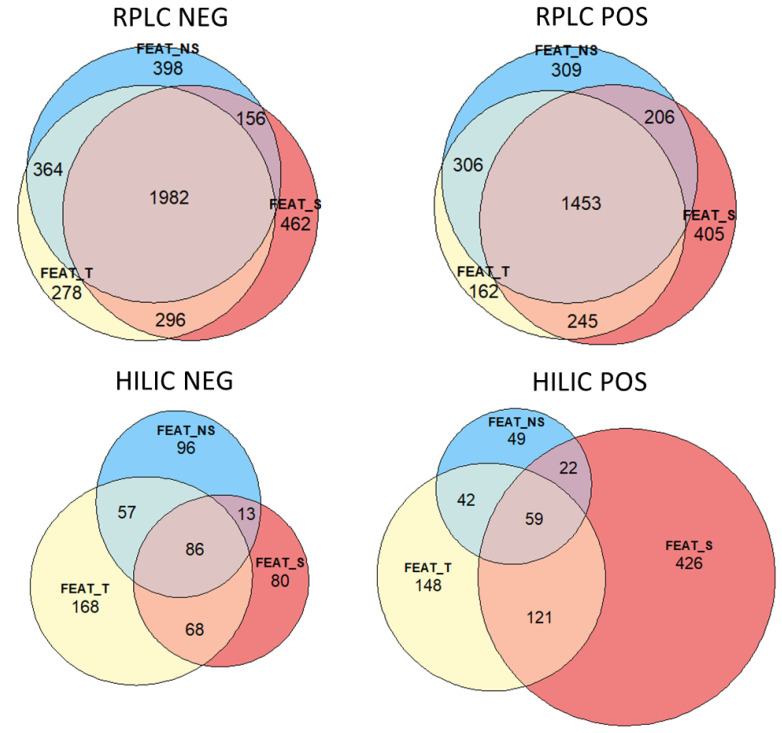
Eulero–Venn graphs, for each chromatographic run, showing the differences in the number of features obtained by separately filtering the dataset with the QC-T (quality controls from all samples) (FEAT_T), the QC-S (quality control from smokers) (FEAT_S), or the QC-NS (quality control from non-smokers) (FEAT_NS).
Figure 3
Figure 3
Eulero–Venn graphs for each chromatographic run, showing the differences in the number of statistically different features between the group of smoking subjects and the group of non-smoking subjects, when considering the T-feature list (FEAT-T) or the SNS-feature list (FEAT-SNS).
Figure 4
Figure 4
Summary of the data elaboration, for each of the four analytical conditions. 1: Total number of features extracted from raw data using the XCMS algorithm. 2: The total feature list was filtered by discarding features present in less than 50% of the QCs, those with a CV ≥ 30% among QCs, and with a blank contribution ≥ 10%. This procedure was performed separately using QC-T, QC-NS, and QC-S. 3: The feature lists obtained using QC-NS and QC-S were merged by eliminating duplicates, to yield the SNS-feature list. 4: A T-test was performed to find significantly different features between urine samples from smokers and non-smokers; this was performed separately with the T-feature list and with the SNS-feature list. 5: Number of features confidentially identified (level 1) with external analytical standards under the same analytical conditions.

References

    1. Rochfort S. Metabolomics reviewed: A new “omics” platform technology for systems biology and implications for natural products research. J. Nat. Prod. 2005;68:1813–1820. doi: 10.1021/np050255w. - DOI - PubMed
    1. Dettmer K., Hammock B.D. Metabolomics—A new exciting field within the “omics” sciences. Environ. Health Perspect. 2004;112:A396–A397. doi: 10.1289/ehp.112-1241997. - DOI - PMC - PubMed
    1. Nicholson J.K., Lindon J.C., Holmes E. “Metabonomics”: Understanding the metabolic responses of living systems to pathophysiological stimuli via multivariate statistical analysis of biological NMR spectroscopic data. Xenobiotica. 1999;29:1181–1189. doi: 10.1080/004982599238047. - DOI - PubMed
    1. Schmidt C.W. Metabolomics: What’s happening downstream of DNA. Environ. Health Perspect. 2004;112:A410–A415. doi: 10.1289/ehp.112-a410. - DOI - PMC - PubMed
    1. Dunn W.B., Broadhurst D.I., Atherton H.J., Goodacre R., Griffin J.L. Systems level studies of mammalian metabolomes: The roles of mass spectrometry and nuclear magnetic resonance spectroscopy. Chem. Soc. Rev. 2011;40:387–426. doi: 10.1039/B906712B. - DOI - PubMed