


Ustekinumab Is Associated with Real-World Long-Term Effectiveness and Improved Health-Related Quality of Life in Crohn's Disease
- PMID: 35459973
- PMCID: PMC9883312
- DOI: 10.1007/s10620-022-07501-z
Ustekinumab Is Associated with Real-World Long-Term Effectiveness and Improved Health-Related Quality of Life in Crohn's Disease
Abstract
Background: Prospectively and systematically collected long-term real-world clinical data on ustekinumab (anti-interleukin-12/23) are still scarce.
Aims: To assess the long-term effectiveness of ustekinumab in patients with active Crohn's disease (CD).
Methods: This is a prospective multicenter study of adult patients with CD initiating ustekinumab according to recommended doses at 20 Swedish hospitals. The primary outcome was clinical remission (Harvey-Bradshaw Index (HBI) ≤ 4 points) at weeks 52 and 104. Secondary outcomes included clinical response (≥ 3-point-decrease in HBI among patients with initial HBI ≥ 5 points), treatment retention, and biomarkers (C-reactive protein (CRP), hemoglobin, fecal-calprotectin) at weeks 52 and 104 compared to baseline. We also reported Health-related Quality of Life (HRQoL) measures.
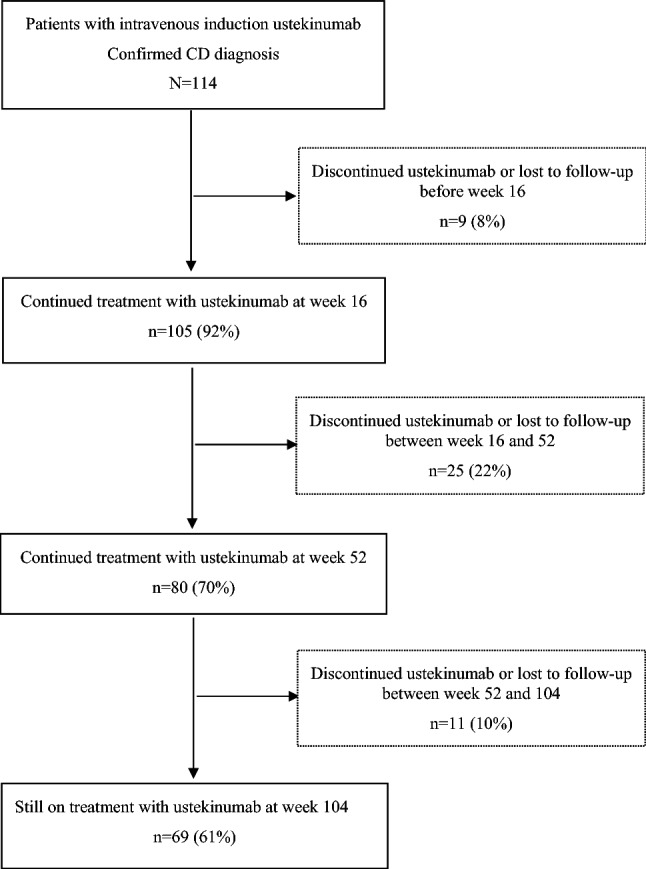
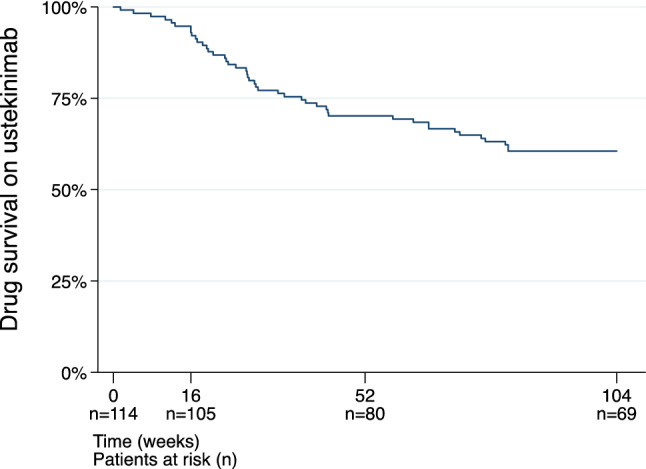
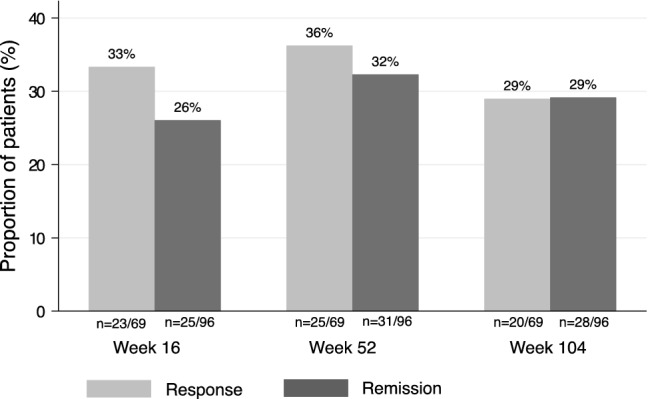
Results: Of 114 included patients, 107 (94%) had previously failed ≥ 1 and 58 (51%) ≥ 2 anti-tumor necrosis factor agents. Forty (35%) had failed anti-integrin agents. Ustekinumab retention rates at weeks 52 and 104 were 70% (n = 80/114) and 61% (n = 69/114), respectively. Clinical response was seen in 36% (n = 25/69) and 29% (n = 20/69) of the patients, and remission was achieved in 32% (n = 31/96) and 29% (n = 28/96) at weeks 52 and 104, respectively. Median HBI and CRP levels decreased significantly at both timepoints as compared to baseline. Significant improvements were also observed in HRQoL. Adverse events were reported in 11% (n = 13/114) of the patients, including five cases of severe adverse events. No malignancies were observed.
Conclusions: In this nationwide prospective real-world 104-week-follow-up study of adult patients with active CD, ustekinumab was associated with long-term clinical effectiveness and improvement in HRQoL measures when used in routine clinical care.
Keywords: Crohn’s disease; Inflammatory bowel disease; Observational study; Ustekinumab.
© 2022. The Author(s).
Conflict of interest statement
PM served as speaker and/or advisory board member for AbbVie, Ferring, Janssen, Pfizer, Takeda, Baxter, and Tillotts Pharma. HS served as speaker and/or advisory board member for AbbVie, Ferring, Janssen, Pfizer, Takeda, Gilead, and Tillotts Pharma. DA served as speaker and/or advisory board member for AbbVie, Janssen, and Takeda. FH is an employee of Janssen Cilag AB, Sweden. OO has been PI on projects at Karolinska Institutet, partly financed by investigator-initiated grants from Janssen and Ferring, and Karolinska Institutet has received fees for lectures and participation on advisory boards from Janssen, Ferring, Takeda, and Pfizer. OO also reports a grant from Pfizer in the context of a national safety monitoring program. JH served as speaker and/or advisory board member for AbbVie, Celgene, Celltrion, Dr. Falk Pharma and the Falk Foundation, Ferring, Hospira, Janssen, MEDA, Medivir, MSD, Olink Proteomics, Pfizer, Prometheus Laboratories, Sandoz/Novartis, Shire, Takeda, Thermo Fisher Scientific, Tillotts Pharma, Vifor Pharma, UCB and received grant support from Janssen, MSD, and Takeda.
Figures
References
Publication types
MeSH terms
Substances
LinkOut - more resources
Full Text Sources
Medical
Research Materials
Miscellaneous
