


Innervation in organogenesis
- PMID: 35461566
- PMCID: PMC10636594
- DOI: 10.1016/bs.ctdb.2022.02.004
Innervation in organogenesis
Abstract
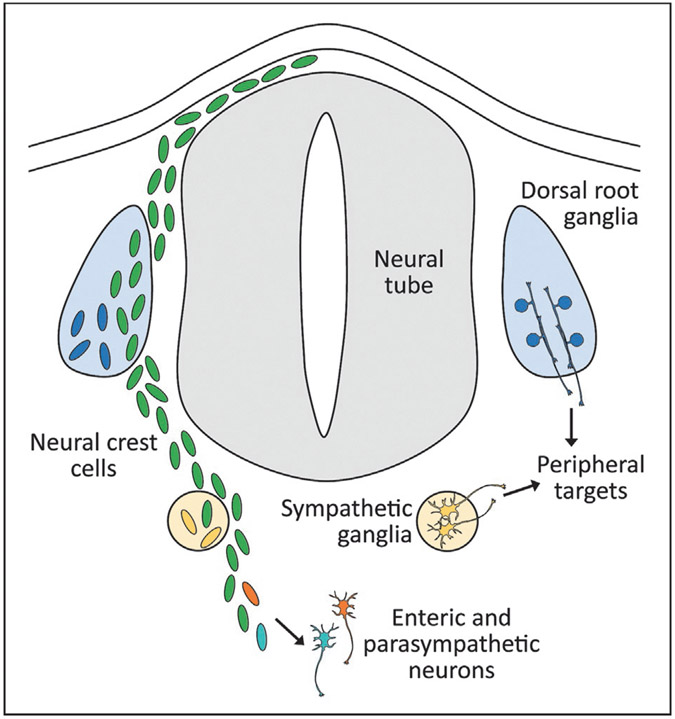
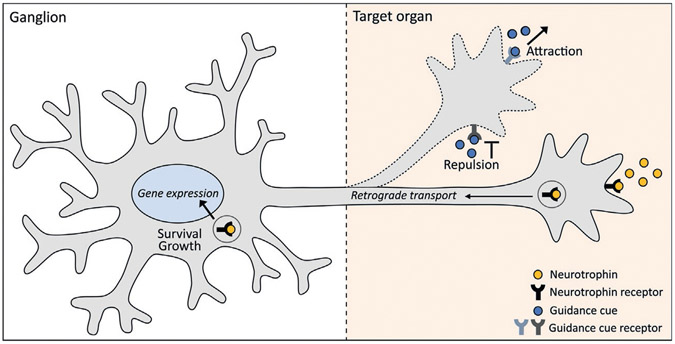
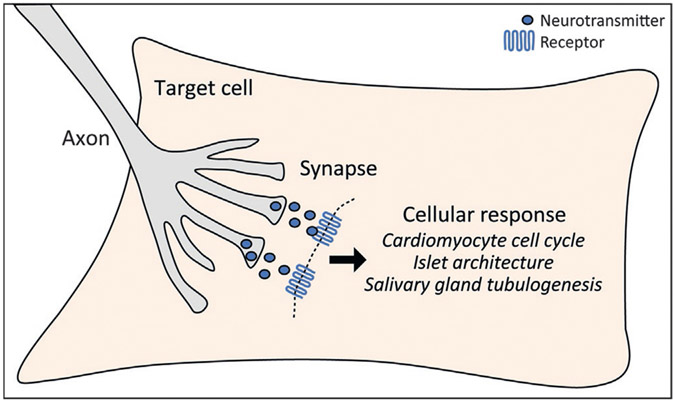
Proper innervation of peripheral organs helps to maintain physiological homeostasis and elicit responses to external stimuli. Disruptions to normal function can result in pathophysiological consequences. The establishment of connections and communication between the central nervous system and the peripheral organs is accomplished through the peripheral nervous system. Neuronal connections with target tissues arise from ganglia partitioned throughout the body. Organ innervation is initiated during development with stimuli being conducted through several types of neurons including sympathetic, parasympathetic, and sensory. While the physiological modulation of mature organs by these nerves is largely understood, their role in mammalian development is only beginning to be uncovered. Interactions with cells in target tissues can affect the development and eventual function of several organs, highlighting their significance. This chapter will cover the origin of peripheral neurons, factors mediating organ innervation, and the composition and function of organ-specific nerves during development. This emerging field aims to identify the functional contribution of innervation to development which will inform future investigations of normal and abnormal mammalian organogenesis, as well as contribute to regenerative and organ replacement efforts where nerve-derived signals may have significant implications for the advancement of such studies.
Keywords: Development; Innervation; Neuron; Organogenesis; Parasympathetic; Sensory; Sympathetic.
Copyright © 2022 Elsevier Inc. All rights reserved.
Figures
References
-
- Anderson RB, Newgreen DF, & Young HM (2006). Neural crest and the development of the enteric nervous system. 589. Advances in Experimental Medicine and Biology (pp. 181–196). Springer. - PubMed
-
- Anderson DJ, Carnahan JF, Michelsohn A, & Patterson PH (1991). Antibody markers identify a common progenitor to sympathetic neurons and chromaffin cells in vivo and reveal the timing of commitment to neuronal differentiation in the sympathoadrenal lineage. The Journal of Neuroscience, 11, 3507–3519. 10.1523/JNEUROSCI.11-11-03507.1991. - DOI - PMC - PubMed
MeSH terms
Grants and funding
LinkOut - more resources
Full Text Sources
