. 2022 Apr 7:9:817324.
doi: 10.3389/fmed.2022.817324. eCollection 2022.

Archetypal Analysis of Injury in Kidney Transplant Biopsies Identifies Two Classes of Early AKI

Affiliations

Archetypal Analysis of Injury in Kidney Transplant Biopsies Identifies Two Classes of Early AKI

Philip F Halloran et al. Front Med (Lausanne). .

Abstract

All transplanted kidneys are subjected to some degree of injury as a result of the donation-implantation process and various post-transplant stresses such as rejection. Because transplants are frequently biopsied, they present an opportunity to explore the full spectrum of kidney response-to-wounding from all causes. Defining parenchymal damage in transplanted organs is important for clinical management because it determines function and survival. In this study, we classified the scenarios associated with parenchymal injury in genome-wide microarray results from 1,526 kidney transplant indication biopsies collected during the INTERCOMEX study. We defined injury groups by using archetypal analysis (AA) of scores for gene sets and classifiers previously identified in various injury states. Six groups and their characteristics were defined in this population: No injury, minor injury, two classes of acute kidney injury ("AKI," AKI1, and AKI2), chronic kidney disease (CKD), and CKD combined with AKI. We compared the two classes of AKI, namely, AKI1 and AKI2. AKI1 had a poor function and increased parenchymal dedifferentiation but minimal response-to-injury and inflammation, instead having increased expression of PARD3, a gene previously characterized as being related to epithelial polarity and adherens junctions. In contrast, AKI2 had a poor function and increased response-to-injury, significant inflammation, and increased macrophage activity. In random forest analysis, the most important predictors of function (estimated glomerular filtration rate) and graft loss were injury-based molecular scores, not rejection scores. AKI1 and AKI2 differed in 3-year graft survival, with better survival in the AKI2 group. Thus, injury archetype analysis of injury-induced gene expression shows new heterogeneity in kidney response-to-wounding, revealing AKI1, a class of early transplants with a poor function but minimal inflammation or response to injury, a deviant response characterized as PC3, and an increased risk of failure. Given the relationship between parenchymal injury and kidney survival, further characterization of the injury phenotypes in kidney transplants will be important for an improved understanding that could have implications for understanding native kidney diseases (ClinicalTrials.gov #NCT01299168).

Keywords: archetypes; biopsy; gene expression; injury; kidney transplantation.


Conflict of interest statement

PH is a consultant to Natera, holds shares in Transcriptome Sciences Inc (TSI), a University of Alberta research company dedicated to developing molecular diagnostics, supported in part by a licensing agreement between TSI and Thermo Fisher, and by a research grant from Natera. The remaining authors declare that the research was conducted in the absence of any commercial or financial relationships that could be construed as a potential conflict of interest.

Figures
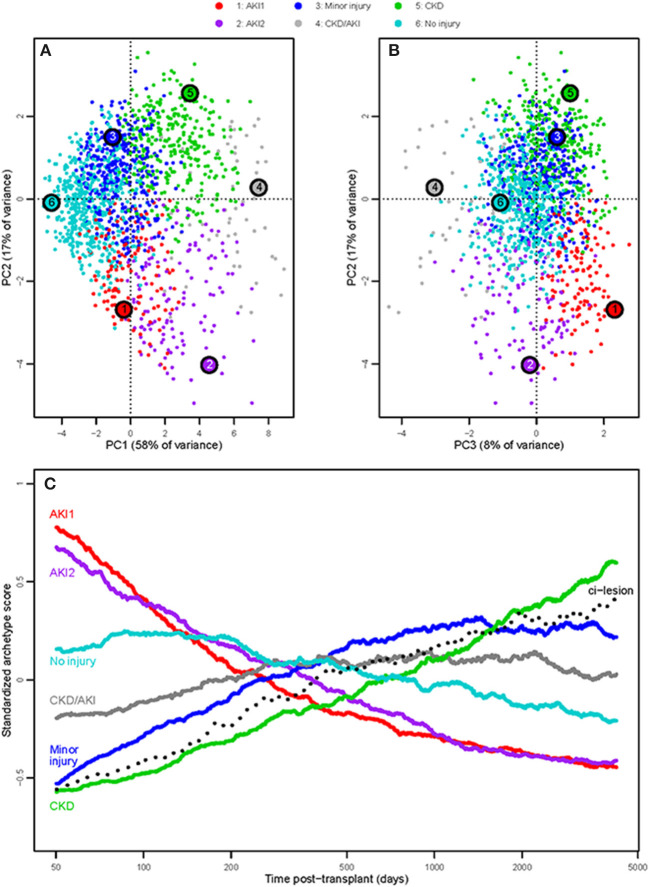
Figure 1
Figure 1
Injury-based PCA, colored by injury archetype cluster. (A) PC2 vs. PC1 scores for each biopsy; (B) PC2 vs. PC3 scores; (C) moving averages of standardized injury archetype scores (window size = 400 biopsies). As there are large differences in mean scores between archetypes, all scores were standardized to a mean of 0.0 before plotting. The y-axis is in standard deviation units. Biopsies sorted by ascending time of biopsy post-transplant.
Figure 2
Figure 2
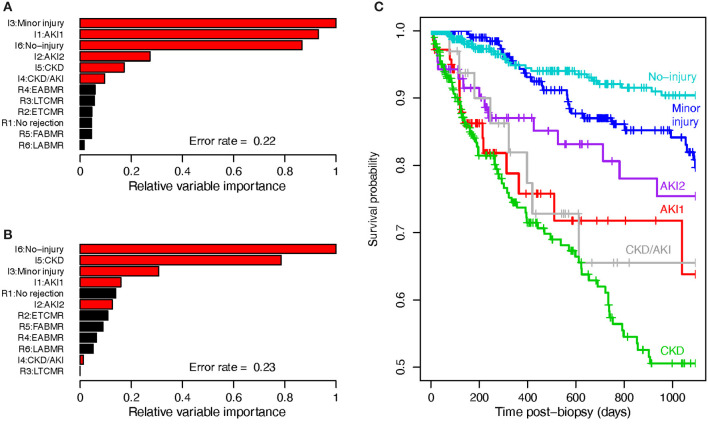
Graft survival analyses. (A) Random forests assessing variable importance in predicting low eGFR (eGFR < 30). (B) Random forests assessing variable importance in predicting 3-year death-censored graft survival. (C) Kaplan-Meier curves showing 3-year post-biopsy actuarial survival in the six AA injury archetype groups.
Figure 3
Figure 3
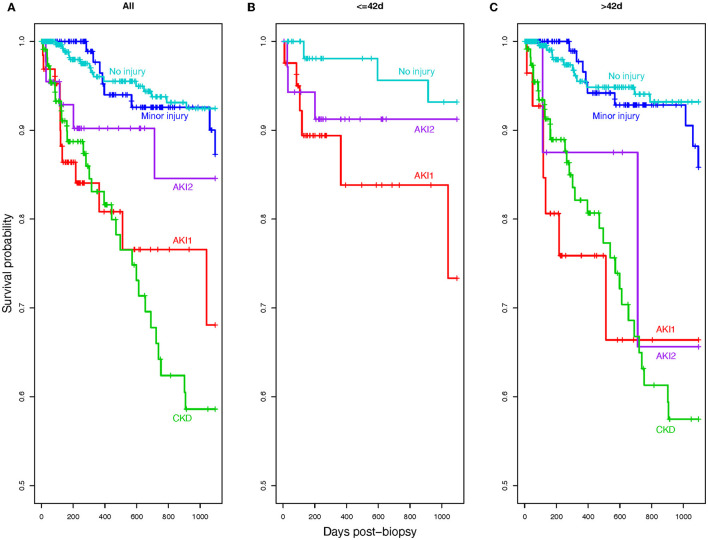
Kaplan-Meier curves showing actuarial 3-year death-censored graft survival in the injury AA groups after excluding all biopsies with rejection. (A) Injury AA groups were compared across time post-biopsy. We also examined the differences between, (B) short-term (≤42 days post-biopsy), and (C) long-term (>42 days post-biopsy) survival probabilities. The CKD/AKI group was removed from these plots due to the very small group size and scarcity of events.
Figure 4
Figure 4
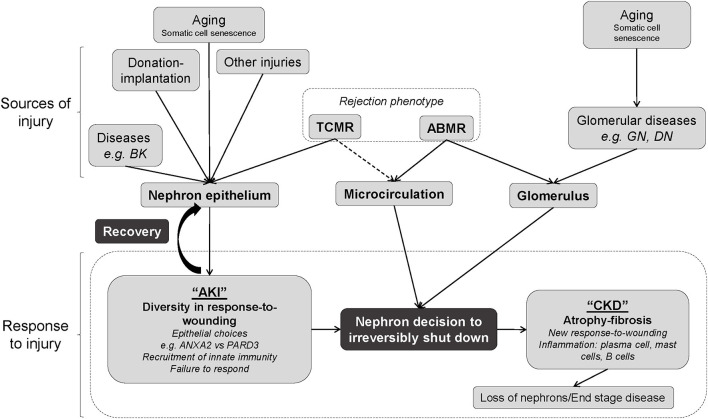
Schematic diagram representing the relationships between sources of injury and response to injury in kidney transplant biopsies based on these analyses. Interplay between sources of injury, pre-existing limitations such as aging, and response to injury by the nephron. There are two routes to irreversible nephron shutdown, namely, the epithelial injury and through glomerulus injury. Epithelial injury should trigger the response-to-wounding, which involves epithelium, matrix, and microcirculation, and evokes innate immunity. Failure to mount a response to wounding and adopting a “PC3”-related response (e.g., PARD3) with minimal inflammation leads to failure to recover. Many sources of injury (separate from and including rejection) interact with the nephron epithelium, producing acute kidney injury (AKI). In this instance, the epithelium can be repaired and the organ can recover, or progress to nephron failure. Alternatively, aging and/or ABMR can contribute to glomerular disease and ABMR can additionally affect the microcirculation, affecting the glomerulus and again causing nephron shutdown, which eventually leads to chronic kidney disease (CKD). If this occurs, a loss of nephrons and end-stage renal disease may occur. Different sources of injury may interact to cause many forms of injury, and injury itself predicts the graft survival while the rejection status does not. Thus, defining the heterogeneity within biopsy injury is an important part of clinical management.

References

    1. Halloran PF, Famulski KS, Reeve J. Molecular assessment of disease states in kidney transplant biopsy samples. Nat Rev Nephrol. (2016) 12:534–48. 10.1038/nrneph.2016.85 - DOI - PubMed
    1. Reeve J, Bohmig GA, Eskandary F, Einecke G, Gupta G, Madill-Thomsen K, et al. Generating automated kidney transplant biopsy reports combining molecular measurements with ensembles of machine learning classifiers. Am J Transplant. (2019) 19:2719–31. 10.1111/ajt.15351 - DOI - PubMed
    1. Reeve J, Bohmig GA, Eskandary F, Einecke G, Lefaucheur C, Loupy A, et al. Assessing rejection-related disease in kidney transplant biopsies based on archetypal analysis of molecular phenotypes. JCI Insight. (2017) 2:e94197. 10.1172/jci.insight.94197 - DOI - PMC - PubMed
    1. Venner JM, Famulski KS, Reeve J, Chang J, Halloran PF. Relationships among injury, fibrosis, and time in human kidney transplants. JCI Insight. (2016) 1:e85323. 10.1172/jci.insight.85323 - DOI - PMC - PubMed
    1. Halloran PF, Reeve J, Akalin E, Aubert O, Bohmig GA, Brennan D, et al. Real time central assessment of kidney transplant indication biopsies by microarrays: the INTERCOMEX study. Am J Transplant. (2017) 17:2851–62. 10.1111/ajt.14329 - DOI - PubMed

Associated data