


COVID-19 susceptibility, severity, clinical outcome and Toll-like receptor (7) mRNA expression driven by TLR7 gene polymorphism (rs3853839) in middle-aged individuals without previous comorbidities
- PMID: 35463461
- PMCID: PMC9013694
- DOI: 10.1016/j.genrep.2022.101612
COVID-19 susceptibility, severity, clinical outcome and Toll-like receptor (7) mRNA expression driven by TLR7 gene polymorphism (rs3853839) in middle-aged individuals without previous comorbidities
Abstract
Background: Toll-like receptors are implicated in the pathophysiology of the severe acute respiratory syndrome coronavirus (SARS-CoV) and the Middle East respiratory disease (MERS), according to several studies. The whole-genome sequencing of SARS-CoV-2 revealed that the TLR7 gene could be implicated in the virus's pathogenesis since the virus includes ssRNA patterns that could bind to TLR7.
Aim: The purpose of this study was to look into the function of the TLR7 (rs3853839) C/G polymorphism and the expression of TLR7 mRNA transcript in the development, severity and progression of COVID-19.
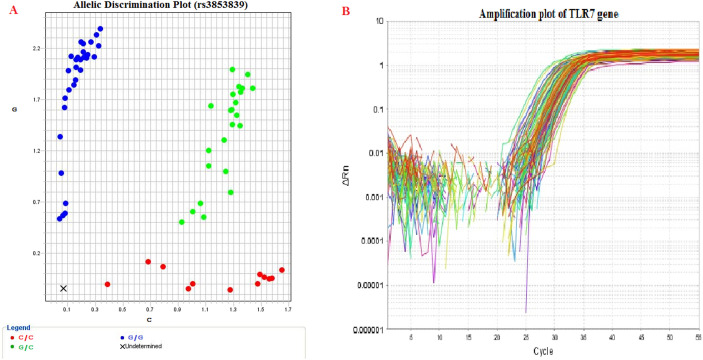
Subjects and methods: A case-control study included 285 participants who were divided into two groups: 150 middle-aged people with COVID 19 who had no previous co-morbidities and 135 healthy volunteers who served as controls. TaqMan test was used to genotype the TLR7 (rs3853839) C/G polymorphism, and real-time PCR was used to determine the relative expression of its mRNA transcript. The level of IL-6 in serum was determined using the ELISA method as an indicator of cytokine storm and COVID-19 severity.
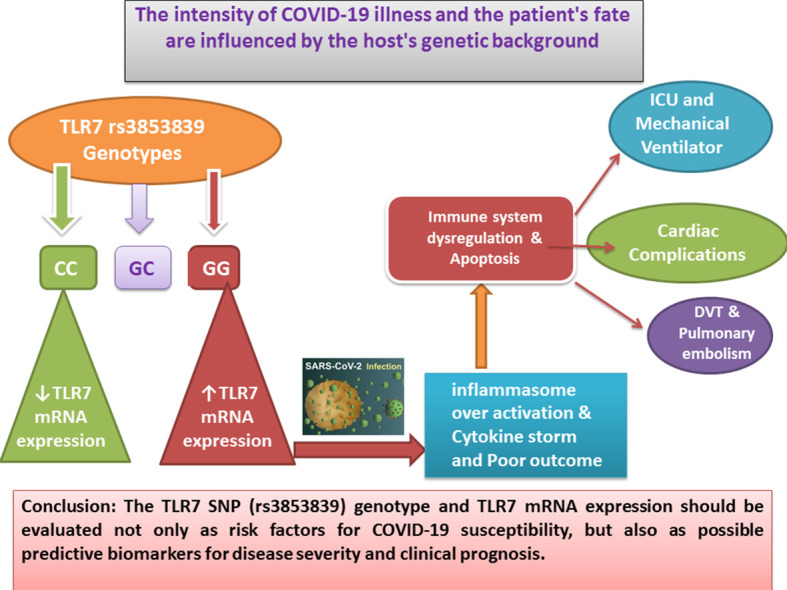
Results: The GG genotype was shown to be much more common in COVID-19 patients (38.7%) than controls (4.4%), with an OR of 19.86 (95% CI: 7.85; 50.22) and was linked to disease severity and poor clinical outcomes (hospitalization, respiratory failure, cardiac complications, ICU admission and mechanical ventilation).As a result, the G allele was considerably higher in cases (57.0%), while the C allele was significantly higher in controls (p = 0.001). The GG genotype was found to be substantially more common in patients who were severely/critically unwell. TLR7 mRNA expression levels were significantly higher in COVID-19 patients (2.44 ± 0.89) than in controls (1.06 ± 0.46) (p = 0.001). TLR7 mRNA levels were highest in COVID 19 patients with the GG genotype (rs3853839). Patients with the GG genotype had considerably lower WBC counts, but significantly higher serum ferritin, CRP, IL-6 and D dimer levels (P = 0.045, 0.001, 0.023, 0.033, 0.001, respectively).
Conclusion: The GG form of the TLR7 SNP (rs3853839) could be a genetic risk factor for COVID-19 infection, severe illness and poor clinical outcome. TLR7 mRNA expression was also elevated in COVID-19 patients who were severely/critically unwell and had a bad outcome, suggesting that they could be used as COVID-19 prognostic biomarkers.
Keywords: ARDS, Acute respiratory distress syndrome; CBC, complete blood count; COVID-19; CRP, C-reactive protein; IL-6; MERS, Middle East respiratory disease, according to several studies; PCR; RT-PCR, reverse transcriptase polymerase chain reaction; SARS-CoV, Severe acute respiratory syndrome coronavirus; SNP; TLR7; TLR7, Toll Like Receptor 7; WHO, World Health Organization; mRNA; ssRNA, single-strand RNA.
© 2022 Elsevier Inc. All rights reserved.
Conflict of interest statement
The authors state that they have no conflicts of interest.
Figures

References
-
- Cascella M., Rajnik M., Aleem A., Dulebohn S.C., Di Napoli R. StatPearls. StatPearls Publishing; Treasure Island (FL): 2022. Features, evaluation, and treatment of coronavirus (COVID-19) January 5. - PubMed
LinkOut - more resources
Full Text Sources
Research Materials
Miscellaneous