. 2022 Apr 12:23:100446.
doi: 10.1016/j.lanwpc.2022.100446. eCollection 2022 Jun.

Multi-site implementation of whole genome sequencing for hospital infection control: A prospective genomic epidemiological analysis

Affiliations

Multi-site implementation of whole genome sequencing for hospital infection control: A prospective genomic epidemiological analysis

Norelle L Sherry et al. Lancet Reg Health West Pac. .

Abstract

Background: Current microbiological methods lack the resolution to accurately identify multidrug-resistant organism (MDRO) transmission, however, whole genome sequencing can identify highly-related patient isolates providing opportunities for precision infection control interventions. We investigated the feasibility and potential impact of a prospective multi-centre genomics workflow for hospital infection control.

Methods: We conducted a prospective genomics implementation study across eight Australian hospitals over 15 months (2017,2018), collecting all clinical and screening isolates from inpatients with vanA VRE, MRSA, ESBL Escherichia coli (ESBL-Ec), or ESBL Klebsiella pneumoniae (ESBL-Kp). Genomic and epidemiologic data were integrated to assess MDRO transmission.

Findings: In total, 2275 isolates were included from 1970 patients, predominantly ESBL-Ec (40·8%) followed by MRSA (35·6%), vanA VRE (15·2%), and ESBL-Kp (8·3%).Overall, hospital and genomic epidemiology showed 607 patients (30·8%) acquired their MDRO in hospital, including the majority of vanA VRE (266 patients, 86·4%), with lower proportions of ESBL-Ec (186 patients, 23·0%), ESBL-Kp (42 patients, 26·3%), and MRSA (113 patients, 16·3%). Complex patient movements meant the majority of MDRO transmissions would remain undetected without genomic data.The genomics implementation had major impacts, identifying unexpected MDRO transmissions prompting new infection control interventions, and contributing to vanA VRE becoming a notifiable condition. We identified barriers to implementation and recommend strategies for mitigation.

Interpretation: Implementation of a multi-centre genomics-informed infection control workflow is feasible and identifies many unrecognised MDRO transmissions. This provides critical opportunities for interventions to improve patient safety in hospitals.

Funding: Melbourne Genomics Health Alliance (supported by State Government of Victoria, Australia), and National Health and Medical Research Council (Australia).

Keywords: Antimicrobial resistance; ESBL-Ec, Extended-spectrum beta-lactamase Escherichia coli; ESBL-Kp, Extended-spectrum beta-lactamase Klebsiella pneumoniae; Hospital epidemiology; Infection prevention and control; MDRO, Multidrug-resistant organism; MRSA, Methicillin-resistant Staphylococcus aureus; VRE, Vancomycin-resistant Enterococcus; WGS, Whole genome sequencing; Whole genome sequencing.


Conflict of interest statement

The authors declare no conflicts of interest.

Figures
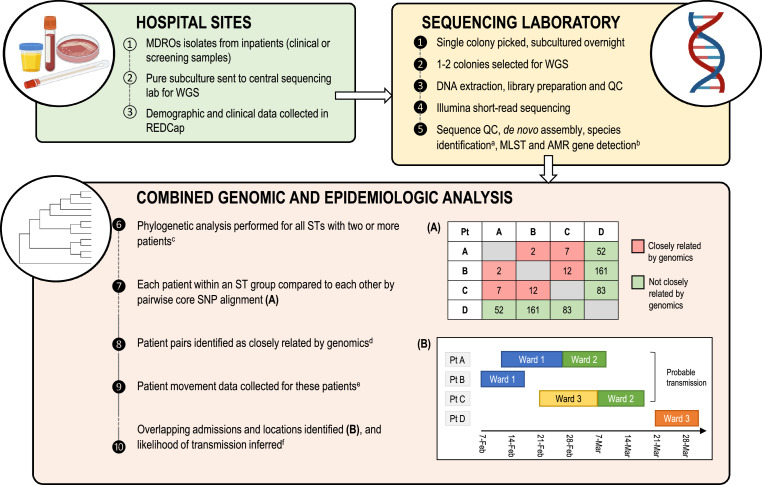
Fig 1
Figure 1
Infection control genomics workflow implemented in this study. (A). Example of pairwise SNP distance matrix for sequences from four patient isolates; patient pairs with pairwise SNP distances at or below the screening threshold (15 SNPs for MRSA, 25 SNPs for other MDROs) are classified as closely related by genomics (red), and pairs above these thresholds are designated as not closely related by genomics. (B) Example of Gantt chart demonstrating bed movements (ward admissions) of same four patients from (A) over time; patients A, B and C had closely related MDROs by genomics, and had overlapping admissions (same ward at the same time), therefore constituting probable MDRO transmission. Patient D's sequence was not related to the other patients’ sequences by genomics (above screening threshold), and not considered to be involved in MDRO transmission to or from these other patients, despite having an MDRO of the same sequence type (ST). a Species identification by k-mer identification (kraken); Klebsiella further subspeciated using kleborate tool. b Sequences analysed for presence of complete vanA operon, ESBL/AmpC genes and mecA/mecC; if these were absent, isolates underwent further phenotypic testing to ensure they met inclusion criteria (phenotypic antimicrobial resistance). c Aligning isolates to reference genome of same ST, or de novo assembly of earliest isolate if this was not available; ST 131 E. coli analysed in two subclades due to large number of isolates. Recombinant sites were masked with gubbins for species other than S. aureus. d Each isolate sequence within an ST was compared to all others, and closely-related isolates were determined by core SNP differences; ≤15 SNPs for Staphylococcus aureus, ≤25 SNPs for other species. e Data collected for 12 months prior to first study sample until the end of study. f Likelihood of transmission inferred from combined genomic and epidemiologic data, categorised as ‘Probable’ (same ward at same time), ‘Possible’ (same ward at different time but within 60 days, or same hospital at the same time), ‘Unlikely’ (neither of the above), or ‘Above screening threshold’ (not closely related by genomics). Abbreviations: MDRO, multidrug-resistant organism; WGS, whole genome sequencing; QC, quality control; MLST, multi-locus sequence typing; AMR, antimicrobial resistance; ST, sequence type; SNP, single-nucleotide polymorphism (single base difference between two or more isolates); Pt, patient.
Fig 2
Figure 2
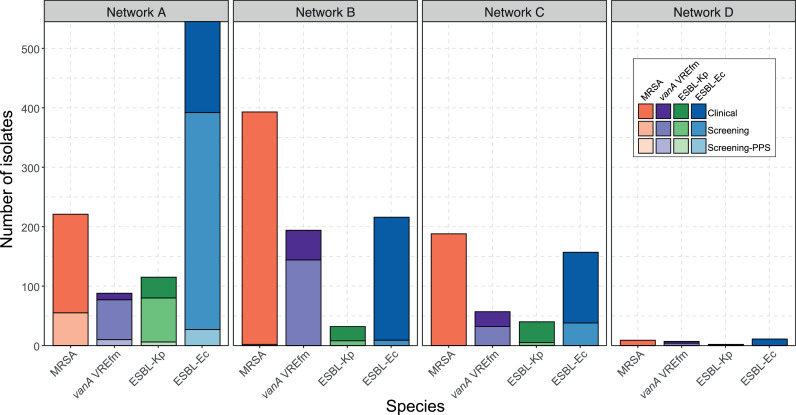
MDRO isolates by network, species, and reason for sample collection. Bars are shaded by reason for sample collection with lightest shades representing clinical samples, middle shades representing screening samples, and darkest shades (only for Network A) representing screening samples performed as part of network-wide biannual point-prevalence surveys (PPS)(note, MRSA not included in PPS). MRSA, methicillin-resistant Staphylococcus aureus; VREfm, vancomycin-resistant Enterococcus faecium; ESBL-Kp, extended-spectrum beta-lactamase-phenotype Klebsiella pneumoniae; ESBL-Ec, extended-spectrum beta-lactamase-phenotype Escherichia coli.
Fig 3
Figure 3
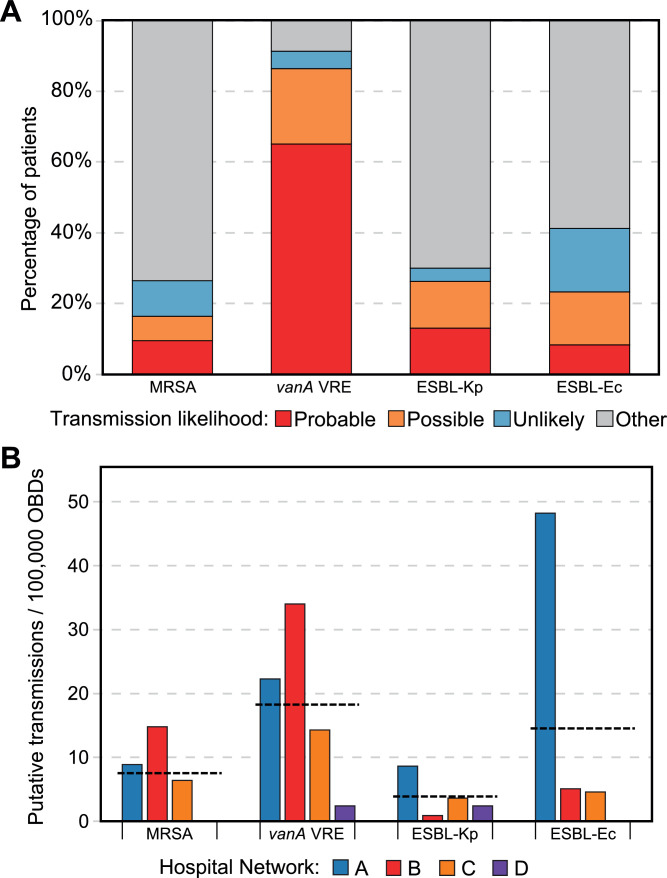
MDRO transmission as assessed by combined genomics and epidemiologic assessment. A/ Likelihood of transmission using combined genomic and epidemiologic data, by species. ‘Other’ (grey) includes patients with samples with no genomic links to other study samples (singleton STs, or above SNP screening thresholds). B. Putative transmission rates per 100,000 occupied bed days (OBDs) by species, coloured by hospital network. Horizontal dotted line represents the mean transmission rate for each species across all hospital networks. MRSA, methicillin-resistant Staphylococcus aureus; VREfm, vancomycin-resistant Enterococcus faecium; ESBL-Kp, extended-spectrum beta-lactamase-phenotype Klebsiella pneumoniae; ESBL-Ec, extended-spectrum beta-lactamase-phenotype Escherichia coli.
Fig 4
Figure 4
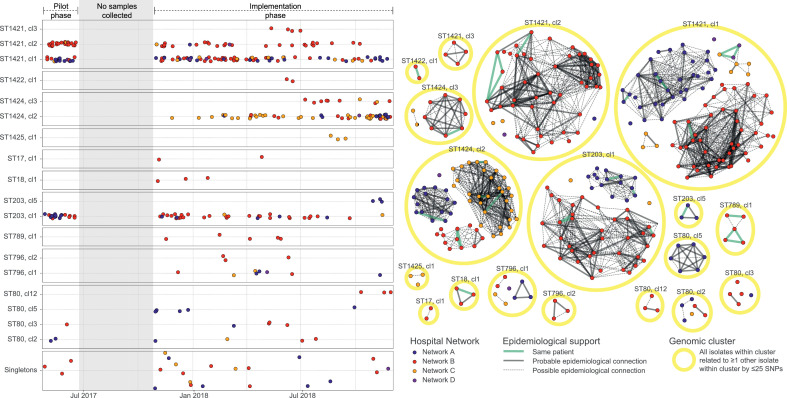
vanA VREfm cluster timeline and genomic transmission networks. A. Timeline of vanA VREfm cases over the study periods, separated by ST and sub-cluster (cl) along the Y axis, and coloured by hospital network. Timeline is separated into pilot phase (left) and implementation phase (right); shaded timeframe shows the time between phases without sampling. Each point represents one case; only the first sample for each case in the study is included. Points have been separated vertically to allow for visualisation of closely-spaced cases. Sample sequences that did not cluster with any other study cases are shown in the ‘Singletons’ panel. B. Network diagram of genomic and epidemiologic links between vanA VREfm cases. Each point represents one case; only the first sample for each case in the study is included, and is coloured by hospital network. The yellow circles outline genomic clusters, and lines between points represent epidemiologic links between cases (thick line, probable transmission; dotted line, possible transmission; green line, same patient. Absence of line indicates unlikely transmission by epidemiology, i.e. no known overlap between patients in space or time). Abbreviations: VREfm, vancomycin-resistant Enterococcus faecium; ST, sequence type; cl, cluster; SNP, single-nucleotide polymorphism.
Fig 5
Figure 5
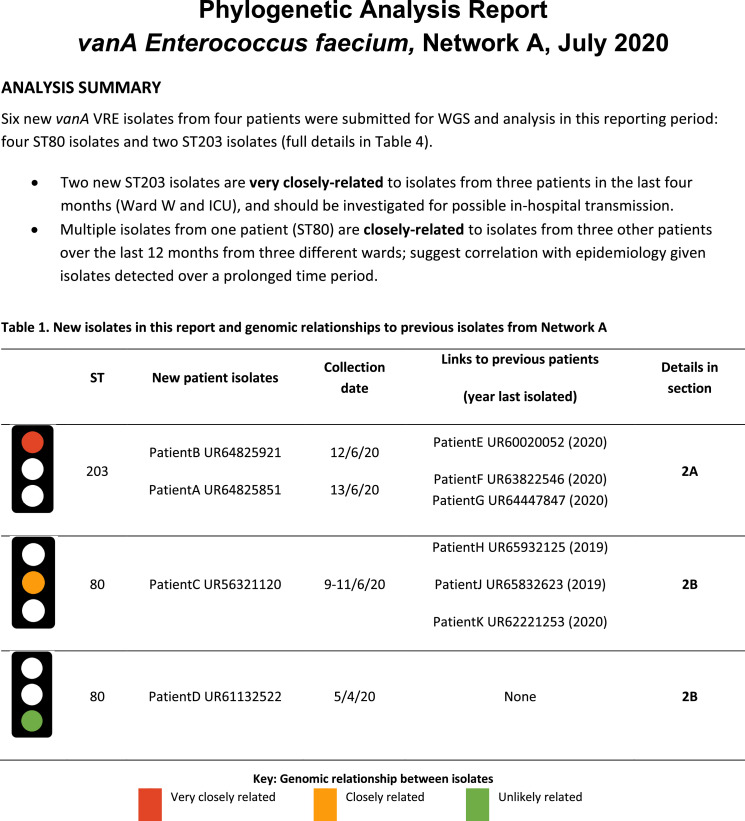
Suggested format for reporting prospective genomics results to an infection control team Excerpt of a suggested report format for intermittently reporting results from prospective genomic surveillance to an infection control team. This report was designed after feedback from focus groups of infection control, infectious diseases and microbiology staff, including some participants with experience in genomics, and some without. All data are fictitious. Full report included in Supplementary Data (Fig. S6).

References

    1. World Health Organization . WHO Press; Geneva, Switzerland: 2014. Antimicrobial Resistance: Global Report on Surveillance.
    1. Chia P., Sengupta S., Kukreja A., et al. The role of hospital environment in transmissions of multidrug-resistant gram-negative organisms. Antimicrob Resist Infect Control. 2020;9:29. doi: 10.1186/s13756-020-0685-1. - DOI - PMC - PubMed
    1. Kritsotakis E., Kontopidou F., Astrinaki E., Roumbelaki M., Ioannidou E., Gikas A. Prevalence, incidence burden, and clinical impact of healthcare-associated infections and antimicrobial resistance: a national prevalent cohort study in acute care hospitals in Greece. Infect Drug Resist. 2017;10:317–328. - PMC - PubMed
    1. Popovich K.J., Snitkin E.S. Whole genome sequencing-implications for infection prevention and outbreak investigations. Curr Infect Dis Rep. 2017;19(4):15. - PubMed
    1. Parcell B.J., Gillespie S.H., Pettigrew K.A., Holden M.T.G. Clinical perspectives in integrating whole-genome sequencing into the investigation of healthcare and public health outbreaks – hype or help? J Hosp Infect. 2021;109:1–9. - PMC - PubMed

LinkOut - more resources