


The Assessment of Cognitive Reserve: A Systematic Review of the Most Used Quantitative Measurement Methods of Cognitive Reserve for Aging
- PMID: 35465541
- PMCID: PMC9023121
- DOI: 10.3389/fpsyg.2022.847186
The Assessment of Cognitive Reserve: A Systematic Review of the Most Used Quantitative Measurement Methods of Cognitive Reserve for Aging
Abstract
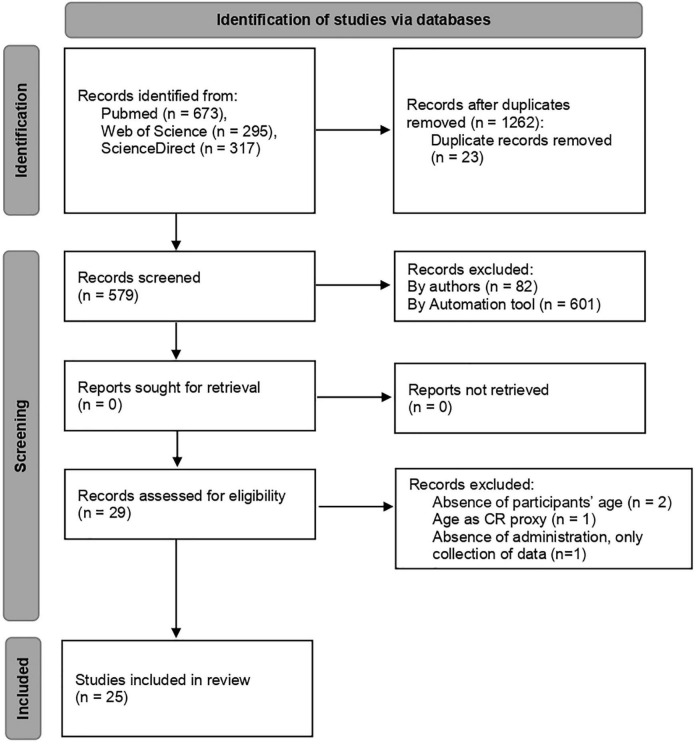
The cognitive reserve (CR) is widely accepted as the active ability to cope with brain damage, using preexisting cognitive and compensatory processes. The common CR proxies used are the number of formal years of education, intelligence quotient (IQ) or premorbid functioning, occupation attainment, and participation in leisure activities. More recently, it has employed the level of literacy and engagement in high-level cognitive demand of professional activities. This study aims to identify and summarize published methodologies to assess the CR quantitatively. We searched for published studies on PubMed, ScienceDirect, and Web of Science between September 2018 and September 2021. We only included those studies that characterized the CR assessment methodology. The search strategy identified 1,285 publications, of which 25 were included. Most of the instruments targeted proxies individually. The lack of a gold standard tool that incorporates all proxies and cognitive tests highlights the need to develop a more holistic battery for the quantitative assessment of CR. Further studies should focus on a quantitative methodology that includes all these proxies supported by normative data to improve the use of CR as a valid measure in clinical contexts.
Keywords: aging; assessment; cognitive functioning; cognitive reserve; measurement methods.
Copyright © 2022 Nogueira, Gerardo, Santana, Simões and Freitas.
Conflict of interest statement
The authors declare that the research was conducted in the absence of any commercial or financial relationships that could be construed as a potential conflict of interest.
References
-
- Belleville S., Moussard A., Ansaldo A. I., Belchior P., Bherer L., Bier N., et al. (2019). Rationale and protocol of the ENGAGE study: a double-blind randomized controlled preference trial using a comprehensive cohort design to measure the effect of a cognitive and leisure-based intervention in older adults with a memory complaint. Trials 20 1–18. 10.1186/s13063-019-3250-6 - DOI - PMC - PubMed
Publication types
LinkOut - more resources
Full Text Sources
