


Using Natural Language Processing and Machine Learning to Preoperatively Predict Lymph Node Metastasis for Non-Small Cell Lung Cancer With Electronic Medical Records: Development and Validation Study
- PMID: 35468085
- PMCID: PMC9086872
- DOI: 10.2196/35475
Using Natural Language Processing and Machine Learning to Preoperatively Predict Lymph Node Metastasis for Non-Small Cell Lung Cancer With Electronic Medical Records: Development and Validation Study
Abstract
Background: Lymph node metastasis (LNM) is critical for treatment decision making of patients with resectable non-small cell lung cancer, but it is difficult to precisely diagnose preoperatively. Electronic medical records (EMRs) contain a large volume of valuable information about LNM, but some key information is recorded in free text, which hinders its secondary use.
Objective: This study aims to develop LNM prediction models based on EMRs using natural language processing (NLP) and machine learning algorithms.
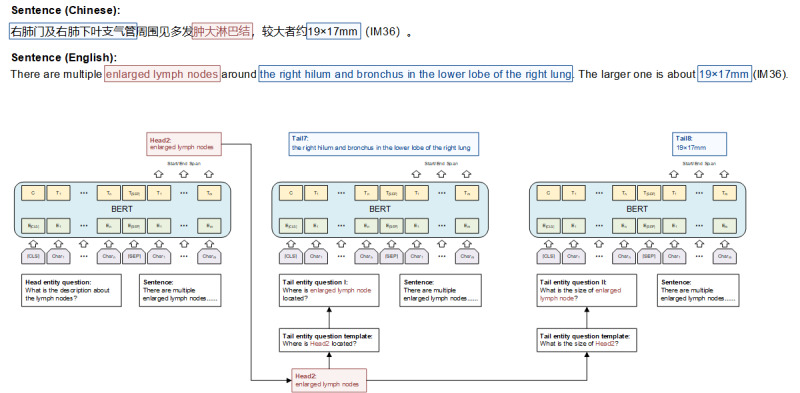
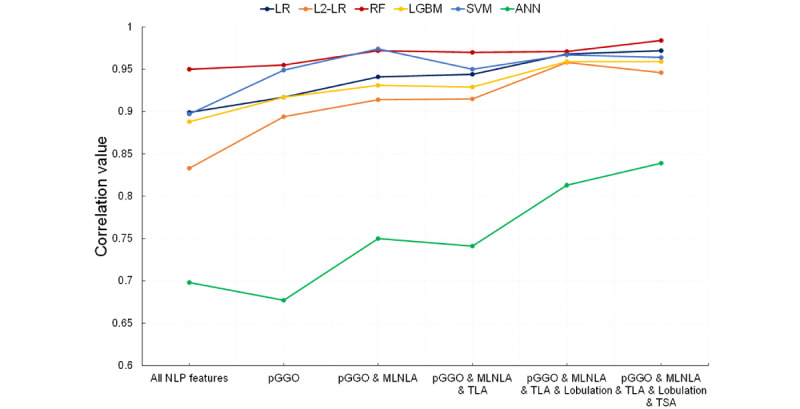
Methods: We developed a multiturn question answering NLP model to extract features about the primary tumor and lymph nodes from computed tomography (CT) reports. We then combined these features with other structured clinical characteristics to develop LNM prediction models using machine learning algorithms. We conducted extensive experiments to explore the effectiveness of the predictive models and compared them with size criteria based on CT image findings (the maximum short axis diameter of lymph node >10 mm was regarded as a metastatic node) and clinician's evaluation. Since the NLP model may extract features with mistakes, we also calculated the concordance correlation between the predicted probabilities of models using NLP-extracted features and gold standard features to explore the influence of NLP-driven automatic extraction.
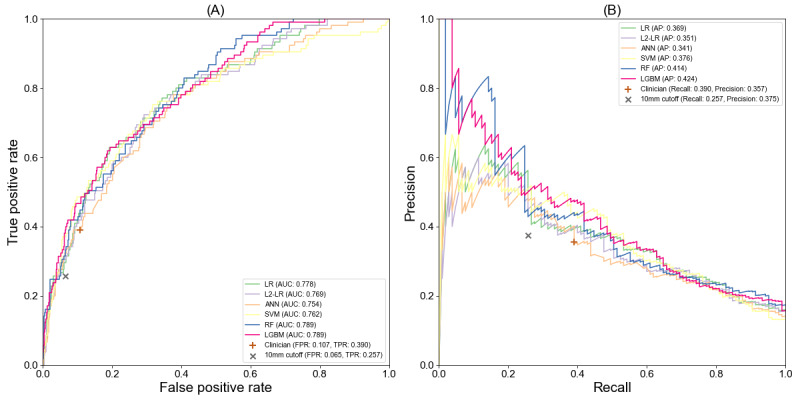
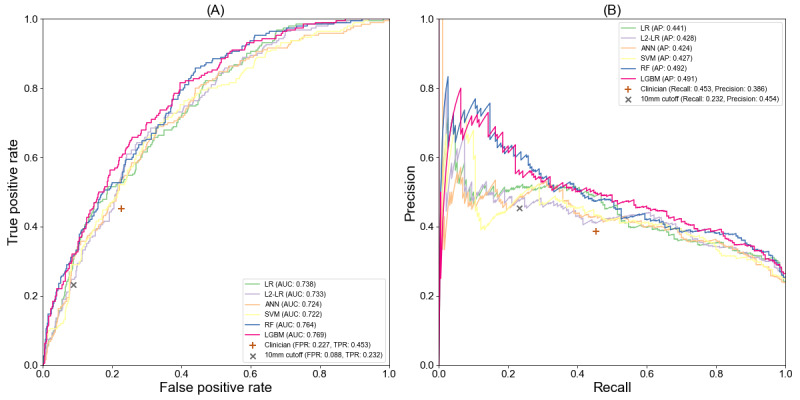
Results: Experimental results show that the random forest models achieved the best performances with 0.792 area under the receiver operating characteristic curve (AUC) value and 0.456 average precision (AP) value for pN2 LNM prediction and 0.768 AUC value and 0.524 AP value for pN1&N2 LNM prediction. And all machine learning models outperformed the size criteria and clinician's evaluation. The concordance correlation between the random forest models using NLP-extracted features and gold standard features is 0.950 and improved to 0.984 when the top 5 important NLP-extracted features were replaced with gold standard features.
Conclusions: The LNM models developed can achieve competitive performance using only limited EMR data such as CT reports and tumor markers in comparison with the clinician's evaluation. The multiturn question answering NLP model can extract features effectively to support the development of LNM prediction models, which may facilitate the clinical application of predictive models.
Keywords: algorithm; decision making; electronic medical records; forest modeling; lung cancer; lymph node metastasis prediction; machine learning; natural language processing; non–small cell lung cancer; prediction models.
©Danqing Hu, Shaolei Li, Huanyao Zhang, Nan Wu, Xudong Lu. Originally published in JMIR Medical Informatics (https://medinform.jmir.org), 25.04.2022.
Conflict of interest statement
Conflicts of Interest: None declared.
Figures
References
-
- Cancer facts and figures 2021. American Cancer Society. [2021-07-14]. https://www.cancer.org/research/cancer-facts-statistics/all-cancer-facts... .
-
- Ettinger D, Wood D, Aisner D, Akerley W, Bauman J, Chirieac L, D'Amico T, DeCamp M, Dilling T, Dobelbower M, Doebele R, Govindan R, Gubens M, Hennon M, Horn L, Komaki R, Lackner R, Lanuti M, Leal T, Leisch L, Lilenbaum R, Lin J, Loo B, Martins R, Otterson G, Reckamp K, Riely G, Schild S, Shapiro T, Stevenson J, Swanson S, Tauer K, Yang S, Gregory K, Hughes M. Non-Small Cell Lung Cancer, Version 5.2017, NCCN Clinical Practice Guidelines in Oncology. J Natl Compr Canc Netw. 2017 Apr;15(4):504–535. doi: 10.6004/jnccn.2017.0050. https://www.nccn.org/guidelines/guidelines-detail?category=1&id=1450 15/4/504 - DOI - PubMed
LinkOut - more resources
Full Text Sources
Miscellaneous
