


Sugar-sweetened beverage and sugar consumption and colorectal cancer incidence and mortality according to anatomic subsite
- PMID: 35470384
- PMCID: PMC9170474
- DOI: 10.1093/ajcn/nqac040
Sugar-sweetened beverage and sugar consumption and colorectal cancer incidence and mortality according to anatomic subsite
Abstract
Background: Recent preclinical research strongly suggests that dietary sugars can enhance colorectal tumorigenesis by direct action, particularly in the proximal colon that unabsorbed fructose reaches.
Objectives: We aimed to examine long-term consumption of sugar-sweetened beverages (SSBs) and total fructose in relation to incidence and mortality of colorectal cancer (CRC) by anatomic subsite.
Methods: We followed 121,111 participants from 2 prospective US cohort studies, the Nurses' Health Study (1984-2014) and Health Professionals Follow-Up Study (1986-2014), for incident CRC and related death. Cox proportional hazards regression was used to compute HRs and 95% CIs.
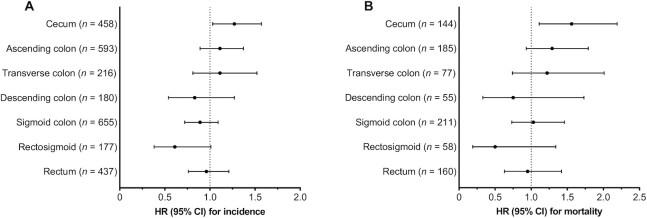
Results: During follow-up, we documented 2733 incident cases of CRC with a known anatomic location, of whom 901 died from CRC. Positive associations of SSB and total fructose intakes with cancer incidence and mortality were observed in the proximal colon but not in the distal colon or rectum (Pheterogeneity ≤ 0.03). SSB consumption was associated with a statistically significant increase in the incidence of proximal colon cancer (HR per 1-serving/d increment: 1.18; 95% CI: 1.03, 1.34; Ptrend = 0.02) and a more pronounced elevation in the mortality of proximal colon cancer (HR: 1.39; 95% CI: 1.13, 1.72; Ptrend = 0.002). Similarly, total fructose intake was associated with increased incidence and mortality of proximal colon cancer (HRs per 25-g/d increment: 1.18; 95% CI: 1.03, 1.35; and 1.42; 95% CI: 1.12, 1.79, respectively). Moreover, SSB and total fructose intakes during the most recent 10 y, rather than those from a more distant period, were associated with increased incidence of proximal colon cancer.
Conclusions: SSB and total fructose consumption were associated with increased incidence and mortality of proximal colon cancer, particularly during later stages of tumorigenesis.
Keywords: added sugar; colorectal cancer; fructose; sucrose; sugar-sweetened beverages.
© The Author(s) 2022. Published by Oxford University Press on behalf of the American Society for Nutrition.
Figures
Comment in
-
Let's not sugarcoat it: the association of sugar-sweetened beverage intake with colorectal cancer risk may be subsite-specific.Am J Clin Nutr. 2022 Jun 7;115(6):1453-1454. doi: 10.1093/ajcn/nqac077. Am J Clin Nutr. 2022. PMID: 35467723 No abstract available.
References
-
- Johnson RK, Appel LJ, Brands M, Howard BV, Lefevre M, Lustig RH, Sacks F, Steffen LM, Wylie-Rosett J. Dietary sugars intake and cardiovascular health: a scientific statement from the American Heart Association. Circulation. 2009;120(11):1011–20. - PubMed
-
- Guthrie JF, Morton JF. Food sources of added sweeteners in the diets of Americans. J Am Diet Assoc. 2000;100(1):43–51., quiz 49–50. - PubMed
-
- Ravich WJ, Bayless TM, Thomas M. Fructose: incomplete intestinal absorption in humans. Gastroenterology. 1983;84(1):26–9. - PubMed
-
- Beyer PL, Caviar EM, McCallum RW. Fructose intake at current levels in the United States may cause gastrointestinal distress in normal adults. J Am Diet Assoc. 2005;105(10):1559–66. - PubMed
Publication types
MeSH terms
Substances
Grants and funding
LinkOut - more resources
Full Text Sources
Medical
