


Strategies for managing marine disease
- PMID: 35470930
- PMCID: PMC9786832
- DOI: 10.1002/eap.2643
Strategies for managing marine disease
Abstract
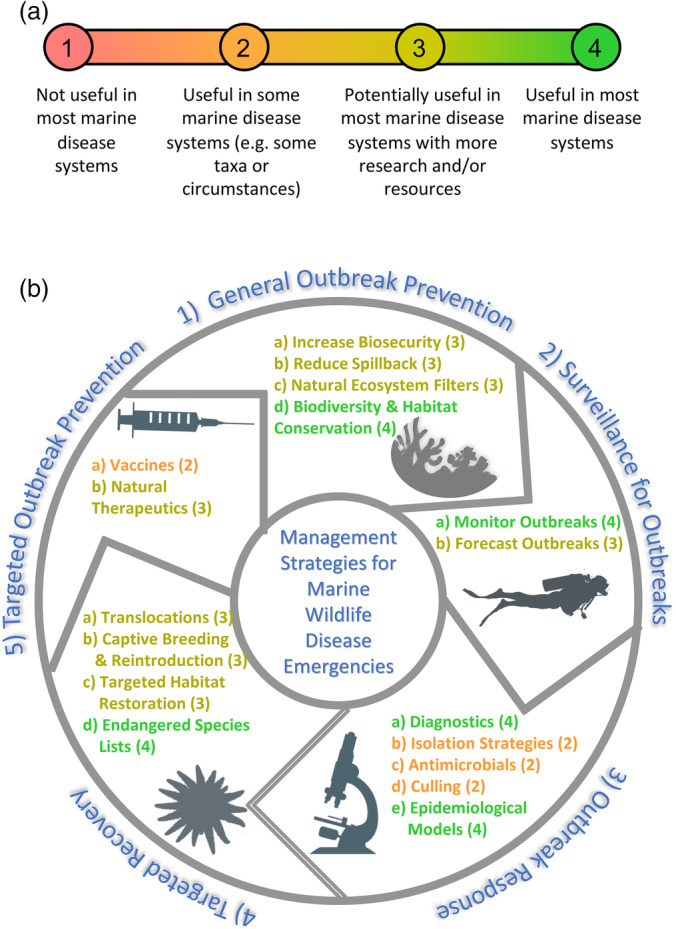
The incidence of emerging infectious diseases (EIDs) has increased in wildlife populations in recent years and is expected to continue to increase with global environmental change. Marine diseases are relatively understudied compared with terrestrial diseases but warrant parallel attention as they can disrupt ecosystems, cause economic loss, and threaten human livelihoods. Although there are many existing tools to combat the direct and indirect consequences of EIDs, these management strategies are often insufficient or ineffective in marine habitats compared with their terrestrial counterparts, often due to fundamental differences between marine and terrestrial systems. Here, we first illustrate how the marine environment and marine organism life histories present challenges and opportunities for wildlife disease management. We then assess the application of common disease management strategies to marine versus terrestrial systems to identify those that may be most effective for marine disease outbreak prevention, response, and recovery. Finally, we recommend multiple actions that will enable more successful management of marine wildlife disease emergencies in the future. These include prioritizing marine disease research and understanding its links to climate change, improving marine ecosystem health, forming better monitoring and response networks, developing marine veterinary medicine programs, and enacting policy that addresses marine and other wildlife diseases. Overall, we encourage a more proactive rather than reactive approach to marine wildlife disease management and emphasize that multidisciplinary collaborations are crucial to managing marine wildlife health.
Keywords: disease ecology; marine conservation; marine wildlife.
© 2022 The Authors. Ecological Applications published by Wiley Periodicals LLC on behalf of The Ecological Society of America.
Conflict of interest statement
The authors declare no conflict of interest.
Figures


References
-
- Aguirre‐Macedo, M. L. , Vidal‐Martinez V. M., Herrera‐Silveira J. A., Valdés‐Lozano D. S., Herrera‐Rodríguez M., and Olvera‐Novoa M. A.. 2008. “Ballast Water as a Vector of Coral Pathogens in the Gulf of Mexico: The Case of the Cayo Arcas Coral Reef.” Marine Pollution Bulletin 56: 1570–7. - PubMed
-
- Albert, E. M. , Fernández‐Beaskoetxea S., Godoy J. A., Tobler U., Schmidt B. R., and Bosch J.. 2015. “Genetic Management of an Amphibian Population after a Chytridiomycosis Outbreak.” Conservation Genetics 16: 103–11.
-
- Amos, K. , Thomas J., and Hopper K.. 1998. “A Case History of Adaptive Management Strategies for Viral Hemorrhagic Septicemia Virus (VHSV) in Washington State.” Journal of Aquatic Animal Health 10: 152–9.
MeSH terms
LinkOut - more resources
Full Text Sources
