. 2022 May 30;12(6):jkac096.
doi: 10.1093/g3journal/jkac096.

Alfalfa (Medicago sativa L.) pho2 mutant plants hyperaccumulate phosphate

Affiliations

Alfalfa (Medicago sativa L.) pho2 mutant plants hyperaccumulate phosphate

Susan S Miller et al. G3 (Bethesda). .

Abstract

In this article, we describe a set of novel alfalfa (Medicago sativa L.) plants that hyper-accumulate Phosphate ion (Pi) at levels 3- to 6-fold higher than wild-type. This alfalfa germplasm will have practical applications reclaiming Pi from contaminated or enriched soil or be used in conservation buffer strips to protect waterways from Pi run-off. Hyper-accumulating alfalfa plants were generated by targeted mutagenesis of PHOSPHATE2 (PHO2) using newly created CRISPR/Cas9 reagents and an improved mutant screening strategy. PHO2 encodes a ubiquitin conjugating E2 enzyme (UBC24) previously characterized in Arabidopsis thaliana, Medicago truncatula, and Oryza sativa. Mutations of PHO2 disrupt Pi homeostasis resulting in Pi hyper-accumulation. Successful CRISPR/Cas9 editing of PHO2 demonstrates that this is an efficient mutagenesis tool in alfalfa despite its complex autotetraploid genome structure. Arabidopsis and M. truncatula ortholog genes were used to identify PHO2 haplotypes in outcrossing tetraploid M. sativa with the aim of generating heritable mutations in both PHO2-like genes (PHO2-B and PHO2-C). After delivery of the reagent and regeneration from transformed leaf explants, plants with mutations in all haplotypes of PHO2-B and PHO2-C were identified. These plants were evaluated for morphology, Pi accumulation, heritable transmission of targeted mutations, segregation of mutant haplotypes and removal of T-DNA(s). The Agrobacterium-mediated transformation assay and gene editing reagents reported here were also evaluated for further optimization for future alfalfa functional genomic studies.

Keywords: Agrobacterium; CRISPR/Cas9; alfalfa; haplotype; pho2.


Figures

Fig. 1.
Fig. 1.
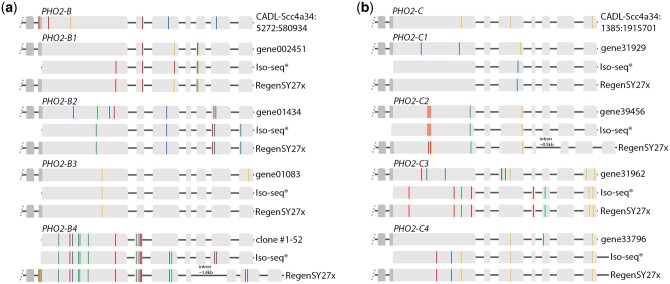
The analysis of PHO2-B and PHO2-C haplotypes. a, b) A schematic representation of the PHO2-B and PHO2-C haplotypes identified in this study. The CADL haplotypes was initially used to identify reagent target sites and facilitate the cloning of genomic clones from RegenSY27x. Each haplotype would be assigned a chromosome number based on its sequence similarity to its haplotype in the medsa. XinJiangDaYe.gnm1 assembly. For example, PHO2-B1-chr2.1, gene002451 and PHO2-C4-chr4.4, gene33796. In addition, the genomic sequences for all of the PHO2-B and PHO2-C haplotypes were identified in a prereleased draft version of the RegenSY27x version x0.9 genome assembly. Notable similarities and some differences can be observed between the haplotypes of medsa. XinJiangDaYe.gnm1 and RegenSY27x version 0.9 assemblies. In addition, the sequence data from the RegenSY27x assembly demonstrated the reliability of the Iso-seq data used initially to identify haplotypes prior to the availability of tetraploid assemblies. The cloned sequence of PHO2-B4 (clone #1-52) used as a placeholder for most this study and was likely a chimera of the PHO2-B3 and PHO2-B4 genomic clones possibly resulting from PCR template swapping.
Fig. 2.
Fig. 2.
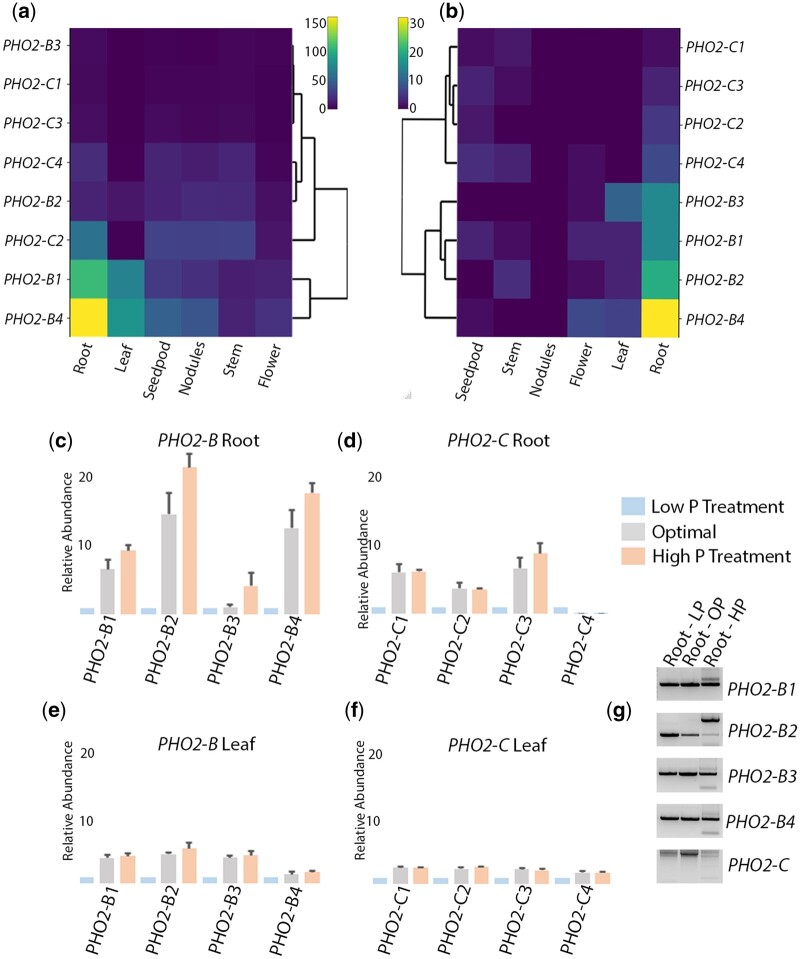
Expression analysis of PHO2-B and PHO2-C genes in alfalfa. a) RNA-seq reads from flower, stem, nodules, seedpod, leaf, and root tissues from the RegenSY27x genotype were mapped to a modified medsa. XinJiangDaYe.gnm1 assembly (Supplementary Data 1). b) PacBio Iso-seq reads from the same flower, stem, nodules, seedpod, leaf, and root tissues, but at less sequencing depth than the RNA-seq experiment. (c–f) Quantitative RT-PCR expression analysis of PHO2-B and PHO2-C genes from root and leaf tissue grown on low (LP; 10 ppm), optimal (OP; 40 ppm, and high (HP; 60 ppm) phosphate treatments. g) Validation of transcript cleavage by miR399 using an RNA-ligase mediated-rapid amplification of cDNA ends assay (RLM-RACE). The gel shows evidence for haplotypes specific cleavage in the PHO2-B haplotypes but not PHO2-C with the high P treatment. LP is low P treatment, OP is optimal treatment, and HP is high P treatment.
Fig. 3.
Fig. 3.
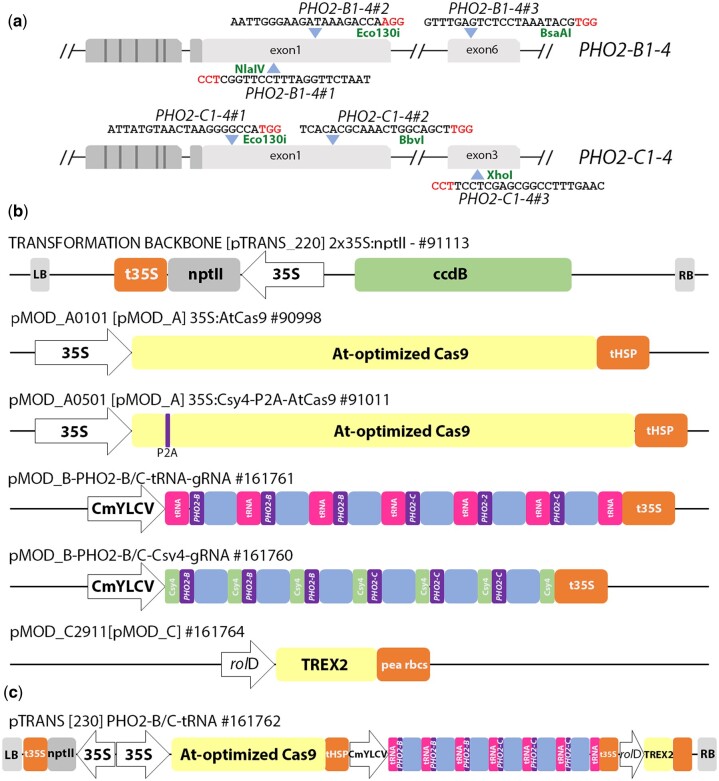
Schematic representation of the PHO2-B and PHO2-C targets and the reagent components. a) Three gRNA targets were designed for each of the 4 PHO2-B and PHO2-C haplotypes with 2 targets in the first exon and the third target in exon 6 for PHO2-B and exon 3 for PHO2-C. b) The reagent components include; the binary vector backbone [pTRANS_220] containing a 35S: nptII selectable marker for kanamycin selection, a Cas9 [pMOD_A] module, a guide RNA [pMOD_B] module that can utilize either the Csy4 or tRNA splicing mechanism for the release of multiple gRNAs, and the rolD: TREX2 exonuclease, in a [pMOD_C] module. All 3 modules are assembled into the binary vector by AarI-mediated golden gate reaction. c) The completed reagent is sequence confirmed and transformed into the Agrobacterium strain LBA4404 for alfalfa leaf explant transformation (Samac and Austin-Phillips 2006). The following nomenclature was used to indicate the type of reagent used for the gene editing. For example, “PhoM#” and “PhocM#” refer to either the pDIRECT or pTRANS reagents with the “c” indicating Csy4 splicing system. The “t” in “PhotM#” refers to the pTRANS reagent with the tRNA splicing system. Both the pTRANS reagents (PhocM# and PhotM#) harbor the TREX2 exonuclease cassette.
Fig. 4.
Fig. 4.
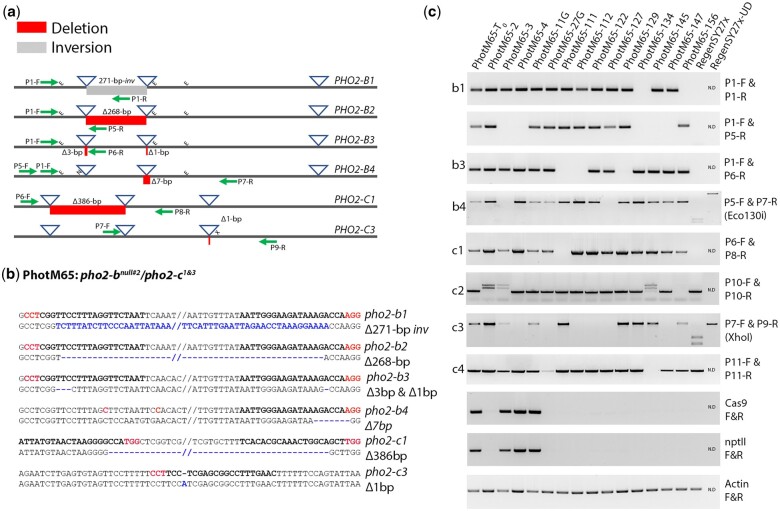
The validation PhotM65 mutant plants. a) Schematic representation of the PCR assays used to validate mutant haplotypes. The blue triangle represents the reagent target sites and the red and gray boxes indicate deleted or inverted DNA sequences, respectively. The green arrows represent the approximate primer locations used to generate amplicons. The “E,” “X,” and the “NlaIV” indicate the location of the Eco130i, XhoI, and NlaIV restriction sites used to genotype haplotypes. b) Sequence confirmation of the haplotypes was carried out using sequence data from the LAA analysis as well as from cloning and sequencing assays using haplotype specific amplicons. The bold red and black text represents the PAM and target guide RNA sites for each reagent, respectively, and the blue text and lime green highlights indicate inverted or deleted DNA sequence. c) Gel images of mutant and wild-type haplotype-specific amplicons from PhotM65 T0 and T1 plants. The absence of a haplotype specific amplicon indicates the segregation of the mutant haplotype in respective plants. Amplicons for the Cas9 and the nptII selectable marker were used to identify the presence or absence of reagent T-DNA in the mutant plants.
Fig. 5.
Fig. 5.
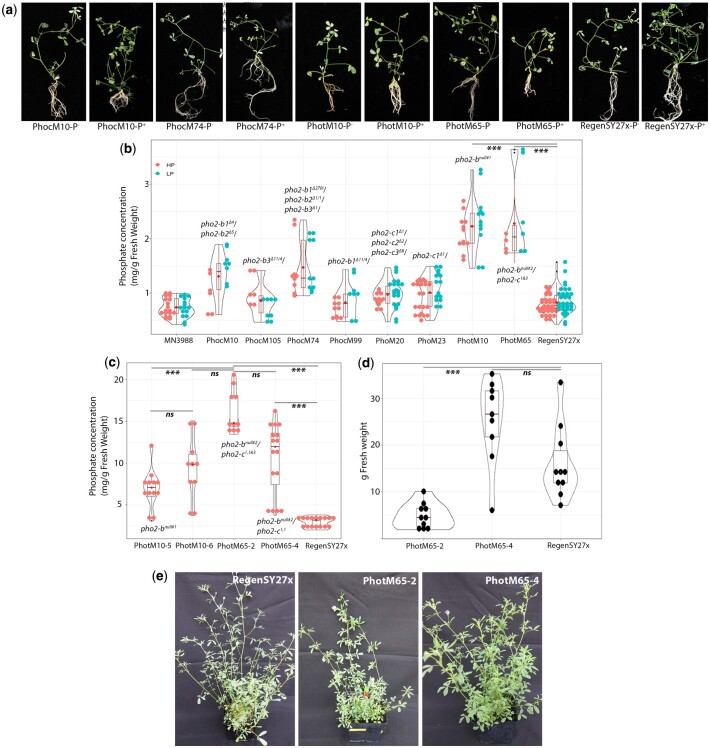
Phenotype screen and analysis alfalfa pho2 mutant plants. a) Morphological appearance of pho2b and pho2-c mutant seedlings grown in plates on low and high Pi media. b) Pi concentration in these shoots, measured in mg Pi g−1 fresh weight by a soluble Pi measurement assay. c) Cuttings from RegenSY27x and PhotM10-5, PhotM10-5, PhotM65-2, and PhotM65-4 grown in soil watered with high P Ruakura nutrient solution 3 times per week for 5 weeks. d) The g/fresh weight of shoot biomass from RegenSY27x, PhotM65-2, and PhotM65-4 plants 5 weeks postclipping. e) RegenSY27x, PhotM65-2, and PhotM65-4 5 weeks postclipping.

References

    1. Aliu E, Azanu MK, Wang and K. Lee K.. Generation of thymidine auxotrophic Agrobacterium tumefaciens strains for plant transformation. bioRxiv. 2020;1–20. DOI: 10.1101/2020.08.21.261941. - DOI
    1. Arsic M, Le Tougaard S, Persson DP, Martens HJ, Doolette CL, Lombi E, Schjoerring JK, Husted S.. Bioimaging techniques reveal foliar phosphate uptake pathways and leaf phosphorus status. Plant Physiol. 2020;183(4):1472–1483. - PMC - PubMed
    1. Aung K, Lin S-I, Wu C-C, Huang Y-T, Su C-L, Chiou T-J.. pho2, a phosphate overaccumulator, is caused by a nonsense mutation in a microRNA399 target gene. Plant Physiol. 2006;141(3):1000–1011. - PMC - PubMed
    1. Bae S, Park J, Kim JS.. Cas-OFFinder: a fast and versatile algorithm that searches for potential off-target sites of Cas9 RNA-guided endonucleases. Bioinformatics. 2014;30(10):1473–1475. - PMC - PubMed
    1. Bari R, Datt Pant B, Stitt M, Scheible WR.. PHO2, microRNA399, and PHR1 define a phosphate-signaling pathway in plants. Plant Physiol. 2006;141(3):988–999. - PMC - PubMed

Publication types

MeSH terms