


Expanding the utility of the ROX index among patients with acute hypoxemic respiratory failure
- PMID: 35472205
- PMCID: PMC9041854
- DOI: 10.1371/journal.pone.0261234
Expanding the utility of the ROX index among patients with acute hypoxemic respiratory failure
Erratum in
-
Correction: Expanding the utility of the ROX index among patients with acute hypoxemic respiratory failure.PLoS One. 2023 Feb 16;18(2):e0282136. doi: 10.1371/journal.pone.0282136. eCollection 2023. PLoS One. 2023. PMID: 36795711 Free PMC article.
Abstract
Background: Delaying intubation in patients who fail high-flow nasal cannula (HFNC) may result in increased mortality. The ROX index has been validated to predict HFNC failure among pneumonia patients with acute hypoxemic respiratory failure (AHRF), but little information is available for non-pneumonia causes. In this study, we validate the ROX index among AHRF patients due to both pneumonia or non-pneumonia causes, focusing on early prediction.
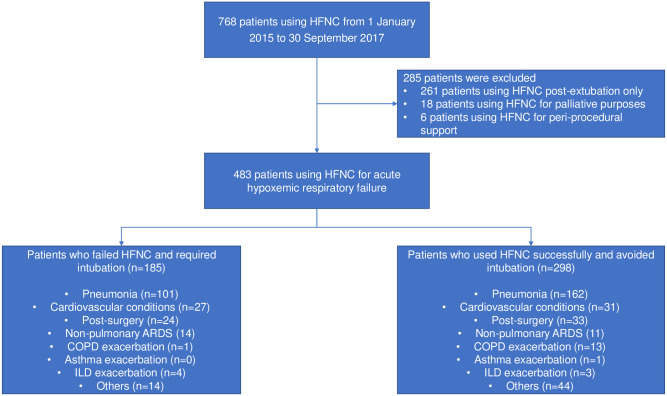
Methods: This was a retrospective observational study in eight Singapore intensive care units from 1 January 2015 to 30 September 2017. All patients >18 years who were treated with HFNC for AHRF were eligible and recruited. Clinical parameters and arterial blood gas values at HFNC initiation and one hour were recorded. HFNC failure was defined as requiring intubation post-HFNC initiation.
Results: HFNC was used in 483 patients with 185 (38.3%) failing HFNC. Among pneumonia patients, the ROX index was most discriminatory in pneumonia patients one hour after HFNC initiation [AUC 0.71 (95% CI 0.64-0.79)], with a threshold value of <6.06 at one hour predicting HFNC failure (sensitivity 51%, specificity 80%, positive predictive value 61%, negative predictive value 73%). The discriminatory power remained moderate among pneumonia patients upon HFNC initiation [AUC 0.65 (95% CI 0.57-0.72)], non-pneumonia patients at HFNC initiation [AUC 0.62 (95% CI 0.55-0.69)] and one hour later [AUC 0.63 (95% CI 0.56-0.70)].
Conclusion: The ROX index demonstrated moderate discriminatory power among patients with either pneumonia or non-pneumonia-related AHRF at HFNC initiation and one hour later.
Conflict of interest statement
The authors have read the journal’s policy and have the following competing interests: KCS received honoraria and travel support from Medtronic and GE Healthcare. MC received travel support and honorarium from Baxter and Medtronic. JP and KR have received travel support from Medtronic. The rest of the authors have no competing interests. This does not alter our adherence to PLOS ONE policies on sharing data and materials. There are no patents, products in development or marketed products associated with this research to declare.
References
Publication types
MeSH terms
LinkOut - more resources
Full Text Sources
Medical
