


Interaction between AhR and HIF-1 signaling pathways mediated by ARNT/HIF-1β
- PMID: 35473600
- PMCID: PMC9044668
- DOI: 10.1186/s40360-022-00564-8
Interaction between AhR and HIF-1 signaling pathways mediated by ARNT/HIF-1β
Abstract
Background: The main causes of lung cancer are smoking, environmental pollution and genetic susceptibility. It is an indisputable fact that PAHs are related to lung cancer, and benzo(a) pyrene is a representative of PAHs. The purpose of the current investigation was to investigate the interaction between AhR and HIF-1 signaling pathways in A549 cells, which provide some experimental basis for scientists to find drugs that block AhR and HIF-1 signaling pathway to prevent and treat cancer.
Methods: This project adopts the CYP1A1 signaling pathways and the expression of CYP1B1 is expressed as a measure of AhR strength index. The expression of VEGF and CAIX volume as a measure of the strength of the signal path HIF-1 indicators. Through the construction of plasmid vector, fluorescence resonance energy transfer, real-time quantitative PCR, western blotting and immunoprecipitation, the interaction between AhR signaling pathway and HIF-1 signaling pathway was observed.
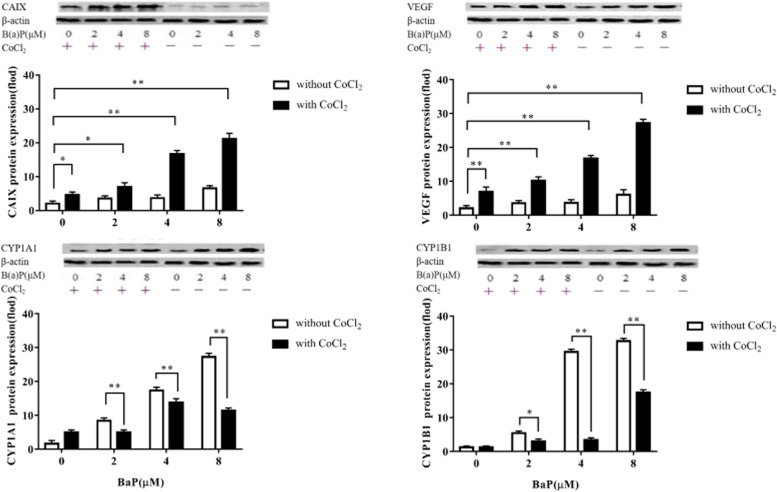
Results: BaP can enhance the binding ability of HIF-1α protein to HIF-1β/ARNT in a dose-dependent manner without CoCl2. However, the binding ability of AhR protein to HIF-1β/ARNT is inhibited by HIF-1α signaling pathway in a dose-dependent manner with CoCl2.
Conclusion: It is shown that activation of the AhR signaling pathway does not inhibit the HIF-1α signaling pathway, but activation of the HIF-1α signaling pathway inhibits the AhR signaling pathway.
Keywords: Aryl hydrocarbon receptor; Aryl hydrocarbon receptor nuclear translocator; Benzopyrene; CoCl2; Hypoxia-inducible factor-1α.
© 2022. The Author(s).
Conflict of interest statement
The funding organizations played no role in the study design; in the collection, analysis, and interpretation of data; in the writing of the report; or in the decision to submit the report for publication.
Figures



References
-
- Hong CH, Lee CH, Yu HS, et al. Benzopyrene, a major polyaromatic hydrocarbon in smoke fume, mobilizes Langerhans cells and polarizes Th2/17 responses in epicutaneous protein sensitization through the aryl hydrocarbon receptor. Int Immunopharmacol. 2016;36:111–117. doi: 10.1016/j.intimp.2016.04.017. - DOI - PubMed
MeSH terms
Substances
LinkOut - more resources
Full Text Sources
Medical
Molecular Biology Databases
