


Global use of SGLT2 inhibitors and GLP-1 receptor agonists in type 2 diabetes. Results from DISCOVER
- PMID: 35473607
- PMCID: PMC9040320
- DOI: 10.1186/s12902-022-01026-2
Global use of SGLT2 inhibitors and GLP-1 receptor agonists in type 2 diabetes. Results from DISCOVER
Abstract
Background: Despite strong evidence of benefit, uptake of newer glucose-lowering medications that reduce cardiovascular risk has been low. We sought to examine global trends and predictors of use of SGLT2i and GLP-1 RA in patients with type 2 diabetes.
Methods: DISCOVER is a global, prospective, observational study of patients with diabetes enrolled from 2014-16 at initiation of second-line glucose-lowering therapy and followed for 3 years. We used hierarchical logistic regression to examine factors associated with use of either an SGLT2i or GLP-1 RA at last follow-up and to assess country-level variability.
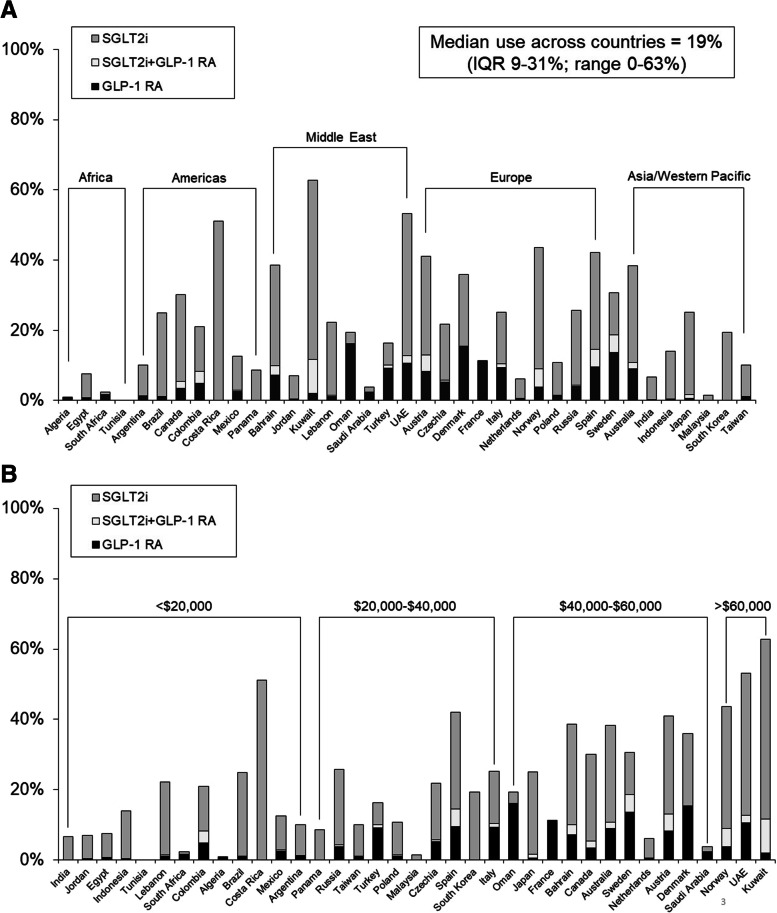
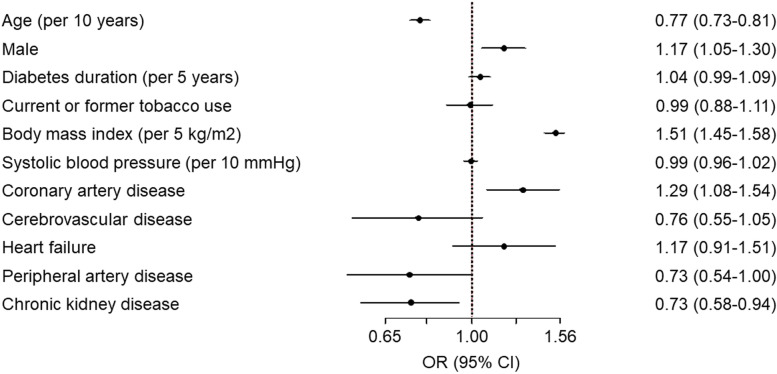
Results: Among 14,576 patients from 37 countries, 1579 (10.8%) were started on an SGLT2i (1275; 8.7%) or GLP-1 RA (318; 2.2%) at enrollment, increasing to 16.1% at end of follow-up, with large variability across countries (range 0-62.7%). Use was highest in patients treated by cardiologists (26.1%) versus primary care physicians (10.4%), endocrinologists (16.9%), and other specialists (22.0%; p < 0.001). Coronary artery disease (OR 1.29, 95% CI 1.08-1.54) was associated with greater use of SGLT2i or GLP-1 RA while peripheral artery disease (OR 0.73, 95% CI 0.54-1.00) and chronic kidney disease (OR 0.73, 95% CI 0.58-0.94) were associated with lower use (OR 0.73, 95% CI 0.54-1.00). The country-level median odds ratio was 3.48, indicating a very large amount of variability in the use of SGLT2i or GLP-1 RA independent of patient demographic and clinical factors.
Conclusions: Global use of glucose-lowering medications with established cardiovascular benefits has increased over time but remains suboptimal, particularly in sub-groups most likely to benefit. Substantial country-level variability exists independent of patient factors, suggesting structural barriers may limit more widespread use of these medications.
Keywords: Cardiovascular disease; Diabetes; Quality of care.
© 2022. The Author(s).
Conflict of interest statement
AC, HC: Employees of AstraZeneca. MBG: Support from AstraZeneca to attend DISCOVER planning meetings; honoraria from Merck-Serono. WR: Research support from Novo Nordisk. IS: Honoraria from Astellas Pharma, AstraZeneca, Boehringer Ingelheim, Kowa, Merck Sharp & Dohme, Mitsubishi Tanabe Pharma, Novo Nordisk, Ono Pharmaceutical, Sanwa Kagaku Kenkyusho and Takeda Pharmaceutical, and research support from Astellas Pharma, AstraZeneca, Daiichi Sankyo, Eli Lilly, Japan Foundation for Applied Enzymology, Japan Science and Technology Agency, Kowa, Kyowa Hakko Kirin, Midori Health Management Center, Mitsubishi Tanabe Pharma, Novo Nordisk, Ono Pharmaceutical, Sanofi, Suzuken Memorial Foundation and Takeda Pharmaceutical. JV: Former employee of AstraZeneca. HW: Support from AstraZeneca to attend DISCOVER planning meetings; honoraria from Astellas Pharma, AstraZeneca, Boehringer Ingelheim, Daiichi Sankyo, Sumitomo Dainippon Pharma, Eli Lilly, Kissei Pharmaceutical, Kowa Pharmaceuticals America Inc., Kyowa Hakko Kirin, Merck Sharp & Dohme, Mitsubishi Tanabe Pharma, Novartis, Novo Nordisk, Ono Pharmaceutical, Sanofi, Sanwa Kagaku Kenkyusho and Takeda; research support from Abbott, Astellas Pharma, AstraZeneca, Bayer, Benefit One Health Care, Boehringer Ingelheim, Bristol-Myers Squibb, Daiichi Sankyo, Dainippon Sumitomo Pharma, Eli Lilly, Johnson & Johnson, Kissei Pharmaceutical, Kowa Pharmaceuticals America Inc., Kyowa Hakko Kirin, Merck Sharp & Dohme, Mitsubishi Tanabe Pharma, Mochida Pharmaceutical, Nitto Boseki, Novartis, Novo Nordisk, Ono Pharmaceutical, Pfizer, Sanofi, Sanwa Kagaku Kenkyusho, Taisho Toyama Pharmaceutical, Takeda and Terumo Corp. KK Investigator-initiated studies for Astra Zeneca, Novartis, Novo Nordisk, Sanofi-Aventis, Lilly and Merck Sharp & Dohme, Boehringer Ingelheim, Bayer, Berlin-Chemie AG / Menarini Group, Janssen, and Napp. MK: Support from AstraZeneca to attend DISCOVER planning meetings; honoraria from Amgen, Applied Therapeutics AstraZeneca, Bayer, Boehringer Ingelheim, Eli Lilly, Janssen, Merck (Diabetes), Novo Nordisk, Sanofi and Vifor Pharma.
Figures
References
-
- Arnold SV, Bhatt DL, Barsness GW, Beatty AL, Deedwania PC, Inzucchi SE, Kosiborod M, Leiter LA, Lipska KJ, Newman JD, et al. Clinical management of stable coronary artery disease in patients with Type 2 Diabetes Mellitus: a scientific statement from the American heart association. Circulation. 2020;141(19):e779–e806. doi: 10.1161/CIR.0000000000000766. - DOI - PMC - PubMed
-
- McGuire DK, Shih WJ, Cosentino F, Charbonnel B, Cherney DZI, Dagogo-Jack S, Pratley R, Greenberg M, Wang S, Huyck S, et al. Association of sglt2 inhibitors with cardiovascular and Kidney outcomes in patients with Type 2 Diabetes: a meta-analysis. JAMA Cardiol. 2021;6(2):148–158. doi: 10.1001/jamacardio.2020.4511. - DOI - PMC - PubMed
-
- Kristensen SL, Rorth R, Jhund PS, Docherty KF, Sattar N, Preiss D, Kober L, Petrie MC, McMurray JJV. Cardiovascular, mortality, and kidney outcomes with GLP-1 receptor agonists in patients with type 2 diabetes: a systematic review and meta-analysis of cardiovascular outcome trials. Lancet Diabetes Endocrinol. 2019;7(10):776–785. doi: 10.1016/S2213-8587(19)30249-9. - DOI - PubMed
Publication types
MeSH terms
Substances
Grants and funding
LinkOut - more resources
Full Text Sources
Medical
