


Lessons Learned: Providing Supportive Accountability in an Online Anxiety Intervention
- PMID: 35473652
- PMCID: PMC9115765
- DOI: 10.1016/j.beth.2021.12.002
Lessons Learned: Providing Supportive Accountability in an Online Anxiety Intervention
Abstract
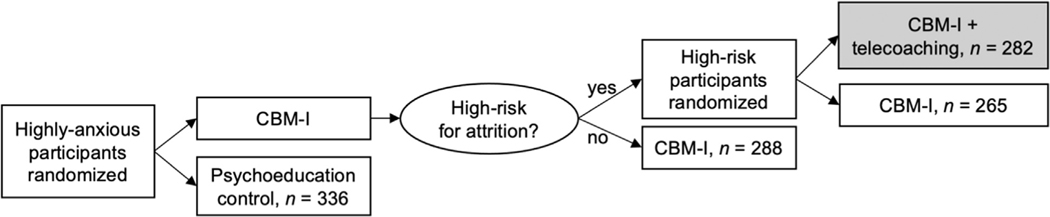
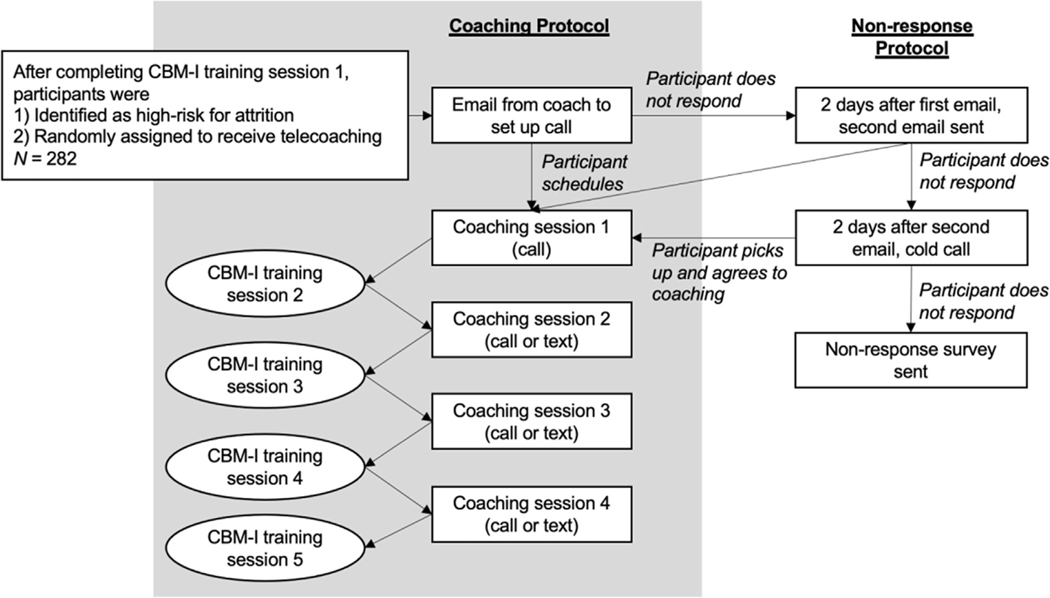
Technology-delivered interventions have the potential to help address the treatment gap in mental health care but are plagued by high attrition. Adding coaching, or minimal contact with a nonspecialist provider, may encourage engagement and decrease dropout, while remaining scalable. Coaching has been studied in interventions for various mental health conditions but has not yet been tested with anxious samples. This study describes the development of and reactions to a low-intensity coaching protocol administered to N = 282 anxious adults identified as high risk to drop out of a web-based cognitive bias modification for interpretation intervention. Undergraduate research assistants were trained as coaches and communicated with participants via phone calls and synchronous text messaging. About half of the sample never responded to coaches' attempts to schedule an initial phone call or did not answer the call, though about 30% completed the full intervention with their coach. Some anxious adults may choose technology-delivered interventions specifically for their lack of human contact and may fear talking to strangers on the phone; future recommendations include taking a more intensive user-centered design approach to creating and implementing a coaching protocol, allowing coaching support to be optional, and providing users with more information about how and why the intervention works.
Keywords: coaching; cognitive bias modification; eHealth; technology-delivered intervention.
Copyright © 2022. Published by Elsevier Ltd.
Conflict of interest statement
Conflict of Interest Statement
The authors declare that there are no conflicts of interest.
Figures
References
-
- Abramowitz JS, Deacon BJ, & Whiteside SPH (2019). Exposure therapy for anxiety: Principles and practice (2nd ed.). Guilford Press; https://books.google.com/books?id=YZ-BDwAAQBAJ.
-
- Alonso J, Liu Z, Evans-Lacko S, Sadikova E, Sampson N, Chatterji S, Abdulmalik J, Aguilar-Gaxiola S, Al-Hamzawi A, Andrade LH, Bruffaerts R, Cardoso G, Cia A, Florescu S, de Girolamo G, Gureje O, Haro JM, He Y, de Jonge P, ... WHO World Mental Health Survey Collaborators (2018). Treatment gap for anxiety disorders is global: Results of the World Mental Health Surveys in 21 countries. Depression and Anxiety, 35(3), 195–208. 10.1002/da.22711. - DOI - PMC - PubMed
-
- Andrade LH, Alonso J, Mneimneh Z, Wells JE, Al-Hamzawi A, Borges G, Bromet E, Bruffaerts R, de Girolamo G, de Graaf R, Florescu S, Gureje O, Hinkov HR, Hu C, Huang Y, Hwang I, Jin R, Karam EG, Kovess-Masfety V, ... Kessler RC (2014). Barriers to mental health treatment: Results from the WHO World Mental Health (WMH) Surveys. Psychological Medicine, 44(6), 1303–1317. 10.1017/S0033291713001943. - DOI - PMC - PubMed
-
- Antony MM, Bieling PJ, Cox BJ, Enns MW, & Swinson RP (1998). Psychometric properties of the 42-item and 21-item versions of the Depression Anxiety Stress Scales in clinical groups and a community sample. Psychological Assessment, 10(2), 176–181. 10.1037/1040-3590.10.2.176. - DOI
Publication types
MeSH terms
Grants and funding
LinkOut - more resources
Full Text Sources
Medical
Miscellaneous
