. 2021 Mar:5:161-179.
doi: 10.1146/annurev-cancerbio-060820-090737. Epub 2020 Dec 2.

Nutritional Preconditioning in Cancer Treatment in Relation to DNA Damage and Aging

Affiliations

Nutritional Preconditioning in Cancer Treatment in Relation to DNA Damage and Aging

Winnie M C van den Boogaard et al. Annu Rev Cancer Biol. 2021 Mar.

Abstract

Dietary restriction (DR) is the most successful nutritional intervention for extending lifespan and preserving health in numerous species. Reducing food intake triggers a protective response that shifts energy resources from growth to maintenance and resilience mechanisms. This so-called survival response has been shown to particularly increase life- and health span and decrease DNA damage in DNA repair-deficient mice exhibiting accelerated aging. Accumulation of DNA damage is the main cause of aging, but also of cancer. Moreover, radiotherapies and most chemotherapies are based on damaging DNA, consistent with their ability to induce toxicity and accelerate aging. Since fasting and DR decrease DNA damage and its effects, nutritional preconditioning holds promise for improving (cancer) therapy and preventing short- and long-term side effects of anticancer treatments. This review provides an overview of the link between aging and cancer, highlights important preclinical studies applying such nutritional preconditioning, and summarizes the first clinical trials implementing nutritional preconditioning in cancer treatment.

Keywords: DNA damage repair; aging; cancer; chemotherapy; dietary restriction; fasting.


Figures
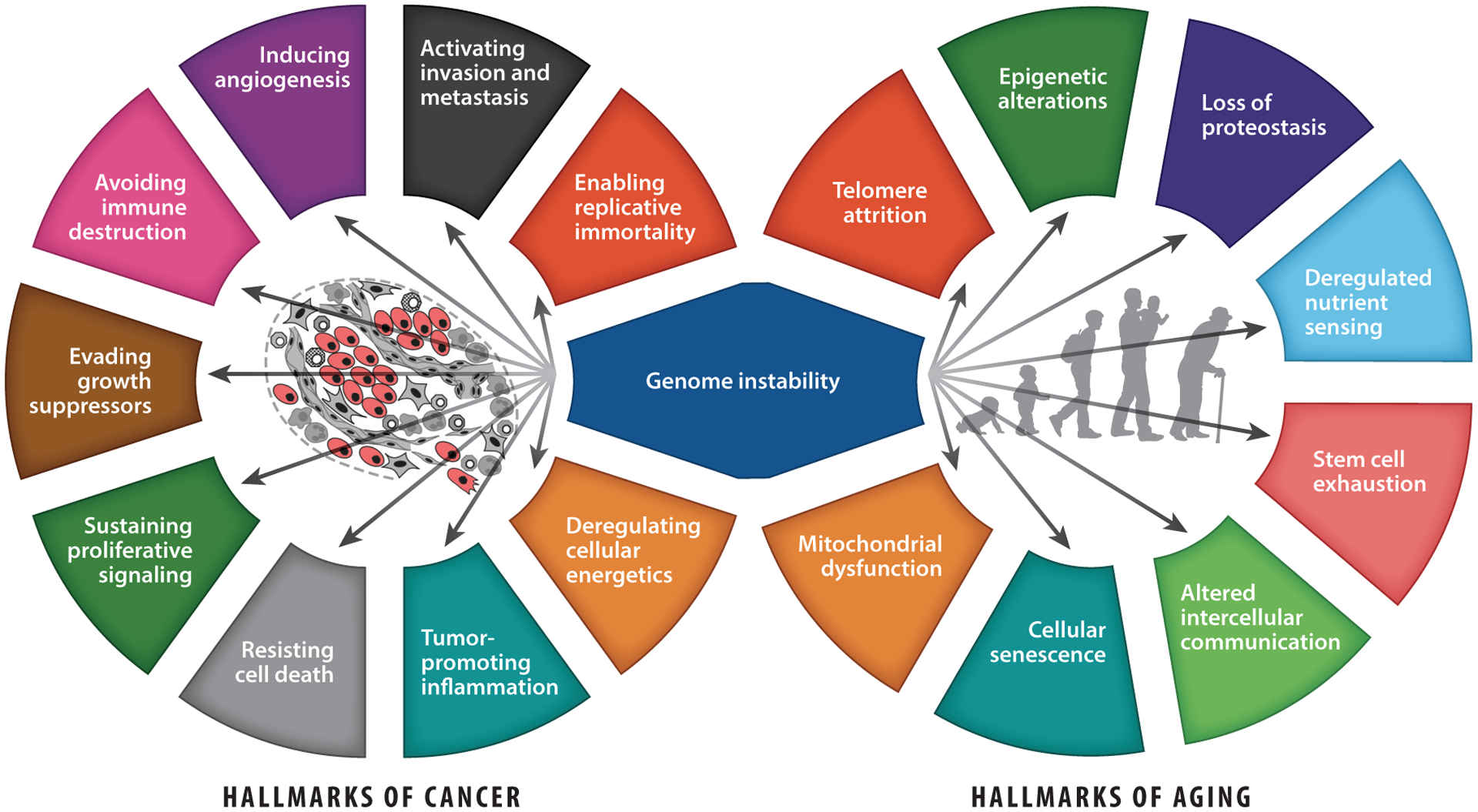
Figure 1
Figure 1
The hallmarks of cancer and aging intersect on genome instability. (Left) The ten hallmarks of cancer, proposed by Hanahan & Weinberg (2011), and (right) the nine hallmarks of aging, proposed by Lòpez-Otin et al. (2013), with genome instability as a common driving hallmark between both. Arrows indicate potential effects of genome instability on other hallmarks, and tumor cells are indicated in red. Center-left image adapted with permission from Hanahan & Weinberg (2011); copyright 2011 Elsevier.
Figure 2
Figure 2
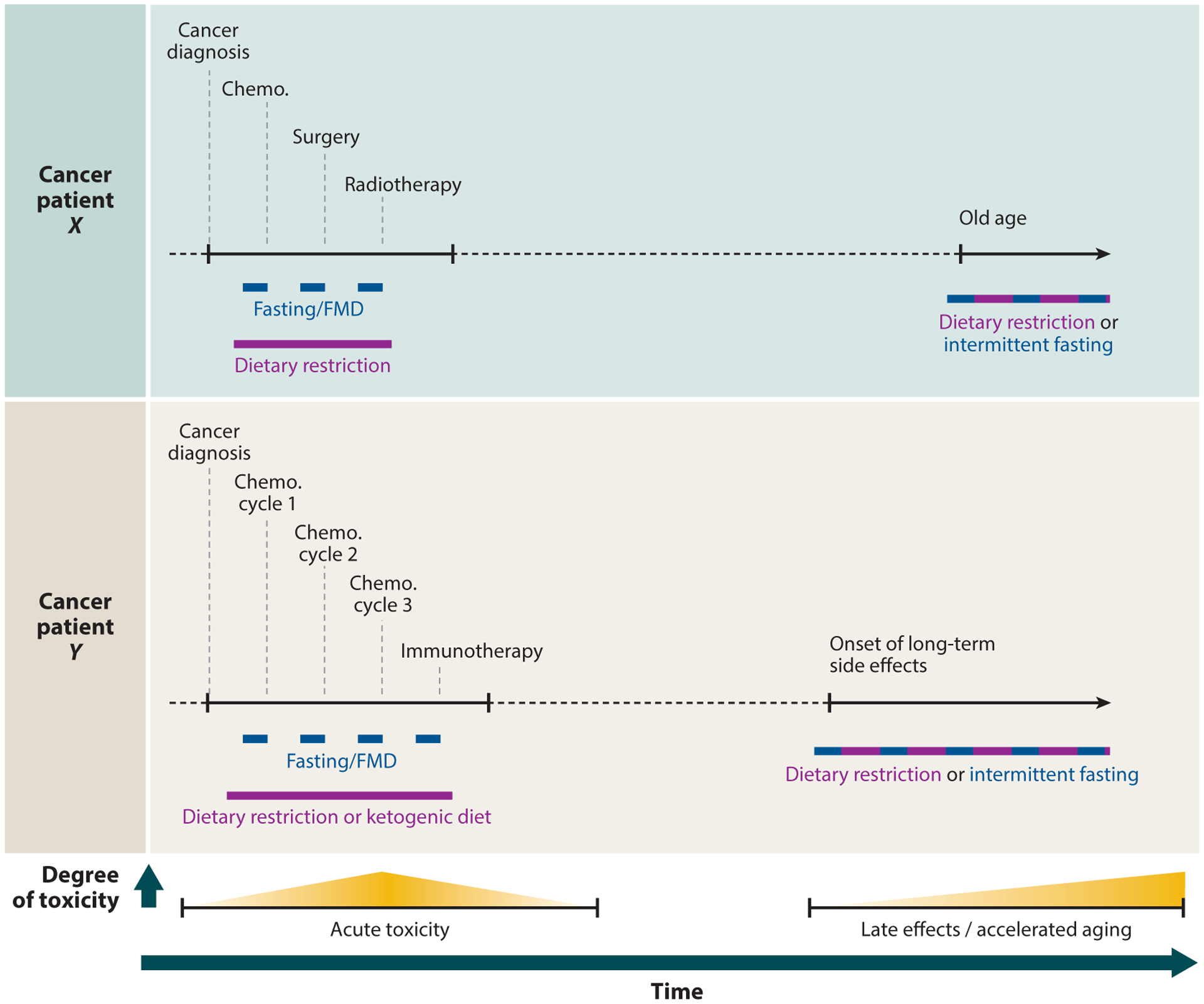
Conceptual overview of nutritional preconditioning implemented alongside cancer treatment (Table 1, Supplemental Table 1) or at older age to prevent side effects of cancer treatment or aging (Supplemental Table 2). Dark blue bars indicate periods of 1–5 days, and purple bars indicate periods of multiple weeks. Abbreviations: chemo., chemotherapy; FMD, fasting-mimicking diet.

References

    1. Ahmad A, Robinson AR, Duensing A, van Drunen E, Beverloo HB, et al. 2008. ERCC1-XPF endonuclease facilitates DNA double-strand break repair. Mol. Cell. Biol 28(16):5082–92 - PMC - PubMed
    1. Armstrong GT, Kawashima T, Leisenring W, Stratton K, Stovall M, et al. 2014. Aging and risk of severe, disabling, life-threatening, and fatal events in the childhood cancer survivor study. J. Clin. Oncol 32(12):1218–27 - PMC - PubMed
    1. Arslan-Ergul A, Erbaba B, Karoglu ET, Halim DO, Adams MM. 2016. Short-term dietary restriction in old zebrafish changes cell senescence mechanisms. Neuroscience 334:64–75 - PubMed
    1. Austad SN. 2012. Ageing: mixed results for dieting monkeys. Nature 489(7415):210–11 - PubMed
    1. Balasubramanian P, Howell PR, Anderson RM. 2017. Aging and caloric restriction research: a biological perspective with translational potential. EBioMedicine 21:37–44 - PMC - PubMed

LinkOut - more resources