


The role of the angular gyrus in semantic cognition: a synthesis of five functional neuroimaging studies
- PMID: 35476027
- PMCID: PMC9813249
- DOI: 10.1007/s00429-022-02493-y
The role of the angular gyrus in semantic cognition: a synthesis of five functional neuroimaging studies
Abstract
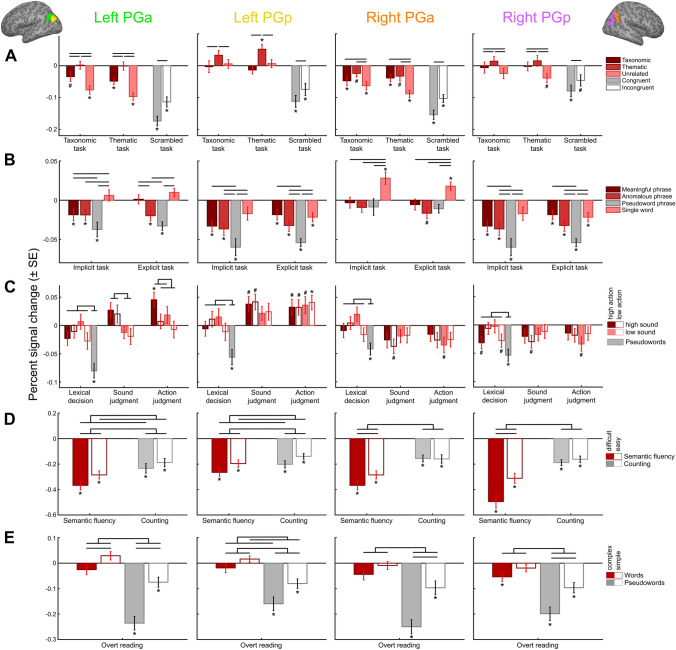
Semantic knowledge is central to human cognition. The angular gyrus (AG) is widely considered a key brain region for semantic cognition. However, the role of the AG in semantic processing is controversial. Key controversies concern response polarity (activation vs. deactivation) and its relation to task difficulty, lateralization (left vs. right AG), and functional-anatomical subdivision (PGa vs. PGp subregions). Here, we combined the fMRI data of five studies on semantic processing (n = 172) and analyzed the response profiles from the same anatomical regions-of-interest for left and right PGa and PGp. We found that the AG was consistently deactivated during non-semantic conditions, whereas response polarity during semantic conditions was inconsistent. However, the AG consistently showed relative response differences between semantic and non-semantic conditions, and between different semantic conditions. A combined analysis across all studies revealed that AG responses could be best explained by separable effects of task difficulty and semantic processing demand. Task difficulty effects were stronger in PGa than PGp, regardless of hemisphere. Semantic effects were stronger in left than right AG, regardless of subregion. These results suggest that the AG is engaged in both domain-general task-difficulty-related processes and domain-specific semantic processes. In semantic processing, we propose that left AG acts as a "multimodal convergence zone" that binds different semantic features associated with the same concept, enabling efficient access to task-relevant features.
Keywords: Concepts; Default mode network; Inferior parietal lobe; Semantic memory; fMRI.
© 2022. The Author(s).
Conflict of interest statement
The authors declare no competing interests.
Figures



References
-
- Bates D, Mächler M, Bolker B, Walker S. Fitting linear mixed-effects models using lme4. J Stat Softw. 2015;67:1–48. doi: 10.18637/jss.v067.i01. - DOI
MeSH terms
Grants and funding
LinkOut - more resources
Full Text Sources
Miscellaneous
