


[G-CSF for prophylaxis of neutropenia and febrile neutropenia, anemia in cancer : Guidelines on supportive treatment part 1]
- PMID: 35476110
- PMCID: PMC9044390
- DOI: 10.1007/s00120-022-01831-6
[G-CSF for prophylaxis of neutropenia and febrile neutropenia, anemia in cancer : Guidelines on supportive treatment part 1]
Erratum in
-
Erratum zu: G-CSF zur Prophylaxe der Neutropenie und der febrilen Neutropenie, Anämie bei Krebserkrankung.Urologie. 2023 Feb;62(2):186. doi: 10.1007/s00120-023-02037-0. Urologie. 2023. PMID: 36719436 Free PMC article. German. No abstract available.
Abstract
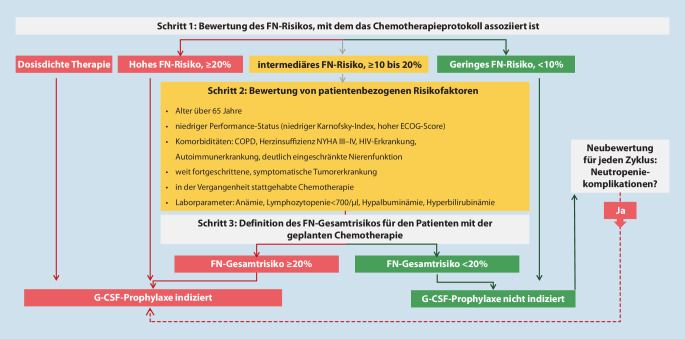
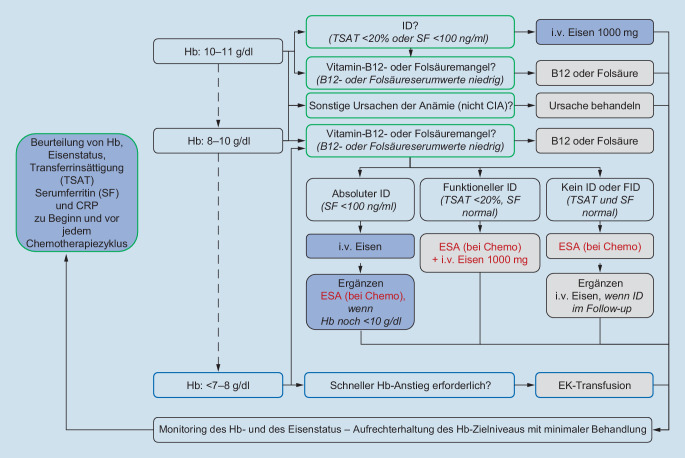
Infections in patients with neutropenia following chemotherapy are mostly manifested as fever (febrile neutropenia, FN). Some of the most important determinants of the risk of FN are the type of chemotherapy, the dose intensity and patient-specific factors. When the risk of FN is 20% or more granulopoiesis is prophylactically stimulated with granulocyte colony stimulating factor (G-CSF) after the treatment. Anemia should always be clarified and if necessary be treated according to the cause when symptomatic. If an absolute or functional iron deficiency is present, intravenous iron substitution is mostly necessary. Erythropoiesis-stimulating agents can be used after chemotherapy with hemoglobin (Hb) levels less than 10 g/dl (6.2 mmol/l). In cases of chronic anemia and Hb levels less than 7-8 g/dl (<4.3-5.0 mmol/l) the indications for transfusion of erythrocyte concentrates should be assessed primarily based on the individual clinical symptoms.
Infektionen bei neutropenischen Patienten nach Chemotherapie manifestieren sich meistens durch Fieber (febrile Neutropenie, FN). Zu den wichtigsten Determinanten des FN-Risikos gehören der Chemotherapietyp, die Dosisintensität und patientenspezifische Faktoren. Bei einem FN-Risiko von 20 % oder höher wird die Granulopoese nach der Therapie prophylaktisch mit G‑CSF („granulocyte colony-stimulating factor“) stimuliert. Eine Anämie sollte immer abgeklärt und falls erforderlich entsprechend ihrer Ursache bei Anämiebeschwerden behandelt werden. Wenn ein absoluter oder funktioneller Eisenmangel vorliegt, dann ist meistens eine intravenöse (i.v.) Eisensubstitution erforderlich. Erythropoesestimulierende Substanzen können nach Chemotherapie bei Hämoglobin(Hb)-Werten unter 10 g/dl (6,2 mmol/l) verwendet werden. Bei chronischer Anämie und Hb-Werten unter 8–7 g/dl (< 5,0–4,3 mmol/l) sollte die Indikation für die Transfusion von Erythrozytenkonzentraten primär anhand der individuellen klinischen Symptomatik gestellt werden.
Keywords: Chemotherapy; Erythropoietin; Granulocyte colony-stimulating factor; Infections; Iron.
© 2022. The Author(s), under exclusive licence to Springer Medizin Verlag GmbH, ein Teil von Springer Nature.
References
-
- Gabrilove JL, Jakubowski A, Scher H, Sternberg C, Wong G, Grous J, et al. Effect of granulocyte colony-stimulating factor on neutropenia and associated morbidity due to chemotherapy for transitional-cell carcinoma of the urothelium. N Engl J Med. 1988;318:1414–1422. doi: 10.1056/NEJM198806023182202. - DOI - PubMed
-
- (2017) CTEP: common terminology criteria for adverse events (CTCAE) v5.0., https://ctep.cancer.gov/protocoldevelopment/electronic_applications/docs.... Zugegriffen: 26.04.2022
-
- Heinz WJ, Buchheidt D, Christopeit M, von Lilienfeld-Toal M, Cornely OA, Einsele H, et al. Diagnosis and empirical treatment of fever of unknown origin (FUO) in adult neutropenic patients: guidelines of the Infectious Diseases Working Party (AGIHO) of the German Society of Hematology and Medical Oncology (DGHO) Ann Hematol. 2017;96(11):1775–1792. doi: 10.1007/s00277-017-3098-3. - DOI - PMC - PubMed
-
- Sternberg CN, Mulder PH, Schornagel JH, Théodore C, Fossa SD, Oosterom ATv, et al. Randomized phase III trial of high–dose-intensity methotrexate, vinblastine, doxorubicin, and cisplatin (MVAC) chemotherapy and recombinant human granulocyte colony-stimulating factor versus classic MVAC in advanced urothelial tract tumors: European organization for research and treatment of cancer protocol no. 30924. J Clin Oncol. 2001;19(10):2638–2646. doi: 10.1200/jco.2001.19.10.2638. - DOI - PubMed
-
- Sternberg CN, de Mulder P, Schornagel JH, Theodore C, Fossa SD, van Oosterom AT, et al. Seven year update of an EORTC phase III trial of high-dose intensity M-VAC chemotherapy and G-CSF versus classic M-VAC in advanced urothelial tract tumours. Eur J Cancer. 2006;42(1):50–54. doi: 10.1016/j.ejca.2005.08.032. - DOI - PubMed
MeSH terms
Substances
LinkOut - more resources
Full Text Sources
Medical
Miscellaneous
