. 2022 Jun 29;7(3):e0008222.
doi: 10.1128/msphere.00082-22. Epub 2022 Apr 28.

Alinity m, a Random-Access System, for Hepatitis B Virus DNA Quantification in Plasma and Whole Blood Collected on Dried Blood Spots

Affiliations

Alinity m, a Random-Access System, for Hepatitis B Virus DNA Quantification in Plasma and Whole Blood Collected on Dried Blood Spots

Valérie Ortonne et al. mSphere. .

Abstract

The International Liver Association recommends the use of accurate and sensitive molecular methods for determination of hepatitis B virus (HBV) DNA levels in plasma or serum of chronic HBsAg carriers. The level of HBV replication represents the strongest predictive biomarker associated with disease progression and long-term outcome of chronic HBV infection. The purpose of this study was to evaluate the ability to the new Alinity m System to detect and quantify HBV DNA in plasma and whole blood collected on dried blood spots (DBS). Paired plasma and DBS samples from patients chronically infected with various HBV genotypes were tested in parallel for HBV DNA detection and quantification. There is a linear relationship between HBV DNA levels measured in plasma samples using the Alinity m HBV assay and the Xpert HBV viral load assay, used for comparison. A slight deviation (0.03 ± 0.31 log IU/mL) was observed within the quantitative range. In DBS, HBV DNA levels closely correlated with levels measured in plasma. All patients had detectable and quantifiable HBV DNA by DBS testing, except for one patient with a plasma HBV DNA level above 2,000 IU/mL. In conclusion, the newly developed real-time PCR-based assay Alinity m HBV assay can correctly detect HBV DNA in DBS, especially for patients with blood HBV DNA levels above 2,000 IU/mL, and also accurately quantify HBV DNA in plasma samples. IMPORTANCE Hepatitis B virus is one of the most prevalent blood-borne viruses affecting the liver and causing acute and chronic hepatitis. Only a small proportion of people with HBV infection are diagnosed. HBV DNA measurement is critical in clinical practice for the diagnosis and treatment decisions of patients requiring antiviral therapy. Dried blood spot (DBS) collection provides a simple, practical, and acceptable alternative to venous blood collection, especially in community settings. We have demonstrated high sensitivity and specificity for HBV DNA detection in DBS compared to plasma samples, especially when using clinically relevant cutoffs of 2,000 and 20,000 IU/mL. Results support the use of DBS in community-based settings.

Keywords: HBV DNA; dried blood spot; hepatitis B virus; real-time PCR; whole blood.


Conflict of interest statement

The authors declare no conflict of interest.

Figures
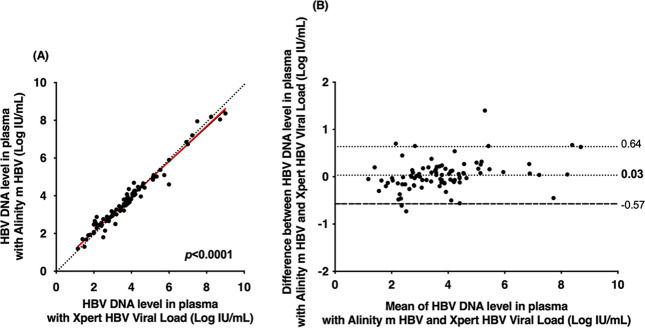
FIG 1
FIG 1
(A) Deming regression of HBV DNA levels measured by the Alinity m HBV assay and Xpert HBV viral load assay in 91 plasma specimens containing HBV genotype A (n = 14), B (n = 7), C (n = 4), D (n = 9), E (n = 39), or G (n = 3) or an unidentified genotype (15 cases). The red solid line represents Deming regression, and the black dotted line represents the reference (i.e., no difference between the two techniques). (B) Bland-Altman plot analysis of HBV DNA levels measured by the Alinity m HBV assay and Xpert HBV viral load assay in 91 plasma specimens containing HBV genotype A (n = 14), B (n = 7), C (n = 4), D (n = 9), E (n = 39), or G (n = 3) or an unidentified genotype (15 cases). The black dotted and dashed lines represent deviation ± 1.96 SD, respectively.
FIG 2
FIG 2
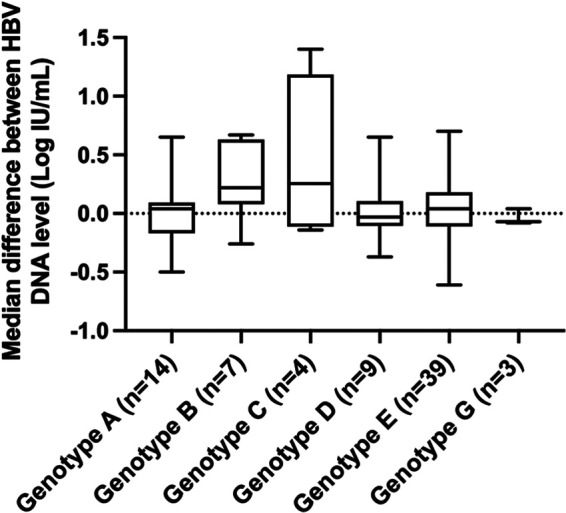
Box plot representation of the distribution of the differences between HBV DNA levels determined by the Alinity m HBV assay and the Xpert HBV viral load assay according to HBV genotype. The midline and the lower and upper edges of boxes represent the median value, 25th percentile, and 75th percentile, respectively. The lower and upper error bars represent the minimum and maximum values, respectively.
FIG 3
FIG 3
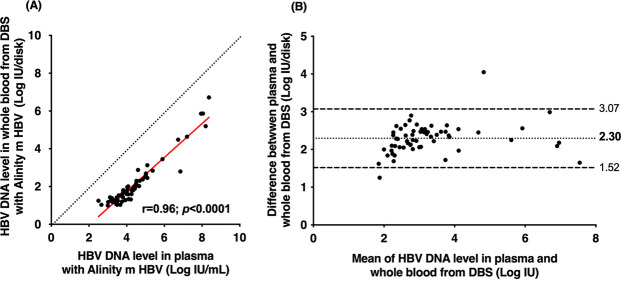
(A) Linear regression of HBV DNA levels measured by Alinity m HBV assay in 61 paired plasma and DBS specimens containing HBV genotype A (n = 10), B (n = 6), C (n = 1), D (n = 6), E (n = 33), or G (n = 1) or an unidentified genotype (4 cases). The red solid line represents the linear regression and the black dotted line represents the reference (i.e., no difference between plasma and DBS specimens). (B) Bland-Altman plot analysis of HBV DNA levels measured by the Alinity m HBV assay in 61 paired plasma and DBS specimens containing HBV genotype A (n = 10), B (n = 6), C (n = 1), D (n = 6), E (n = 33), or G (n = 1) or an unidentified genotype (4 cases). The black dotted and dashed lines represent deviation ± 1.96 SD, respectively.

References

    1. Hellard ME, Chou R, Easterbrook P. 2017. WHO guidelines on testing for hepatitis B and C—meeting targets for testing. BMC Infect Dis 17:703. doi:10.1186/s12879-017-2765-2. - DOI - PMC - PubMed
    1. Polaris Observatory Collaborators. 2018. Global prevalence, treatment, and prevention of hepatitis B virus infection in 2016: a modelling study. Lancet Gastroenterol Hepatol 3:383–403. doi:10.1016/S2468-1253(18)30056-6. - DOI - PubMed
    1. Hutin Y, Nasrullah M, Easterbrook P, Nguimfack BD, Burrone E, Averhoff F, Bulterys M. 2018. Access to treatment for hepatitis B virus infection—worldwide, 2016. MMWR Morb Mortal Wkly Rep 67:773–777. doi:10.15585/mmwr.mm6728a2. - DOI - PMC - PubMed
    1. European Association for the Study of the Liver. 2017. EASL 2017 Clinical Practice Guidelines on the management of hepatitis B virus infection. J Hepatol 67:370–398. doi:10.1016/j.jhep.2017.03.021. - DOI - PubMed
    1. Terrault NA, Lok ASF, McMahon BJ, Chang KM, Hwang JP, Jonas MM, Brown RS, Jr, Bzowej NH, Wong JB. 2018. Update on prevention, diagnosis, and treatment of chronic hepatitis B: AASLD 2018 hepatitis B guidance. Hepatology 67:1560–1599. doi:10.1002/hep.29800. - DOI - PMC - PubMed