


Microbial fuel cells for in-field water quality monitoring
- PMID: 35479166
- PMCID: PMC9031575
- DOI: 10.1039/d1ra01138c
Microbial fuel cells for in-field water quality monitoring
Abstract
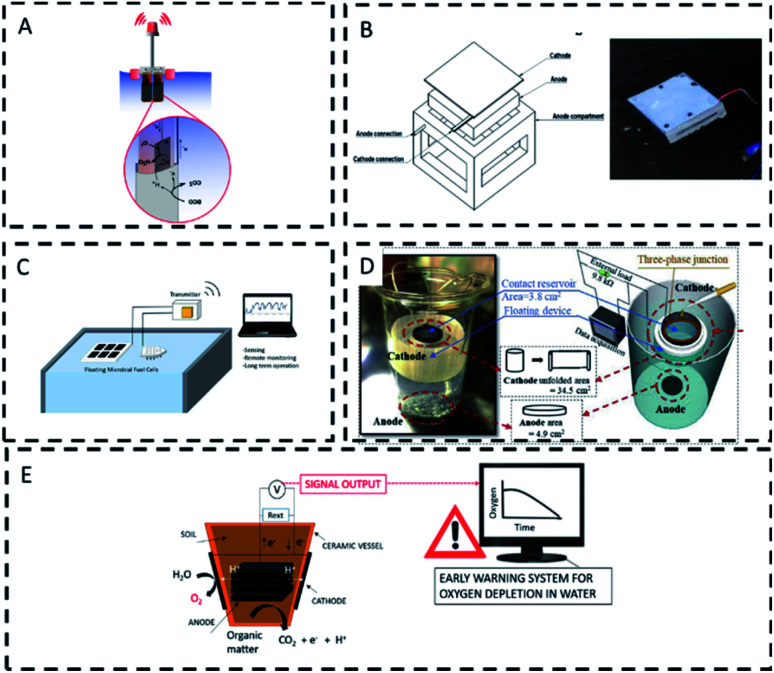
The need for water security pushes for the development of sensing technologies that allow online and real-time assessments and are capable of autonomous and stable long-term operation in the field. In this context, Microbial Fuel Cell (MFC) based biosensors have shown great potential due to cost-effectiveness, simplicity of operation, robustness and the possibility of self-powered applications. This review focuses on the progress of the technology in real scenarios and in-field applications and discusses the technological bottlenecks that must be overcome for its success. An overview of the most relevant findings and challenges of MFC sensors for practical implementation is provided. First, performance indicators for in-field applications, which may diverge from lab-based only studies, are defined. Progress on MFC designs for off-grid monitoring of water quality is then presented with a focus on solutions that enhance robustness and long-term stability. Finally, calibration methods and detection algorithms for applications in real scenarios are discussed.
This journal is © The Royal Society of Chemistry.
Conflict of interest statement
There are no conflicts to declare.
Figures
References
-
- SDG 6 Synthesis Report 2018 on Water and Sanitation, 2018
-
- UNICEF and WHO, Progress on household drinking water, sanitation and hygiene 2000–2017: Special focus on inequalities, 2019
-
- Glasgow H. B. Burkholder J. A. M. Reed R. E. Lewitus A. J. Kleinman J. E. J. Exp. Mar. Biol. Ecol. 2004;300:409–448. doi: 10.1016/j.jembe.2004.02.022. - DOI
-
- European Environmental Agency, Assessment of information gaps in existing, Copenhagen, 2008
Publication types
LinkOut - more resources
Full Text Sources
Miscellaneous
