


Google Trends as a Predictive Tool for COVID-19 Vaccinations in Italy: Retrospective Infodemiological Analysis
- PMID: 35481982
- PMCID: PMC9031689
- DOI: 10.2196/35356
Google Trends as a Predictive Tool for COVID-19 Vaccinations in Italy: Retrospective Infodemiological Analysis
Abstract
Background: Google Trends is an infoveillance tool widely used by the scientific community to investigate different user behaviors related to COVID-19. However, several limitations regarding its adoption are reported in the literature.
Objective: This paper aims to provide an effective and efficient approach to investigating vaccine adherence against COVID-19 via Google Trends.
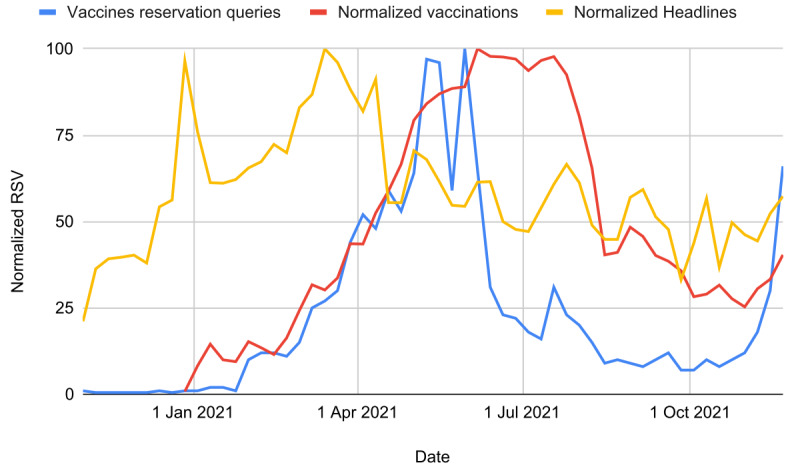
Methods: Through the cross-correlational analysis of well-targeted hypotheses, we investigate the predictive capacity of web searches related to COVID-19 toward vaccinations in Italy from November 2020 to November 2021. The keyword "vaccine reservation" query (VRQ) was chosen as it reflects a real intention of being vaccinated (V). Furthermore, the impact of the second most read Italian newspaper (vaccine-related headlines [VRH]) on vaccine-related web searches was investigated to evaluate the role of the mass media as a confounding factor. Fisher r-to-z transformation (z) and percentage difference (δ) were used to compare Spearman coefficients. A regression model V=f(VRH, VRQ) was built to validate the results found. The Holm-Bonferroni correction was adopted (P*). SEs are reported.
Results: Simple and generic keywords are more likely to identify the actual web interest in COVID-19 vaccines than specific and elaborated keywords. Cross-correlations between VRQ and V were very strong and significant (min r²=0.460, P*<.001, lag 0 weeks; max r²=0.903, P*<.001, lag 6 weeks). The remaining cross-correlations have been markedly lower (δ>55.8%; z>5.8; P*<.001). The regression model confirmed the greater significance of VRQ versus VRH (P*<.001 vs P=.03, P*=.29).
Conclusions: This research provides preliminary evidence in favor of using Google Trends as a surveillance and prediction tool for vaccine adherence against COVID-19 in Italy. Further research is needed to establish the appropriate use and limits of Google Trends for vaccination tracking. However, these findings prove that the search for suitable keywords is a fundamental step to reduce confounding factors. Additionally, targeting hypotheses helps diminish the likelihood of spurious correlations. It is recommended that Google Trends be leveraged as a complementary infoveillance tool by government agencies to monitor and predict vaccine adherence in this and future crises by following the methods proposed in this paper.
Keywords: COVID-19; Google Trends; Italy; SARS-CoV-2; epidemiology; infodemiology; infoveillance; public health; social media; social media analysis; vaccinations; vaccines.
©Alessandro Rovetta. Originally published in JMIRx Med (https://med.jmirx.org), 19.04.2022.
Conflict of interest statement
Conflicts of Interest: None declared.
Figures
Update of
- JMIRx Med. 1:e35356. doi: 10.2196/preprints.35356
References
-
- Springer S, Zieger M, Strzelecki A. The rise of infodemiology and infoveillance during COVID-19 crisis. One Health. 2021 Dec;13:100288. doi: 10.1016/j.onehlt.2021.100288. https://linkinghub.elsevier.com/retrieve/pii/S2352-7714(21)00078-1 S2352-7714(21)00078-1 - DOI - PMC - PubMed
-
- Eysenbach G. Infodemiology and infoveillance: framework for an emerging set of public health informatics methods to analyze search, communication and publication behavior on the Internet. J Med Internet Res. 2009 Mar 27;11(1):e11. doi: 10.2196/jmir.1157. https://www.jmir.org/2009/1/e11/ v11i1e11 - DOI - PMC - PubMed
-
- Brodeur A, Clark AE, Fleche S, Powdthavee N. COVID-19, lockdowns and well-being: evidence from Google Trends. J Public Econ. 2021 Jan;193:104346. doi: 10.1016/j.jpubeco.2020.104346. http://europepmc.org/abstract/MED/33281237 S0047-2727(20)30210-3 - DOI - PMC - PubMed
LinkOut - more resources
Full Text Sources
Miscellaneous
