


The effects of U.S. county and state income inequality on self-reported happiness and health are equivalent to zero
- PMID: 35482148
- PMCID: PMC9188529
- DOI: 10.1007/s11136-022-03137-8
The effects of U.S. county and state income inequality on self-reported happiness and health are equivalent to zero
Abstract
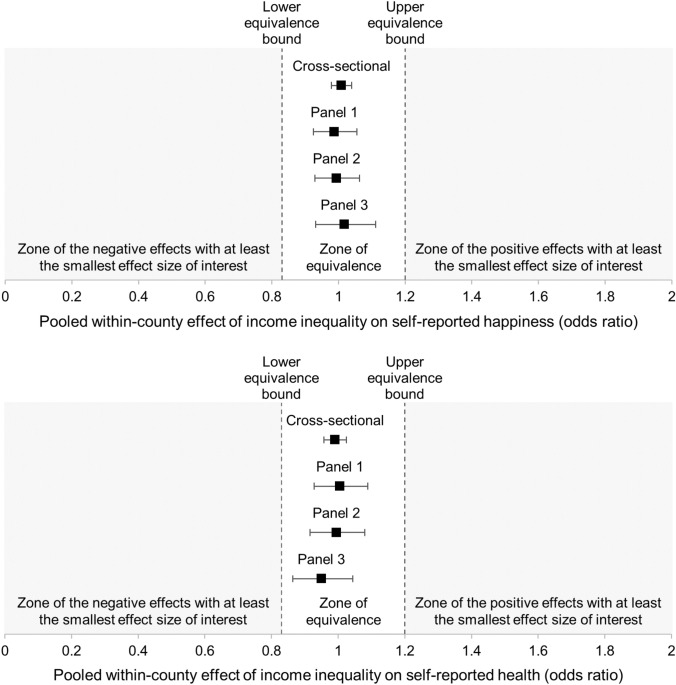
Purpose: A popular idea in the social sciences is that contexts with high income inequality undermine people's well-being and health. However, existing studies documenting this phenomenon typically compare a small number of higher-level units (countries/regions). Here, we use local income inequality indicators and temporal designs to provide the most highly powered test to date of the associations between income inequality and self-reported happiness and health in the USA METHOD: We combined county-level income inequality data (county-level Gini coefficients) with the responses from the General Social Survey (GSS) Cross-sectional dataset (13,000 + participants from ≈1000 county-waves) and Panels (3 × 3000 + participants from 3 × ≈500 county-waves); we used the GSS happiness ("not too happy," "pretty happy," or "very happy") and health ("poor," "fair," "good," or "excellent") variables.
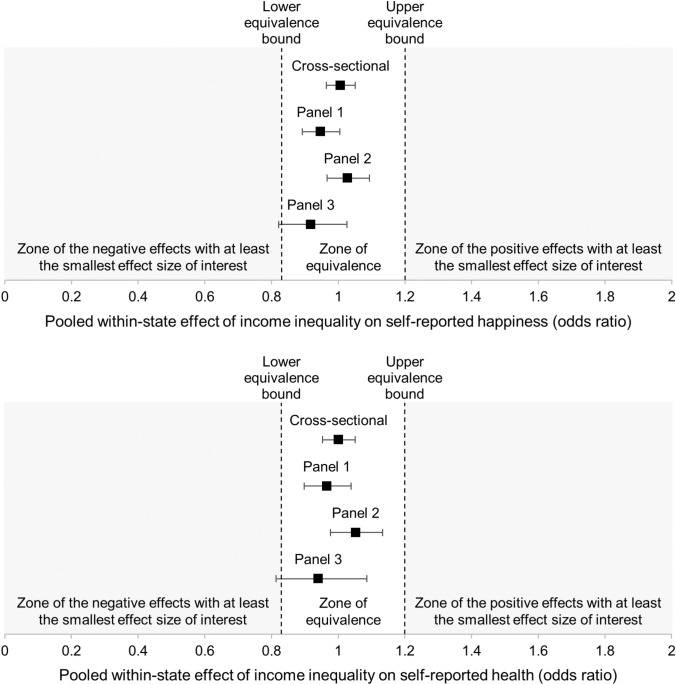
Results: Multilevel-ordered logistic models and equivalence tests revealed that the within-county effects of income inequality on self-reported happiness and health were systematically equivalent to zero. Additional analyses revealed that the within-state effects were identical, that using alternative measures of state income inequality led to the same conclusions, and that lagged effects (between + 1 and + 12 years) were never significant and always equivalent to zero.
Conclusion: The present work suggests that-at least in the USA-income inequality is likely neither associated with self-reported happiness nor with self-reported health.
Keywords: Equivalence testing; Health; Income inequality; Multilevel modeling; Well-being.
© 2022. The Author(s).
Conflict of interest statement
The authors declare no competing interests.
Figures
References
-
- World Bank. (2021). GDP per capita (current US$). Retrieved April 26, 2022, from https://data.worldbank.org/indicator/NY.GDP.PCAP.CD.
-
- Saez, E. (2020). Striking it richer: The Evolution of Top Incomes in the United States (Updated with 2018 estimates). Retrieved April 26, 2022, from https://elsa.berkeley.edu/~saez/saez-UStopincomes-2018.pdf
-
- Wilkinson R, Pickett K. The spirit level: Why equality is better for everyone. Penguin; 2010.
MeSH terms
Grants and funding
LinkOut - more resources
Full Text Sources
Miscellaneous
