


Biomarkers of disease progression in people with psoriasis: a scoping review
- PMID: 35482474
- PMCID: PMC9796834
- DOI: 10.1111/bjd.21627
Biomarkers of disease progression in people with psoriasis: a scoping review
Abstract
Background: Identification of those at risk of more severe psoriasis and/or associated morbidities offers opportunity for early intervention, reduced disease burden and more cost-effective healthcare. Prognostic biomarkers of disease progression have thus been the focus of intense research, but none are part of routine practice.
Objectives: To identify and catalogue candidate biomarkers of disease progression in psoriasis for the translational research community.
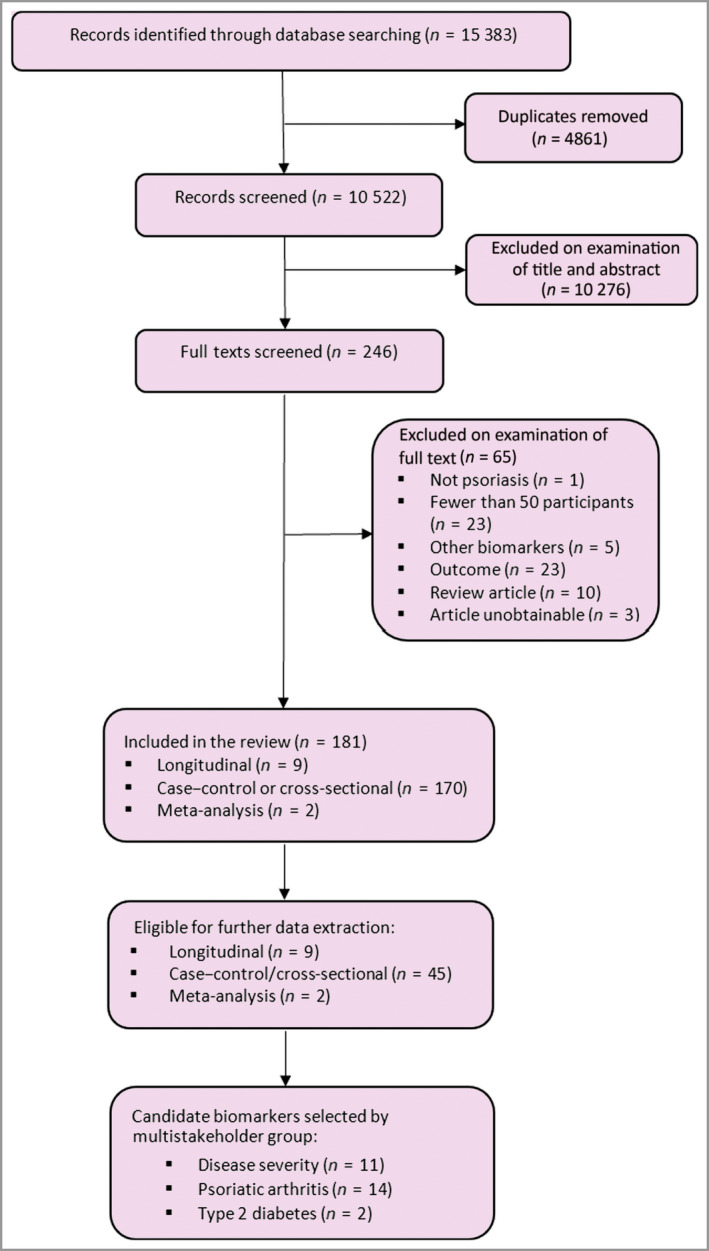
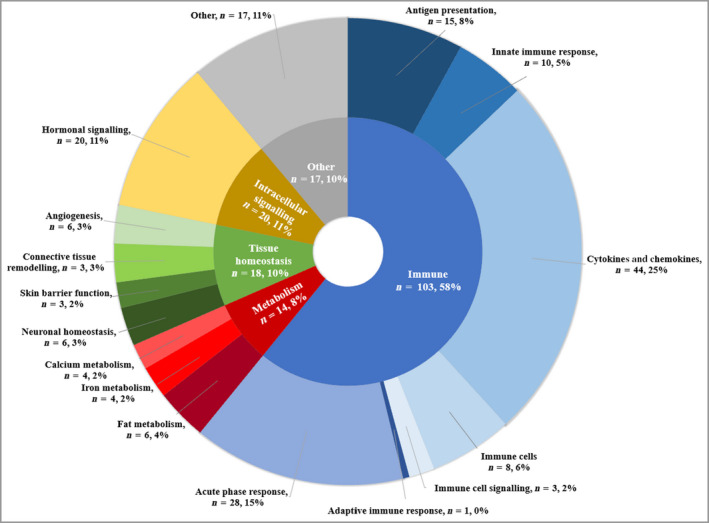
Methods: A systematic search of CENTRAL, Embase, LILACS and MEDLINE was performed for relevant articles published between 1990 and December 2021. Eligibility criteria were studies involving patients with psoriasis (any age, n ≥ 50) reporting biomarkers associated with disease progression. The main outcomes were any measure of skin severity or any prespecified psoriasis comorbidity. Data were extracted by one reviewer and checked by a second; studies meeting minimal quality criteria (longitudinal design and/or use of methods to control for confounding) were formally assessed for bias. Candidate biomarkers were identified by an expert multistakeholder group using a majority voting consensus exercise, and mapped to relevant cellular and molecular pathways.
Results: Of 181 included studies, most investigated genomic or proteomic biomarkers associated with disease severity (n = 145) or psoriatic arthritis (n = 30). Methodological and reporting limitations compromised interpretation of findings, most notably a lack of longitudinal studies, and inadequate control for key prognostic factors. The following candidate biomarkers with future potential utility were identified for predicting disease severity: LCE3D, interleukin (IL)23R, IL23A, NFKBIL1 loci, HLA-C*06:02 (genomic), IL-17A, IgG aHDL, GlycA, I-FABP and kallikrein 8 (proteomic), tyramine (metabolomic); psoriatic arthritis: HLA-C*06:02, HLA-B*27, HLA-B*38, HLA-B*08, and variation at the IL23R and IL13 loci (genomic); IL-17A, CXCL10, Mac-2 binding protein, integrin b5, matrix metalloproteinase-3 and macrophage-colony stimulating factor (proteomic) and tyramine and mucic acid (metabolomic); and type 2 diabetes mellitus: variation in IL12B and IL23R loci (genomic). No biomarkers were supported by sufficient evidence for clinical use without further validation.
Conclusions: This review provides a comprehensive catalogue of investigated biomarkers of disease progression in psoriasis. Future studies must address the common methodological limitations identified herein to expedite discovery and validation of biomarkers for clinical use. What is already known about this topic? The current treatment paradigm in psoriasis is reactive. There is a need to develop effective risk-stratified management approaches that can proactively attenuate the substantial burden of disease. Prognostic biomarkers of disease progression have therefore been the focus of intense research. What does this study add? This review is the first to scope, collate and catalogue research investigating biomarkers of disease progression in psoriasis. The review identifies potentially promising candidate biomarkers for further investigation and highlights common important limitations that should be considered when designing and conducting future studies in this area.
© 2022 The Authors. British Journal of Dermatology published by John Wiley & Sons Ltd on behalf of British Association of Dermatologists.
Conflict of interest statement
S.K.M. has received departmental funding from AbbVie, Celgene, Eli Lilly, Janssen‐Cilag, Novartis, Sanofi and UCB. P.D.M. has received research grants from UCB and consultancy/speaker honoraria from Novartis, UCB and Janssen. K.E. has received honoraria and/or research grants from AbbVie, Almirall, Boehringer Ingelheim, Bristol Myers Squibb, Janssen, LEO Pharma, Lilly, Novartis, Pfizer and UCB. C.C. has received honoraria and/or research grants from AbbVie, Actelion, Almirall, Amgen, Boehringer Ingelheim, Bristol Myers Squibb, Celgene, Janssen, LEO Pharma, Eli Lilly, MSD, Novartis, Pfizer, Samsung and UCB. J.N.B. has received honoraria and/or research grants from AbbVie, Almirall, Amgen, Boehringer Ingelheim, Bristol Myers Squibb, Celgene, Janssen, LEO Pharma, Lilly, Novartis, Samsung and Sun Pharma. L.S. has received honoraria and/or research grants from AbbVie, Almirall, Bristol Myers Squibb, Celgene, Sanofi, UCB, Janssen, LEO Pharma, Lilly and Novartis. C.H.S. reports grants from an MRC‐funded stratified medicine consortium with multiple industry partners, grants from IMI (Horizon 2020)‐funded European consortium with multiple industry partners, and others from AbbVie, Novartis, Pfizer, Sanofi, Boehringer Ingelheim and SOBI, outside the submitted work; and is Chair of UK guidelines on biologic therapy in psoriasis.
Figures
References
-
- Griffiths CEM, Armstrong AW, Gudjonsson JE, Barker JNW. Psoriasis. Lancet 2021; 397:1301–15. - PubMed
-
- Davidovici BB, Sattar N, Prinz JC et al. Psoriasis and systemic inflammatory diseases: potential mechanistic links between skin disease and co‐morbid conditions. J Invest Dermatol 2010; 130:1785–96. - PubMed
-
- Aletaha D, Smolen JS. Diagnosis and management of rheumatoid arthritis: a review. JAMA 2018; 320:1360–72. - PubMed
Publication types
MeSH terms
Substances
Grants and funding
LinkOut - more resources
Full Text Sources
Other Literature Sources
Medical
Research Materials
