


Analysis of the Long-term Visual Outcomes of ForeseeHome Remote Telemonitoring: The ALOFT Study
- PMID: 35483614
- PMCID: PMC11407913
- DOI: 10.1016/j.oret.2022.04.016
Analysis of the Long-term Visual Outcomes of ForeseeHome Remote Telemonitoring: The ALOFT Study
Abstract
Purpose: To evaluate long-term visual acuity (VA) and performance of a monitoring strategy with a self-operated artificial-intelligence-enabled home monitoring system in conjunction with standard care for early detection of neovascular age-related macular degeneration (nAMD).
Design: Retrospective review.
Subjects: Patients with dry-age-related macular degeneration from 5 referral clinics.
Methods: Clinical data of patients monitored with ForeseeHome (FSH) device from August 2010 to July 2020 were reviewed.
Main outcome measures: Visual acuity at baseline, VA at diagnosis of nAMD for eyes that converted while monitored, and VA from the final study follow-up, weekly frequency of use, duration of monitoring, modality of conversion diagnosis (system alert vs. detection by other standard care means), and duration and number of treatments since conversion to final study follow-up were collected.
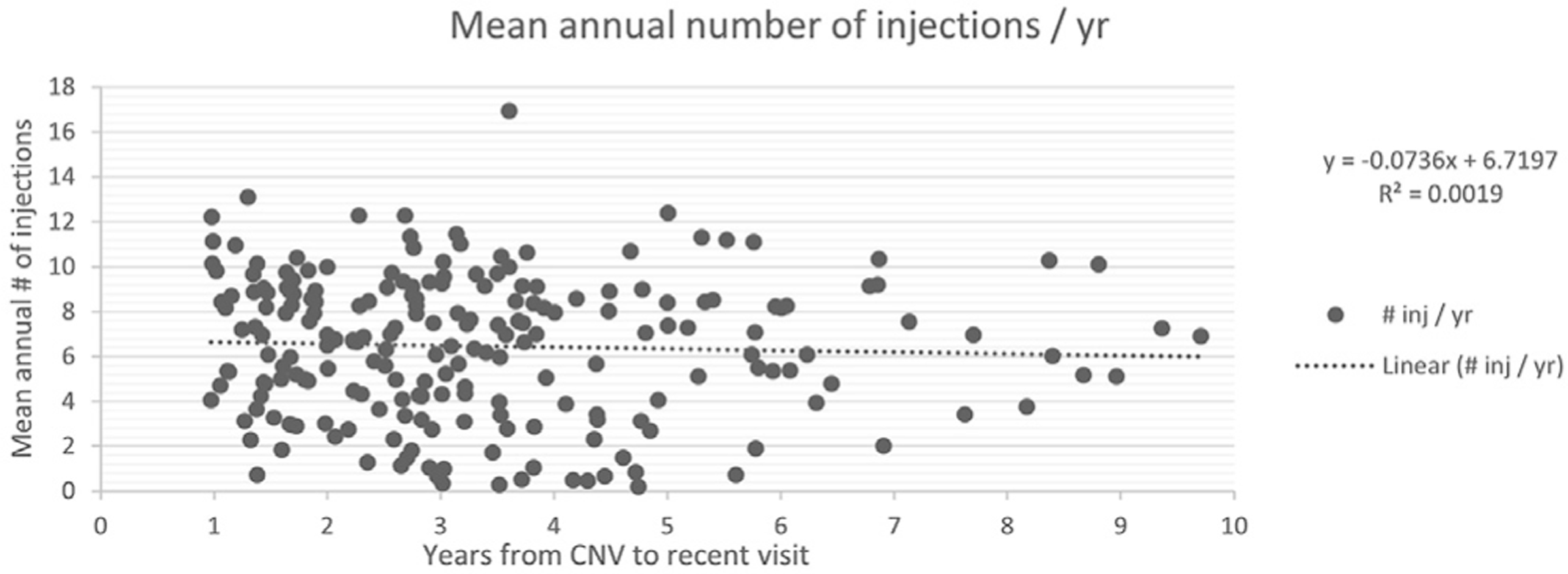
Results: We reviewed 3334 eyes of 2123 patients with a mean (standard deviation [SD]) age of 74(8) years, monitored for a mean (SD) duration of 3.1 (2.4) years, with a total of 1 706 433 tests in 10 474 eye-monitoring years. The mean (SD) weekly use per patient was 5.2 (3.4), and it was persistent over the usage period. Two hundred eighty-five eyes converted while monitored at an annual rate of 2.72% and were treated with a mean (SD) 17.3 (16.5) injections over a mean (SD) 2.7 (2.0) years, with 6.4 (3.1) injections per year for eyes treated for > 1 year. The median VAs at baseline and at final follow-up for eyes that did not convert were 20/27 and 20/34 with a median change of 0.0 letters. The median VAs at baseline, conversion, and final follow-up for eyes that converted during the monitoring period were 20/30, 20/39, and 20/32 with a median change from baseline to conversion, baseline to recent, and conversion to recent of -4, -4, and 0 letters, respectively. Fifty-two percent of conversions detected had a system alert before conversion. Forty-eight percent of patients were detected by symptoms or routine visit. Patients experienced a non-nAMD alert on average every 4.6 years. At conversion and at final follow-up, the proportion (95% CI) of eyes that maintained ≥ 20/40 was 84% (78% to 88%) and 82% (76% to 86%), respectively.
Conclusions: Patients in the FSH monitoring program showed excellent long-term VA years after conversion to nAMD.
Keywords: Anti-VEGF; Artificial intelligence; Home monitoring; Macular degeneration; Retina; Telemedicine.
Copyright © 2022 American Academy of Ophthalmology. All rights reserved.
Figures



References
-
- Pascolini D, Mariotti SP, Pokharel GP, et al. 2002 global update of available data on visual impairment: a compilation of population-based prevalence studies. Ophthal Epidemiol. 2004;11(2):67–115. - PubMed
-
- Congdon N, O’Colmain B, Klaver CC, et al. Causes and prevalence of visual impairment among adults in the United States. Arch Ophthalmol. 2004;122(4):477–485. - PubMed
-
- Friedman DS, O’Colmain BJ, Muñoz B, et al. Prevalence of age-related macular degeneration in the United States. Arch Ophthalmol. 2004;122(4):564–572. - PubMed
-
- Ferris FL III, Fine SL, Hyman L. Age-related macular degeneration and blindness due to neovascular maculopathy. Arch Ophthalmol. 1984;102(11):1640–1642. - PubMed
Publication types
MeSH terms
Substances
Grants and funding
LinkOut - more resources
Full Text Sources
Medical
